Multiple Choice Question
Question
A wet surface primarily lowers the
Hint:
Think about how slippery ice feels.
Correct!
Yes, μ drops on wet roads.
Incorrect
Not quite. The weight is unchanged; grip depends on μ.
Why slippage?
Friction
Friction is a surface force that resists motion because countless microscopic bumps on the two surfaces lock together.
A thin film of water acts like tiny ball bearings, loosening the lock-up and lowering friction, so wet floors feel slippery.
Static friction
Static friction
Contact force that keeps a body at rest by adjusting to oppose impending motion, along the surface and opposite the applied push.
Maximum value
\(f_{s,\text{max}} = \mu_s N\)
Beyond this limit the object begins to move.
- Self-adjusting
- Opposes impending motion
- Along surface
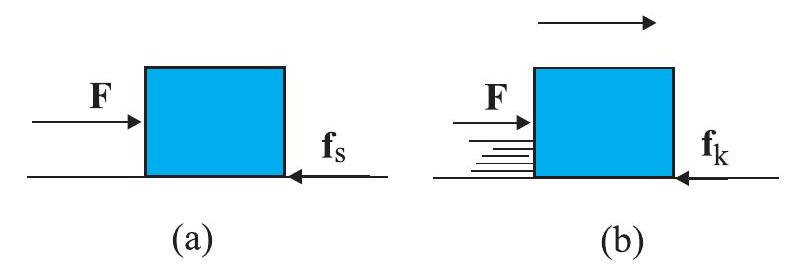
Static vs Kinetic
Static Friction
Kinetic Friction
Key Similarities
Key equations
Both forces are proportional to the normal reaction \(N\).
Variable Definitions
Applications
Predict slip onset
Compare applied force with \(f_{s,\text{max}}\) to decide if motion starts.
Calculate sliding force
Use \(f_k\) to find the net force once the object is moving.
Source: NCERT Section 5.4
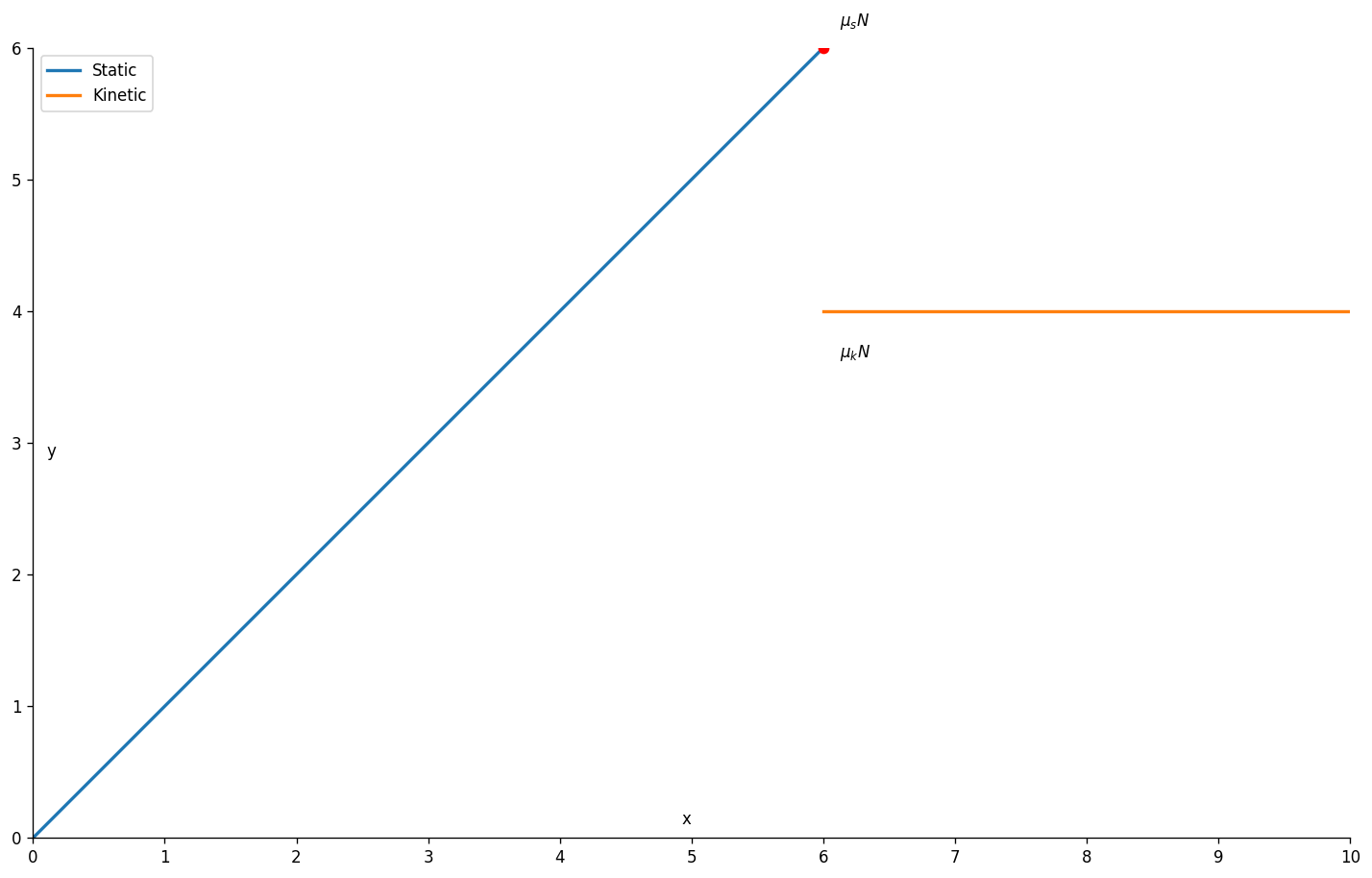
Force vs Friction Graph
Interpret how friction responds as applied force increases.
Key observation
Notice the sudden drop at motion onset.
- Static region: \(F_f = F_{applied}\) up to \(F_s^{\max}= \mu_s N\).
- Corner point marks the instant the block starts to move.
- Kinetic region: friction holds nearly constant at \(F_k = \mu_k N\).
Tip: Because \(F_s^{\max} > F_k\), the graph always drops from \(F_s\) to \(F_k\) when sliding begins.