Why Won’t It Budge?
Starting to push a heavy cupboard is harder than keeping it moving.
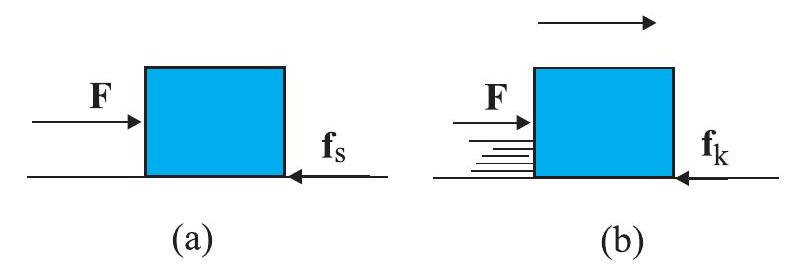
Scenario
You push a heavy cupboard resting on the floor.
What happens
- Static friction opposes your force up to its maximum value.
- You must exceed this maximum to set the cupboard in motion.
- Once moving, smaller kinetic friction keeps resisting, so less push is needed.
Takeaway: Static friction is usually larger than kinetic friction—hence the tough first shove.
Multiple Choice Question
Question
The sofa resists motion chiefly because of _____ between its legs and the floor.
Hint:
It acts before motion begins.
Correct!
Yes—static friction holds objects at rest.
Incorrect
Not quite. Think before sliding starts.
What Causes Friction?
Microscopic view: rough peaks, interlocking, and adhesion.
-
1
Microscopic roughness
Even polished surfaces have tiny bumps called asperities.
-
2
Interlocking bumps
Asperities fit together and resist relative motion until enough force breaks the locks.
-
3
Adhesive forces
Atoms at the contact points share electrons, creating adhesion that adds to friction.
Heavier loads press asperities closer, strengthening both interlocking and adhesion.
Static vs Kinetic Friction
Use relative motion to tell them apart.
Static friction
- No relative motion between surfaces.
- Adapts up to a limit: \(F_s \le \mu_s N\).
- Opposes impending motion.
Kinetic friction
- Surfaces slide in relative motion.
- Nearly constant: \(F_k = \mu_k N\).
- Opposes actual motion.
Common ground
- Both act parallel to the contact surface.
- Magnitude depends on normal force \(N\) and surface pair.
- Disappear if contact is removed.
Usually \( \mu_s > \mu_k \). Decide relative motion first, then choose the correct formula.
Maximum Static Friction
\( f_s^{\text{max}} = \mu_s N \)
Maximum static friction equals the coefficient of static friction multiplied by the normal reaction \(N\), which acts perpendicular to the surface.
Here, \( \mu_s \) is unit-less and typically lies between 0 and 1.
Source: NCERT Eq. 4.13
Kinetic Friction Law
\(f_k = \mu_k N\)
Kinetic friction opposes sliding motion. Its magnitude equals the product of the coefficient of kinetic friction and the normal reaction.
\(\mu_k\) stays nearly constant for a given surface pair at moderate speeds—use the relation to find friction on any steadily moving object.
Source: NCERT Eq. 4.14
Block on an Incline
Resolve forces and spot the friction direction.
Will it slide down?
The downhill pull \(mg\sin\theta\) must beat the maximum static friction to start motion.
- Parallel pull: \(mg\sin\theta\) down the plane.
- Normal force: \(N = mg\cos\theta\) perpendicular.
- Static friction \(f_s\) points up the plane, opposing possible slide.
Tip: Motion begins when \(mg\sin\theta = \mu_s N\). Increase θ to reach the “angle of repose.”
Worked Example
2 kg block on \(30^{\circ}\) incline, \(\mu_k = 0.2\). Find its acceleration.
-
1
Draw forces
Show \(mg\sin\theta\) down-slope, \(N\) normal, \(f_k\) up-slope.
-
2
Normal force
\(N = mg\cos\theta = 2 \times 9.8 \times \cos30^{\circ} \approx 17 \text{ N}\).
-
3
Calculate \(f_k\)
\(f_k = \mu_k N = 0.2 \times 17 \approx 3.4 \text{ N}\).
-
4
Net force
\(F_{\text{net}} = mg\sin\theta - f_k \approx 9.8 - 3.4 = 6.4 \text{ N}\).
-
5
Acceleration
\(a = \frac{F_{\text{net}}}{m} = \frac{6.4}{2} = 3.2 \text{ m/s}^2\).
Use \(\mu_k\) because the block is moving; \(\mu_s\) applies only before motion starts.
Multiple Choice Question
Question
A 10 kg crate rests on a level floor where the coefficient of static friction is 0.5. What horizontal force just starts it moving? Choose the closest value of \(f_s^{\text{(max)}}\).
Hint:
Normal force \(N = mg\) on level ground.
Correct!
Well done.
Incorrect
Re-calculate \(\mu_s N\).
Common Pitfall: Direction of Friction
Friction opposes relative motion of the two surfaces.
It is not always opposite to the object’s velocity.
Key Takeaways — Friction
Know these four points to recall the concept.
Static > Kinetic
Starting friction is higher than sliding for most dry surfaces.
Linear law
\(f_s^{\text{max}}=\mu_s N\), \(f_k=\mu_k N\).
Opposes motion
Acts opposite to relative motion or its tendency.
Material dependent
Coefficients \(\mu\) vary with the surface pair.
Multiple Choice Question
Question
On a level road, the car experiences forward friction during acceleration because:
Hint:
Think action–reaction between tyre and road.
Correct!
Exactly! The backward push of the tyre produces an equal forward friction force.
Incorrect
Remember Newton’s third law at the tyre–road contact.