Why Bulbs Glow Bright Voltage, current, resistance—lighting up the story.

Ohm’s Law

Ohm’s Law

Ohm’s Law: Current through a conductor is directly proportional to the voltage across it, if temperature stays constant.

Key Equation

\[V = I \cdot R\]

Variable Definitions

V Potential difference  (volt, V)
I Current  (ampere, A)
R Resistance  (ohm, Ω)

Applications

Ohm’s Triangle

Cover the unknown in the triangle to reveal the correct rearrangement.

Find Current of a Bulb

With supply \(V\) and bulb resistance \(R\), compute \(I = \tfrac{V}{R}\).

Set Resistor Values

Choose \(R\) so that a device draws safe current from a given voltage.

Water Pipe Analogy

Water pipe analogy

Electricity ↔ Water Flow

Picture a tank pushing water through a pipe: that is how voltage pushes charge.

Current is the water flow rate, while resistance is how narrow the pipe is.

Key Points:

  • Higher pressure (V) → greater flow (I) if pipe width stays same.
  • Wider pipe means lower resistance, so more current for a given voltage.
  • Narrow pipe raises resistance and limits current, matching Ohm’s Law.

Straight-Line Proof
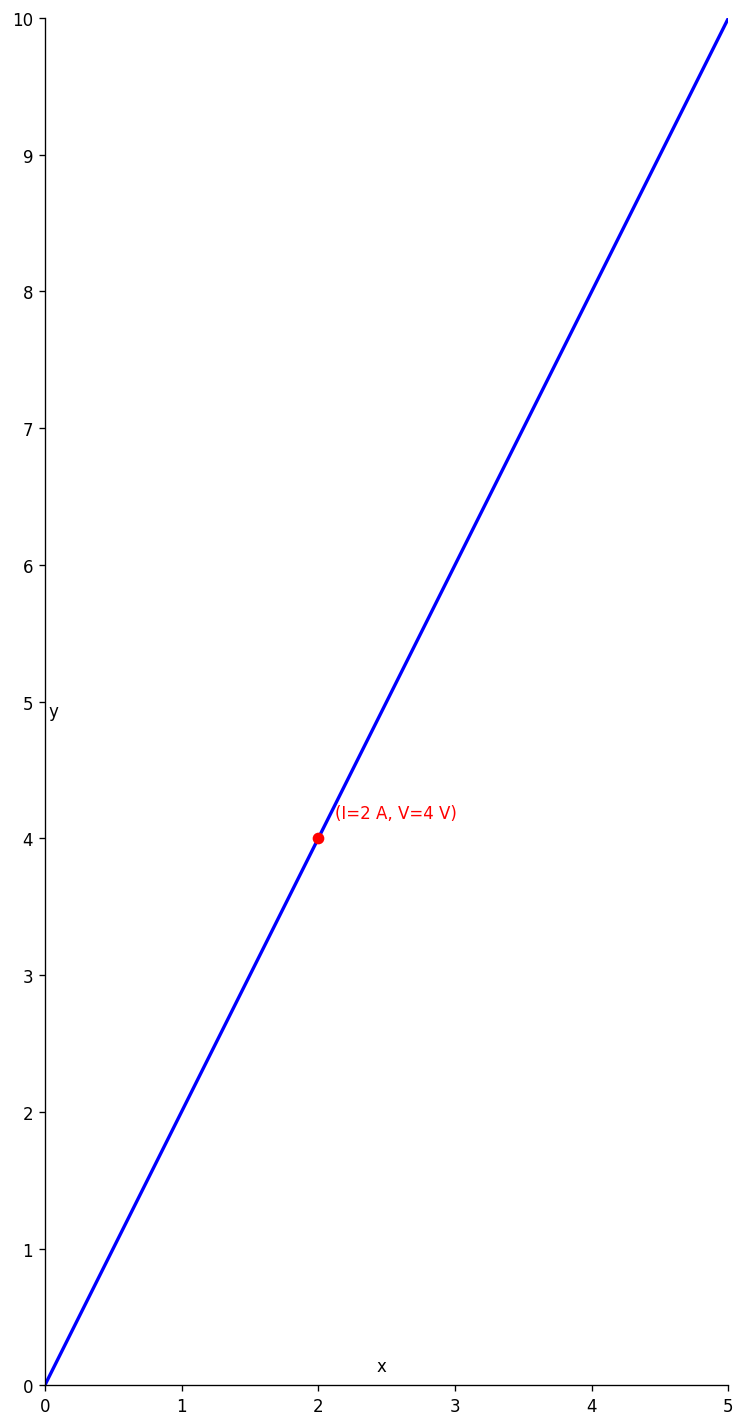
V–I graph for 2 Ω resistor

V–I graph: slope = 2 Ω

Straight V–I line for a 2 Ω resistor

The graph confirms voltage varies linearly with current for a fixed resistor.

Key Points:

  • Line passes through origin ⇒ \(V \propto I\).
  • Slope \(= \frac{V}{I} = 2\,\Omega\) (resistance).
  • Doubling \(I\) doubles \(V\); e.g., \(I = 2\text{ A}\) gives \(V = 4\text{ V}\).

Worked Example

1

Write Given Data

Voltage \(V = 12 \text{ V}\); Resistance \(R = 4 \, \Omega\).

2

Recall Formula

Ohm’s Law gives current: \(I = \frac{V}{R}\).

3

Substitute & Calculate

\(I = \frac{12\text{ V}}{4\,\Omega} = 3 \text{ A}\).

4

State Answer

The resistor carries a current of \(3 \text{ A}\).

Pro Tip:

Always convert to SI units before using \(I = V/R\).

Multiple Choice Question

Question

If resistance doubles while voltage remains constant, what happens to the current?

1
Halves
2
Doubles
3
Stays the same
4
Becomes zero

Hint:

Recall Ohm's law \(I = \frac{V}{R}\).

Key Takeaways

Ohm’s Law

Voltage equals current times resistance: \(V = I R\).

Voltage (V)

Acts as the push that drives charges through the circuit.

Current (I)

Measures how fast charge flows; more push gives more current.

Resistance (R)

Opposes current; higher resistance means lower current for the same voltage.