An object accelerates more when the net force is larger and less when its mass is bigger.
Small mass, gentle push—cart accelerates easily.
Big mass needs stronger push for the same acceleration.
Twice the force makes the cart speed up faster.
Second Law: more force gives more acceleration, but more mass cuts it down.
Multiply mass by acceleration to find net force.
Use kg for m and m/s² for a so F is in Newtons.
Force vs Acceleration graph for a 2 kg cart
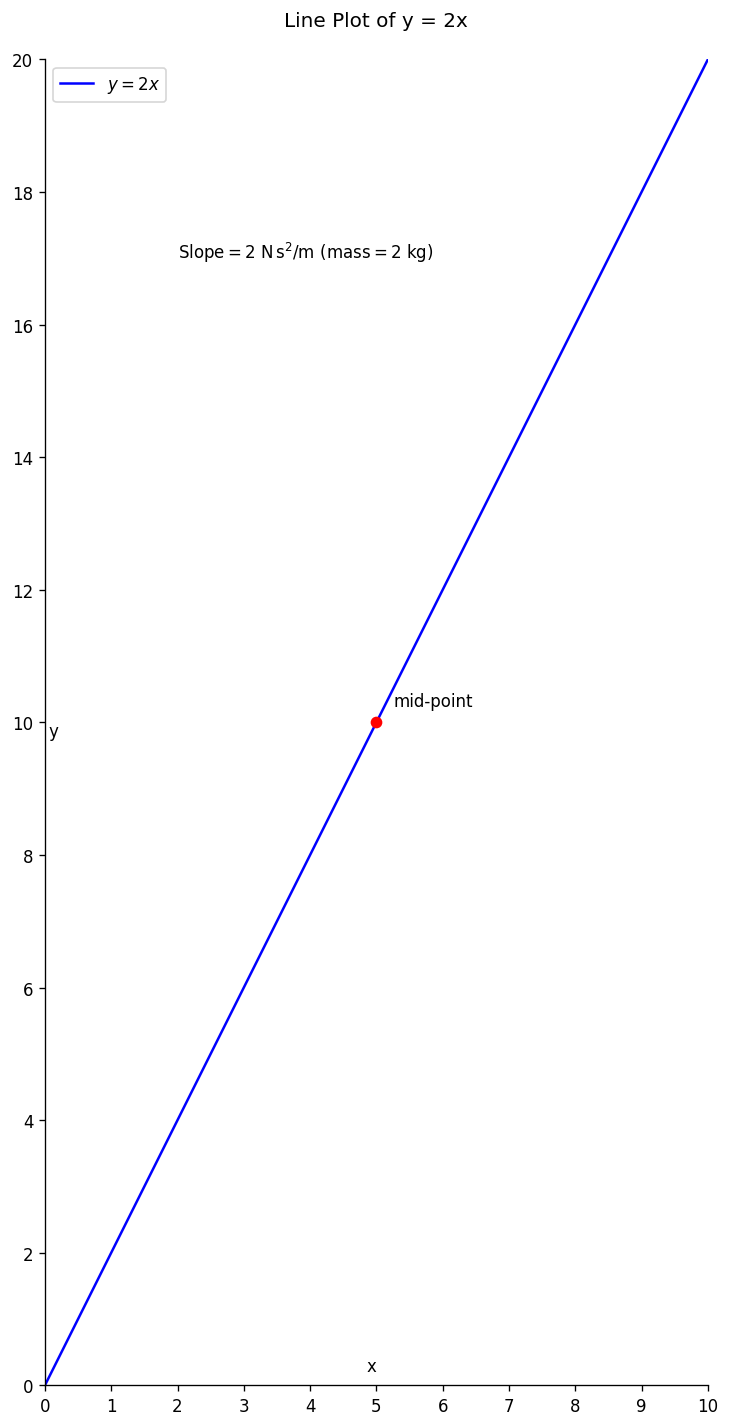
The straight line through the origin is a graphical representation of Force (N) against Acceleration (m/s²).
Because the line is straight, doubling acceleration doubles force—showing a direct proportion \(F \propto a\).
A 10 N force acts on a 2 kg box. Find its acceleration.
Use \(a = \frac{F}{m}\).
Great! \(a = \frac{10}{2} = 5\ \text{m/s}^2\).
Recall \(a = \frac{F}{m}\). Divide 10 N by 2 kg to get 5 m/s².
Changes with applied force and the object’s mass.
\(F = m \times a\) links force, mass, and acceleration.
Stronger push gives faster acceleration.
Heavier objects accelerate less under the same force.
Cart pushes, bike rides, and football kicks show the law.