Inside a Polynomial

Each label shows a different part of the term.
Name each part
A polynomial is a sum of terms. Each term has smaller parts you must recognise.
Knowing these names lets you identify parts of any polynomial expression.
Key Points:
- Coefficient – the number multiplying the variable.
- Variable – the symbol that can change, such as \(x\) or \(y\).
- Exponent – the power showing how many times the variable is used.
- Constant – a number without any variable.
Key Vocabulary
Basic Terms
Term: one separate part of a polynomial. Variable: letter that can change, e.g., \(x\). Coefficient: number multiplying the variable; \(5\) in \(5x\). Exponent: power on the variable; \(3\) in \(x^{3}\). Constant: number without a variable.
Quick check: In \(7x^{2}\), the coefficient is 7.
Counting the Terms
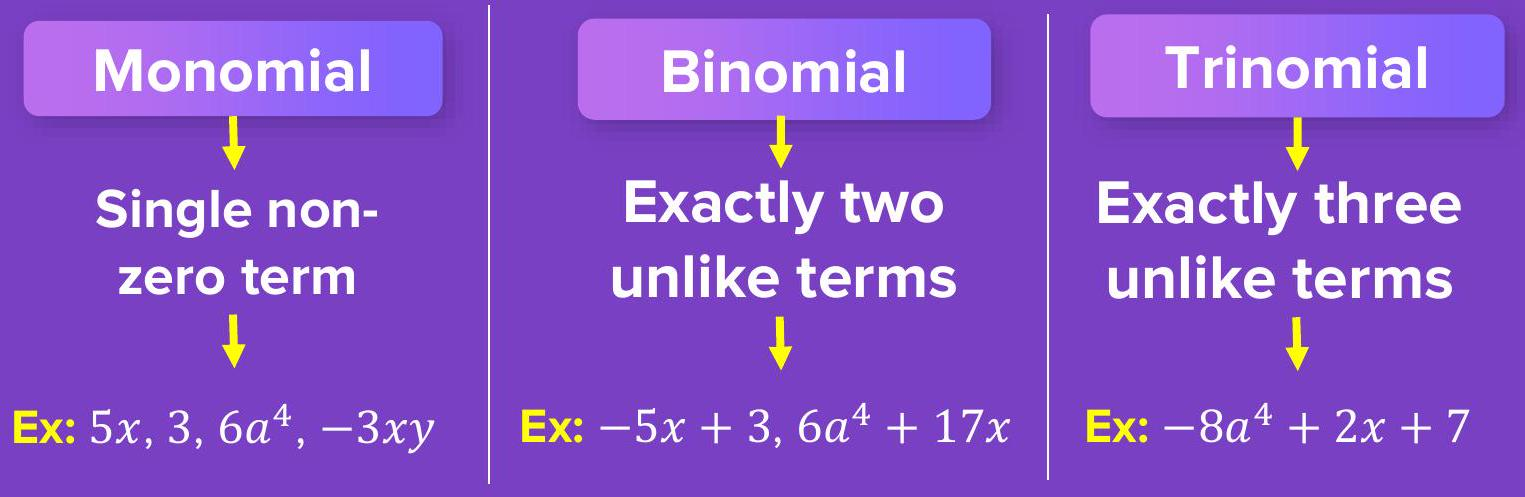
Names based on number of terms
A polynomial’s name tells how many unlike terms it has.
Memorise these three common types.
Key Points:
- Monomial – 1 term, e.g., \(5x^2\)
- Binomial – 2 terms, e.g., \(3x + 4\)
- Trinomial – 3 terms, e.g., \(x^2 - 5x + 6\)
Degree of a Polynomial
Degree
The degree of a polynomial is the highest exponent of its variable. In \(6x^{3}+2x^{2}+x\), the highest exponent is 3, so the degree is 3.
By Degree
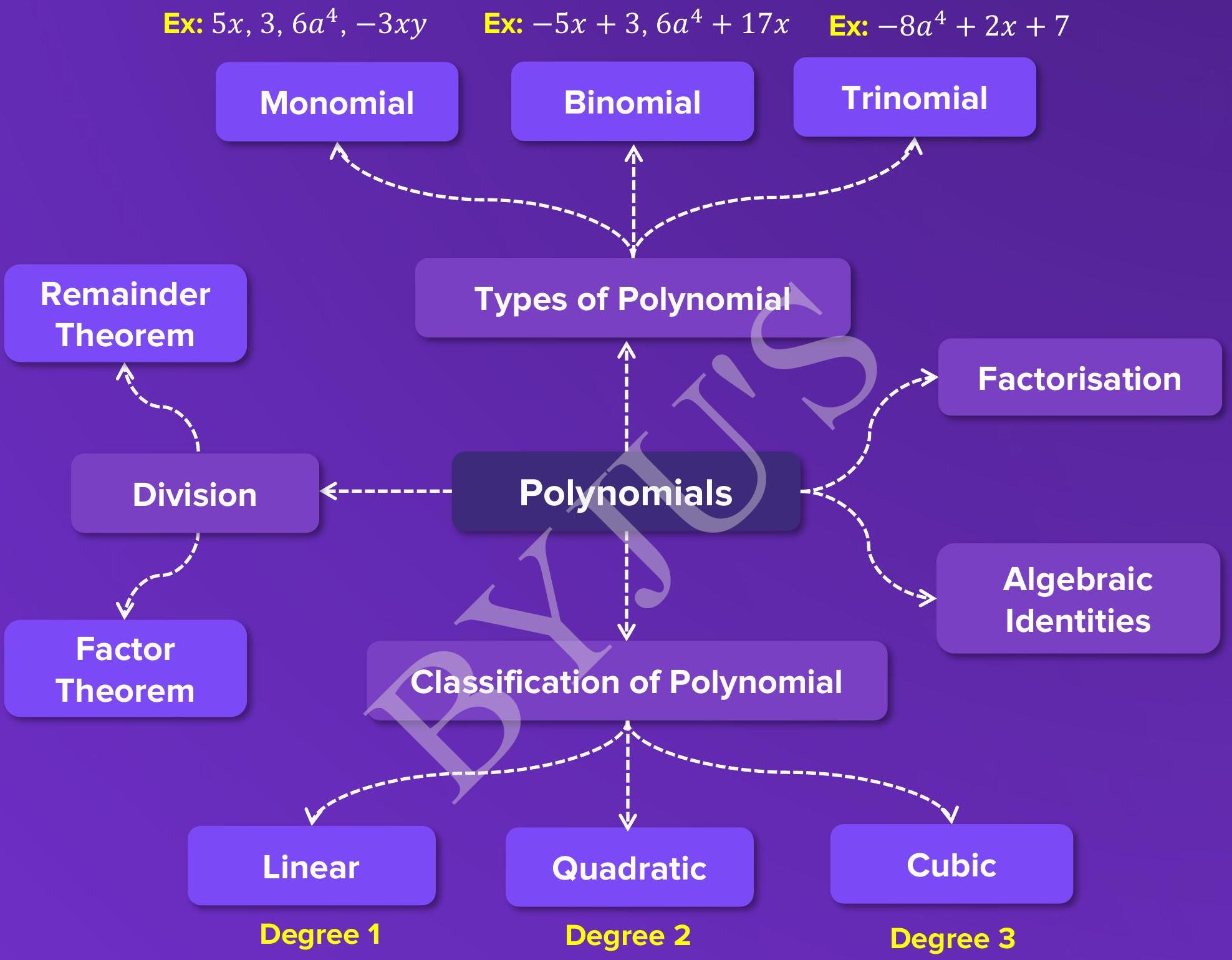
Linear, Quadratic, Cubic
Notice how the examples change as the degree increases.
| Name | Degree | General Form | Example |
|---|---|---|---|
| Linear | 1 | \(ax + b\) | \(2x + 3\) |
| Quadratic | 2 | \(ax^{2} + bx + c\) | \(x^{2} - 4x + 1\) |
| Cubic | 3 | \(ax^{3} + bx^{2} + cx + d\) | \(2x^{3} - 5x + 7\) |
Evaluate Quickly
Substitute
Replace \(x\) with \(2\): \(2(2)^2 + 3(2) + 1\).
Square First
Compute the power: \(2^2 = 4\). Now \(2 \times 4 + 3 \times 2 + 1\).
Multiply
Work out the products: \(8 + 6 + 1\).
Add Terms
Add the results: \(8 + 6 + 1 = 15\). Therefore \(p(2)=15\).
Pro Tip:
Do powers before multiplying and adding to avoid mistakes.
Multiple Choice Question
Question
Identify the degree of the polynomial \(5x^{2}-4x+7\).
Hint:
The degree equals the highest power of \(x\) present.
Correct!
Great job! You correctly identified the polynomial’s degree.
Incorrect
Review the hint and try again.
What We Learned
A polynomial adds terms whose variables have whole-number exponents.
Each term has a coefficient, variable, exponent, and possible constant.
By term count we name them monomial, binomial, or trinomial.
The degree equals the highest exponent present.
Degrees 1, 2, and 3 are called linear, quadratic, and cubic.
Evaluate a polynomial by substituting a number for the variable.
Thank You!
We hope you found this lesson informative and engaging.