Question Distribution & Your Strength
| Chapter | Marks (70) | % of Paper | Your Proficiency |
|---|---|---|---|
| Electrostatics | 8 | 11 % | High |
| Current Electricity | 7 | 10 % | Medium |
| Magnetism & EMI | 15 | 21 % | Low |
| Electromagnetic Waves | 3 | 4 % | High |
| Optics | 14 | 20 % | Medium |
| Dual Nature & Matter Waves | 6 | 9 % | Low |
| Atoms & Nuclei | 8 | 11 % | High |
| Semiconductor Devices | 9 | 14 % | Medium |
Source: CBSE SQP 2024-25 & Self-assessment log
Electric Charges & Fields – Challenge
Q28 (3 marks)
Problem Statement
Using Gauss’s law, derive the magnitude of the electric field \(E(r)\) at a radial distance \(r\) from an infinitely long straight wire of linear charge density \(\lambda\).
Given:
- Infinite straight wire (high symmetry).
- Uniform linear charge density \(\lambda\).
- Vacuum permittivity \(\varepsilon_{0}\).
To Find:
Expression for \(E(r)\) using Gauss’s law and symmetry.
Solution Approaches
Gauss law + Cylindrical Symmetry
Choose coaxial cylinder, use flux only through curved surface, get \(E=\frac{\lambda}{2\pi\varepsilon_{0}r}\).
Coulomb Integral
Integrate contributions of charge elements along the wire; longer and prone to error.
Numerical Simulation
Discretise line charge and compute field numerically; unnecessary for this symmetric case.
Logical Breakdown
1 Symmetry Check
Field is radial and uniform over any circle around the wire.
2 Gaussian Surface
Choose cylinder of radius \(r\) and length \(\ell\) coaxial with wire.
3 Flux Calculation
Flux through ends is zero; curved area flux \(=E(2\pi r\ell)\).
4 Apply Gauss Law
Set flux equal to enclosed charge \(\lambda\ell/\varepsilon_{0}\) and solve for \(E\).
Step-by-Step Solution
Select Gaussian cylinder
Radius \(r\), length \(\ell\), axis along wire.
Compute electric flux
Ends contribute zero; curved surface flux \( \Phi = E\,2\pi r\ell \).
Apply Gauss’s law & solve
\(\Phi =\lambda\ell/\varepsilon_{0}\) ⇒ \(E=\lambda/(2\pi\varepsilon_{0}r)\).
Key Insights
-
Symmetry lets us ignore flux through cylinder ends.
-
Using only the curved area prevents the common area mistake.
-
Always keep \(\varepsilon_{0}\) in the final expression.
Analytical Problem Solver
Moving Charges & Magnetism – Q26
Problem Statement
A +10 mC, 10 g sphere moves east → west inside a vertical insulating tube through a 2 T uniform magnetic field. What minimum speed keeps it level, and which way must the field point?
Given:
- Charge \(q = +10\,\text{mC} = 1.0\times10^{-2}\,\text{C}\)
- Mass \(m = 10\,\text{g} = 0.01\,\text{kg}\); \(g = 9.8\,\text{m s}^{-2}\)
- Magnetic field \(B = 2\,\text{T}\) (uniform)
To Find:
Minimum speed \(v_{\text{min}}\) and direction of \(\vec B\) that gives upward magnetic force balancing weight (Lorentz force balance).
Solution Approaches
Force-balance equation
Set \(qvB = mg\) and solve for \(v\).
Vector cross-product check
Use \(\vec F = q(\vec v \times \vec B)\) to ensure force is upward.
Fleming’s left-hand rule
Quickly picks the correct field orientation.
Logical Breakdown
Forces present
Weight \(mg\) down, magnetic force \(qvB\) up.
Lorentz expression
\(\vec F = q(\vec v \times \vec B)\) gives magnitude \(qvB\).
Balance condition
Set magnitudes equal: \(qvB = mg\).
Direction check
\(\vec v\) west ⇒ \(\vec B\) south gives \(\vec F\) upward.
Step-by-Step Solution
Write force balance
For equilibrium, upward magnetic force equals weight.
Solve for speed
Insert values and compute.
Find field direction
Using right-hand rule, \(\vec B\) must point south.
Key Insights
-
Magnetic force can exactly counter weight when \(qvB = mg\).
-
Required speed falls as charge or field strength rises.
-
Direction comes from the \(\vec v \times \vec B\) rule, not from gravity.
Alternating Current – Quick Test
Q6 (1 mark)
Problem Statement
In a series \(LCR\) circuit the voltages across \(R\), \(L\) and \(C\) are each 10 V (r.m.s.). The capacitor is short-circuited. Calculate the new voltage across the inductor.
Given:
- Series \(LCR\) at resonance, so \(X_L = X_C\).
- \(V_R = V_L = V_C = 10\text{ V}\).
- Source voltage \(V_s = 10\text{ V}\) (equals \(V_R\)).
To Find:
New inductor voltage \(V_L'\) after removing the capacitor.
Solution Approaches
Phasor diagram
Show \(V_R\) and \(V_L\) at right angles after \(C\) is removed; apply Pythagoras.
Impedance method
Use \(Z=\sqrt{R^{2}+X_L^{2}}\), find current \(I\), then \(V_L'=I X_L\).
Quick check
Result must be <10 V because current drops when \(C\) is gone.
Logical Breakdown
Resonance fact
At resonance \(X_L = X_C\) and reactive voltages cancel.
Supply equals \(V_R\)
Because only \(V_R\) is in phase with current.
Find \(R\)
\(V_L = I X_L = I R\) ⇒ \(R = X_L\).
After shorting \(C\)
Circuit becomes \(L\!-\!R\); phasors no longer cancel.
Step-by-Step Solution
Relate \(R\) and \(X_L\)
From \(V_R = V_L\) and \(I = V_R/R\), obtain \(R = X_L\).
Compute current
With \(C\) removed, \(Z = \sqrt{R^{2}+X_L^{2}} = R\sqrt{2}\).
Find new \(V_L\)
\(V_L' = I' X_L = \dfrac{V_R}{\sqrt{2}} = \dfrac{10}{\sqrt{2}} ≈ 7.1\text{ V}\).
Key Insights
-
At resonance, supply voltage equals \(V_R\) even when reactive voltages are larger.
-
Removing \(C\) converts the series \(LCR\) to an \(L\!-\!R\) circuit; use phasor addition, not arithmetic.
-
Voltage division with impedance quickly yields the new component voltage.
Analytical Problem Solver
Wave Optics – Interference Puzzle | CBSE Grade 12
Problem Statement
In a Young’s double-slit experiment, coherent light of wavelengths 400 nm and 600 nm falls on the slits. Find the smallest distance from the central bright fringe where a dark fringe for both wavelengths would occur, if possible.
Given:
- \(\lambda_1 = 400\,\text{nm}\)
- \(\lambda_2 = 600\,\text{nm}\)
- Double-slit separation \(d\) and screen distance \(D\)
To Find:
Least non-zero fringe distance \(y\) where both colours are simultaneously dark, i.e. common beat dark fringe.
Solution Approaches
Integral-matching path difference
Solve \((m_1+\tfrac12)\lambda_1 = (m_2+\tfrac12)\lambda_2\) for integers \(m_1,m_2\).
LCM of half-wavelengths
Find the least common multiple of \(\tfrac{\lambda_1}{2}\) and \(\tfrac{\lambda_2}{2}\) to predict a candidate \(\Delta\).
Beat dark-fringe reasoning
Analyse whether parity permits any common dark; else conclude “no solution”.
Logical Breakdown
1 | Dark condition
For each colour: \(\Delta=(m+\tfrac12)\lambda\).
2 | Common path
Set \((2m_1+1)\lambda_1 = (2m_2+1)\lambda_2\).
3 | Parity test
\((2m+1)\) is odd. Equation demands even = odd ⇒ impossible.
4 | Result
No simultaneous dark fringe forms; beat minima never reach zero.
Step-by-Step Solution
Write dark conditions
For 400 nm and 600 nm: \( \Delta_1=(m_1+\tfrac12)\lambda_1,\; \Delta_2=(m_2+\tfrac12)\lambda_2\).
Seek common \(\Delta\)
Equate: \((2m_1+1)\lambda_1 = (2m_2+1)\lambda_2\).
Parity check & conclusion
After dividing by 200, equation becomes \(2p = 3q\) with \(p,q\) odd → even = odd, contradiction.
Key Insights
-
In double-slit interference, simultaneous dark needs odd-multiple parity to match.
-
For 400 nm and 600 nm, parity mismatch kills the common beat dark fringe.
-
Learning outcome met: we proved no fringe distance satisfies both wavelengths simultaneously.
Visual Image Problem
Nuclear Binding Energy Curve
Problem Context
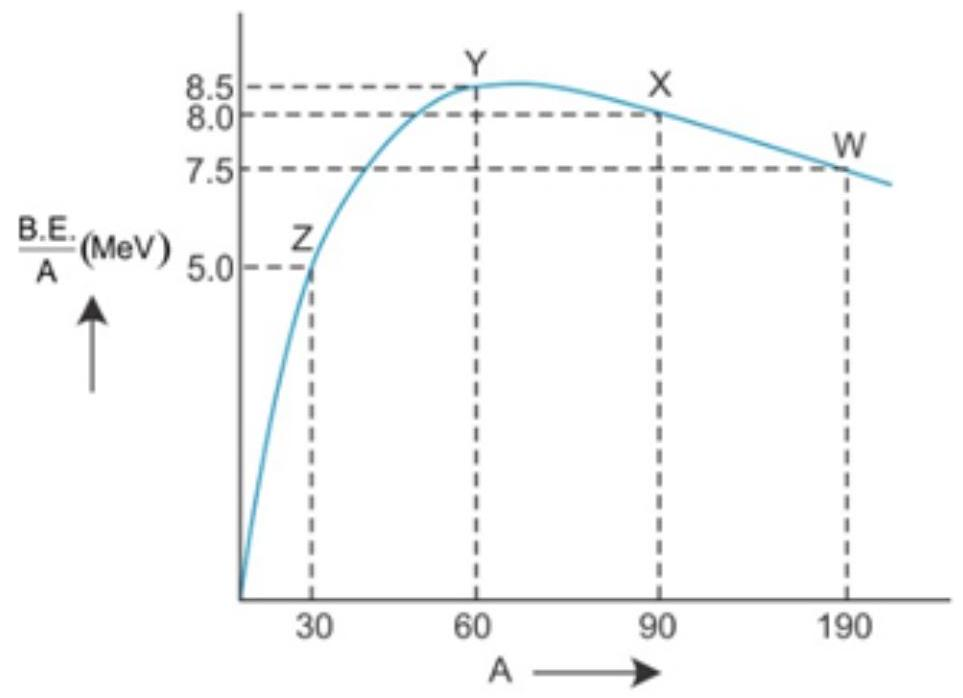
The graph plots binding energy per nucleon \( \text{(BE/A)} \) versus mass number \( A \). Points W, X, Y and Z mark specific nuclei.
Question
Using the curve, identify the nucleus that favours (a) fission and (b) fusion. Support each choice with the BE/A trend.
a) Suitable for fission :
b) Suitable for fusion :
Helpful Hints
Hint 1
Heavy nuclei (A ≫ 56) gain BE/A when they split.
Hint 2
Light nuclei (A ≲ 30) gain BE/A when they merge.
Hint 3
Peak of curve is near A ≈ 56 (Fe). Reactions moving toward this peak release energy.
Things to Consider
- Compare BE/A before and after the nuclear reaction.
- Energy released = increase in total binding energy.
- Fission and fusion are opposite nuclear reactions aiming for the same peak.
Related Concepts
Analytical Problem Solver
Electrostatic Potential & Capacitance – Q23
Problem Statement
A parallel-plate capacitor (area \(A\), gap \(d\)) receives an inserted slab of thickness \(t<d\). (i) Dielectric with relative permittivity \(\varepsilon_r\). (ii) Perfect conductor. Derive the new capacitances \(C_d\) and \(C_c\) and state which is larger.
Given:
- Parallel-plate capacitor, plates area \(A\), separation \(d\).
- Slab thickness \(t<d\) inserted centrally.
- Case (i) dielectric \(\varepsilon_r\); case (ii) perfect conductor.
To Find:
Expressions for \(C_d\) and \(C_c\); decide which >.
Solution Approaches
Dielectric as Series Combination
Treat air gap \((d-t)\) and dielectric \((t)\) as two series capacitors: \(C_d=\frac{\varepsilon_0A}{d-t+t/\varepsilon_r}\).
Conductor as Reduced Gap
Conductor enforces zero field inside; effective separation becomes \(d-t\): \(C_c=\frac{\varepsilon_0A}{d-t}\).
Comparison
Since \(\varepsilon_r>1\) ⇒ \(d-t+t/\varepsilon_r>d-t\), hence \(C_c>C_d\).
Logical Breakdown
Geometry Split
Capacitor now has two regions: air \((d-t)\) and slab \((t)\).
Basic Formula
For any region: \(C=\frac{\varepsilon A}{\ell}\).
Series Rule
Series capacitors: \(1/C=1/C_1+1/C_2\).
Conductor Effect
Zero field inside conductor removes \(t\) from effective gap.
Step-by-Step Solution
Model Arrangement
Identify two dielectrics in series: air \((\varepsilon_0)\) and slab \((\varepsilon_0\varepsilon_r)\).
Compute \(C_d\)
Use series rule.
Compute \(C_c\) & Compare
For conductor, distance is reduced.
Key Insights
-
Dielectric raises capacitance by lowering effective gap; formula depends on \(t\) and \(\varepsilon_r\).
-
Conducting insert maximises capacitance for the same thickness.
-
Effective separation concept simplifies multi-medium capacitor problems.
Analytical Problem Solver
Electromagnetic Waves – Displacement Current | Q5 (1 mark)
Problem Statement
A parallel-plate capacitor (\(A = 0.001\,\text{m}^2,\;d = 1.0\times10^{-4}\,\text{m}\)) is charged so that \(\frac{dV}{dt}=1.0\times10^{8}\,\text{V s}^{-1}\). Calculate the displacement current between its plates.
Given:
- \(A = 0.001\,\text{m}^2\)
- \(d = 1.0 \times 10^{-4}\,\text{m}\)
- \(\frac{dV}{dt}=1.0\times10^{8}\,\text{V s}^{-1}\)
- \(\varepsilon_0 = 8.85\times10^{-12}\,\text{F m}^{-1}\)
To Find:
Displacement current \(I_d\).
Solution Approaches
Maxwell correction formula
Apply \(I_d = \varepsilon_0 \frac{A}{d}\frac{dV}{dt}\).
Field-rate method
Find \(\frac{dE}{dt}\) then use \(I_d = \varepsilon_0 A \frac{dE}{dt}\).
Flux-change viewpoint
Relate to change in electric flux in Ampere-Maxwell law.
Logical Breakdown
Maxwell correction
Adds displacement current term to Ampère’s law.
Link E & V
\(E = \frac{V}{d}\) for uniform field between plates.
Rate of change
\(\frac{dE}{dt} = \frac{1}{d}\frac{dV}{dt}\).
Numeric evaluation
Insert values to obtain \(I_d\).
Step-by-Step Solution
Write governing formula
Using Maxwell correction, displacement current is proportional to changing electric flux.
Insert numerical values
Substitute all known quantities.
Evaluate
Calculate the product to obtain the current.
Key Insights
-
Maxwell’s displacement current term ensures Ampère’s law works inside a capacitor gap.
-
Magnitude depends on \(\varepsilon_0\), plate geometry, and the rate of voltage change.
-
Here \(I_d = 8.85\,\text{mA}\) equals the conduction current in the external circuit.
Dual Nature – Photoelectron Wavelength
Q17 (2 marks)
Problem Statement
Light of frequency \(1.6\times10^{15}\,\text{Hz}\) falls on platinum \((\phi = 5.63\,\text{eV})\). Calculate the minimum de Broglie wavelength of the emitted photoelectrons.
Given:
- Work function \( \phi = 5.63\,\text{eV}\)
- Incident frequency \( \nu = 1.6\times10^{15}\,\text{Hz}\)
- Constants: \(h = 6.626\times10^{-34}\,\text{J·s}\), \(m_e = 9.11\times10^{-31}\,\text{kg}\)
To Find:
Minimum de Broglie wavelength \(\lambda_{\text{min}}\) of photoelectrons.
Solution Approaches
Einstein Equation
Photoelectric effect gives \(K_{\text{max}} = h\nu - \phi\).
Electron Momentum
Use \(p = \sqrt{2m_e K_{\text{max}}}\) to link energy to momentum.
de Broglie Relation
Finally, \(\lambda = \frac{h}{p}\) gives wavelength.
Logical Breakdown
Photon Energy
Compare \(h\nu\) with work function to initiate photoelectric effect.
Unit Conversion
Convert \(\phi\) from eV to joules to keep units consistent.
Electron Momentum
Relate \(K_{\text{max}}\) to \(p\) using energy–momentum link.
Wave Nature
Apply de Broglie formula to express momentum as wavelength.
Step-by-Step Solution
Find \(K_{\text{max}}\)
\(K_{\text{max}} = h\nu - \phi = 1.58\times10^{-19}\,\text{J}\).
Compute Momentum
\(p = \sqrt{2m_eK_{\text{max}}}=5.4\times10^{-25}\,\text{kg·m s^{-1}}\).
Determine Wavelength
\(\lambda_{\text{min}}=\frac{h}{p}\approx1.2\,\text{nm}\).
Key Insights
-
Einstein equation links photon energy to electron kinetic energy in the photoelectric effect.
-
Electron momentum bridges kinetic energy and de Broglie wavelength.
-
Proper unit conversion avoids major numerical errors.
Semiconductors – Power Supply Blocks
Q22 (3 marks)
Problem Statement
A power-supply diagram shows two unlabeled blocks X and Y in series. Name each block and sketch its output waveform.
Given:
- Input: 50 Hz sinusoidal AC.
- Block X feeds block Y directly.
- Oscilloscope available for waveform sketch.
To Find:
Labels of X and Y, plus their respective output waveforms.
Solution Approaches
Identify Full-Wave Rectifier
Look for diode bridge/centre-tap giving same-polarity halves.
Spot Filter Circuit
Search for RC/LC components smoothing rectifier output.
Combine for Low-Ripple DC
Sequence rectification then filtering to obtain usable DC.
Logical Breakdown
AC Input
Supplies alternating voltage of both polarities.
Full-Wave Rectifier (X)
Flips negative half cycles, giving double-frequency pulses.
Filter Circuit (Y)
Capacitor/inductor smooths pulses, reducing ripple.
Pulsating DC Output
Voltage hovers near steady level, suitable for biasing circuits.
Step-by-Step Solution
Label X
X is a full-wave rectifier using diode bridge or centre-tap transformer.
Label Y
Y is an RC or LC filter reducing ripple by charging and slow discharge.
Draw Waveforms
Rectifier: double-frequency pulses touching zero. Filtered: nearly horizontal line with small saw-tooth ripple.
Key Insights
-
Full-wave rectification doubles output frequency and polarity.
-
Filters cannot create pure DC; they only reduce ripple amplitude.
-
Correct waveform sketches secure the final mark.
Analytical Problem Solver
Current Electricity – Temperature Effects
Problem Statement
A \(100\text{ V}\) battery with internal resistance \(r=1\:\Omega\) drives a heater that draws \(10\text{ A}\) at \(20^{\circ}\text{C}\). The heater’s temperature rises to \(320^{\circ}\text{C}\); its temperature coefficient is \(\alpha = 3.7\times10^{-4}\,^{\circ}\text{C}^{-1}\). Calculate the power wasted inside the battery after the rise.
Given:
- \(E = 100\text{ V}\), \(r = 1\:\Omega\)
- Initial current \(I = 10\text{ A}\) at \(20^{\circ}\text{C}\)
- \(\alpha = 3.7\times10^{-4}\,^{\circ}\text{C}^{-1}\), \(\Delta T = 300^{\circ}\text{C}\)
To Find:
Power loss \(P_b\) inside the battery at \(320^{\circ}\text{C}\).
Solution Approaches
Direct Calculation
Use \(\alpha\) to update heater resistance, then find new current and \(P_b\).
Ratio Method
Compare total resistance before and after heating to scale current quickly.
Graphical Insight
Plot I-V curve including \(r\) to visualise how temperature shift lowers current.
Logical Breakdown
Temperature Coefficient
\(\Delta R = R_0\alpha\Delta T\) links temperature rise to resistance change.
Initial Heater Resistance
\(R_0 = \frac{E}{I} - r\) uses internal resistance \(r\).
New Current
\(I' = \frac{E}{R + r}\) once heater warms.
Battery Power Loss
\(P_b = I'^2 r\) quantifies wastage inside the battery.
Step-by-Step Solution
Find \(R_0\)
\(R_0 = \frac{100}{10} - 1 = 9\:\Omega\).
Update Heater Resistance & Current
\(R = 9\bigl(1 + 3.7\times10^{-4}\times300\bigr) \approx 10\:\Omega\).
\(I' = \frac{100}{10+1} \approx 9.09\:\text{A}\).
Compute Battery Loss
\(P_b = (9.09)^2 \times 1 \approx 82.6\text{ W}\).
Key Insights
-
Heater resistance rises linearly with temperature via the temperature coefficient.
-
Internal resistance must be included to get the correct new current.
-
Learning outcome achieved: you can now compute current change and battery power loss after a temperature shift.
Analytical Problem Solver
Electromagnetic Induction – AC Generator (Q32 (I))
Problem Statement
An \(N\)-turn coil of area \(A\) rotates with angular speed \(\omega\) in a uniform magnetic field \(B\). Explain the working of an AC generator. Using Faraday’s law, derive \(e = N A B \omega \sin \omega t\). State the mechanical source of energy converted to electrical form.
Given:
- Number of turns \(N\)
- Coil area \(A\)
- Uniform field \(B\) and angular speed \(\omega\)
To Find:
Expression for induced emf and source of energy (mechanical → electrical).
Solution Approaches
Flux Method
Relate changing magnetic flux to emf using Faraday’s law.
Phasor View
Treat coil normal as a rotating vector to show sinusoidal variation.
Energy Perspective
Link mechanical torque from turbine/engine to electrical output.
Logical Breakdown
Magnetic Flux
\(\Phi = B A \cos \theta\) varies as coil rotates.
Faraday’s Law
\(e = -N \frac{d\Phi}{dt}\) gives induced emf.
Sinusoidal Form
With \(\theta = \omega t\), emf becomes \(NAB\omega \sin \omega t\).
Energy Conversion
Mechanical work from turbine/engine is converted to electrical energy.
Step-by-Step Solution
Write Flux
For angle \(\theta\) between field and coil normal, \(\Phi = B A \cos \theta\).
Apply Faraday’s Law
Differentiate flux to find emf.
Identify Energy Source
Mechanical torque from a turbine or engine maintains rotation, supplying the electrical output power.
Key Insights
-
Faraday’s law links changing flux to induced emf.
-
Uniform rotation leads to a pure sinusoidal emf.
-
Generators convert mechanical work into electrical energy—energy is not created.
Analytical Problem Solver
Ray Optics – Telescope Computation | Q33 (I)
Problem Statement
A telescope has \(f_o = 15\,\text{m}\) and \(f_e = 1\,\text{cm}\). (a) Find its angular magnification in normal adjustment. (b) Compute the diameter of the Moon’s image at the objective. Given: Moon’s diameter \(3.48\times10^{6}\,\text{m}\); distance \(3.8\times10^{8}\,\text{m}\).
Given:
- \(f_o = 15\,\text{m}\)
- \(f_e = 0.01\,\text{m}\)
- \(D_\text{Moon}=3.48\times10^{6}\,\text{m}\)
- \(R_\text{Moon}=3.8\times10^{8}\,\text{m}\)
- Normal adjustment (final image at ∞)
To Find:
1. Angular magnification \(M\)
2. Image diameter at objective \(d_i\)
Solution Approaches
Focal-length ratio
Use \(M=\frac{f_o}{f_e}\) and small-angle formula \(d_i=f_o\theta\).
Angular definition
Find object angle \(\theta\), then image angle, verify \(M=\theta_i/\theta\).
Lens-formula cross-check
Apply lens equation for the objective to get same \(d_i\).
Logical Breakdown
Angular magnification
For normal adjustment \(M=\frac{f_o}{f_e}\).
Object angle
\(\theta\approx\frac{D}{R}\) (small-angle approximation).
Image formation
Linear size: \(d_i=f_o\theta\).
Unit vigilance
Keep \(\theta\) in radians; ignore eyepiece in image-size step.
Step-by-Step Solution
Magnification
\(M=\frac{15}{0.01}=1500\).
Angular size of Moon
\(\theta=\frac{3.48\times10^{6}}{3.8\times10^{8}}\approx9.2\times10^{-3}\,\text{rad}\).
Image diameter
\(d_i=f_o\theta=15\times0.0092\approx0.14\,\text{m}\approx14\,\text{cm}\).
Key Insights
-
Magnification of a refracting telescope equals \(f_o/f_e\) when adjusted for infinity.
-
Image size at the objective depends on object angle and objective focal length only.
-
Always express small angles in radians to avoid conversion errors.
Atoms – Spectral Line Mystery
Q14 (Assertion-Reason)
Problem Statement
Hydrogen holds one electron, yet its discharge tube shows many spectral lines. Explain this using the Bohr model.
Given:
- ≈1023 hydrogen atoms in the lamp.
- Collisions excite electrons to Bohr orbits n = 2, 3, 4…
- Photon energy equals \(E_i-E_f\) for each electronic transition.
To Find:
Reason multiple discrete emission lines appear in the hydrogen spectrum.
Solution Approaches
Bohr energy-level view
Many atoms occupy n = 2, 3, 4…; each level can later drop.
Count transition pairs
For highest level n, possible lines \(N=\frac{n(n-1)}{2}\).
Series identification
Group transitions ending at same level: Lyman, Balmer, Paschen…
Logical Breakdown
Multiple atoms
Each atom behaves independently.
Excited populations
Collisions raise electrons to high n states.
Electronic transitions
Electrons drop to lower orbits, emitting photons.
Distinct energies
Different \(E_i-E_f\) values create unique wavelengths.
Step-by-Step Solution
Recall Bohr levels
Energy \(E_n=-13.6/n^2\) eV gives discrete orbit values.
Identify transitions
For highest occupied n, ordered pairs (ni, nf) define photons.
Relate to spectrum
Photons from countless atoms overlap, producing many bright lines grouped into series.
Key Insights
-
One-electron atom still owns infinite Bohr energy levels.
-
Many atoms + many downward electronic transitions = many spectral lines.
-
Observed wavelengths precisely match Bohr model predictions, validating the theory.
Key Take-aways
Formula Recap
Keep core equations handy: \(v = u + at\), \(F = qvB\), \(E = \frac{hc}{\lambda}\), \(P = \frac{V^2}{R}\).
Units Matter
Things to remember: write SI units, convert early, and verify dimensional consistency.
Solve Smart
Sketch free-body or circuit, spot symmetry, apply conservation laws to trim algebra & save time.
Time Management
Aim for 1.5 min per mark; if stuck beyond 2 min, flag, move on, return later.