Question Distribution & Your Strength
| Chapter | Paper Marks | Your Accuracy | Strength |
|---|---|---|---|
| Electrostatics | 8 | 90% | Strong |
| Current Electricity | 7 | 60% | Moderate |
| Magnetism & Matter | 5 | 70% | Moderate |
| EMI & AC | 8 | 50% | Weak |
| Optics | 14 | 80% | Strong |
| Dual Nature, Atoms & Nuclei | 10 | 55% | Weak |
| Semiconductor Electronics | 9 | 92% | Strong |
| Communication Systems | 4 | 65% | Moderate |
Source: Self-assessment mock test, April 2024
Analytical Problem Solver
Electric Charges & Fields
Problem Statement
Using Gauss’s theorem, derive \(E(r)\) at distance \(r\) from an infinitely long straight wire of uniform linear charge density \( \lambda \).
Given:
- Infinite straight wire (length ≫ \(r\)).
- Uniform linear charge density \( \lambda \).
- Medium: free space with \( \varepsilon_0 \).
To Find:
Electric field magnitude \(E(r)\).
Solution Approaches
Gauss’s law (cylindrical surface)
Exploit cylindrical symmetry; flux through curved area only.
Direct integration
Integrate Coulomb’s law along wire; calculus-heavy, same result.
Numerical simulation
Discretise charges and sum fields; useful for teaching only.
Logical Breakdown
Symmetry
Field is radial and identical over a circle of radius \(r\).
Gaussian surface
Coaxial cylinder of length \(L\), radius \(r\).
Flux calculation
\( \Phi = E(2\pi r L) \); end caps give zero flux.
Gauss’s law
Set \( \Phi = \frac{\lambda L}{\varepsilon_0} \) and solve for \(E\).
Step-by-Step Solution
Choose Gaussian surface
Take a cylinder with radius \(r\) and length \(L\) coaxial with the wire.
Compute electric flux
Field is perpendicular to curved surface; zero on end caps.
Apply Gauss’s law
Set \( \Phi = q_{\text{enc}}/\varepsilon_0 = \lambda L/\varepsilon_0 \).
Key Insights
-
Linear symmetry leads to \(E \propto 1/r\), not \(1/r^2\).
-
Flux through end caps is zero because field lines are parallel.
-
Avoid treating \( \lambda \) as surface charge or adding forgotten caps.
Moving Charges & Magnetism
Equilibrium of a charged sphere
Problem Statement
A +10 mC sphere rests inside a vertical tube. The tube moves east–west through a uniform 2 T horizontal magnetic field. Find the minimum speed and field orientation needed so the magnetic force exactly cancels the sphere’s weight.
Given:
- Charge \(q = +10\,\text{mC} = 0.01\,\text{C}\)
- Magnetic field \(B = 2\,\text{T}\) (horizontal, magnitude known)
- Gravitational acceleration \(g = 9.8\,\text{m s}^{-2}\)
To Find:
Least velocity \(v\) and the required field direction for equilibrium.
Solution Approaches
Force-balance method
Set \(F_B = mg\) with \(F_B = qvB\) when \(\mathbf{v}\perp\mathbf{B}\).
Right-hand rule
Choose \(\mathbf{B}\) so \(q\mathbf{v}\times\mathbf{B}\) points upward.
Minimum-speed check
Speed is minimum when \(\mathbf{v}\perp\mathbf{B}\), giving maximum \(F_B\).
Logical Breakdown
Magnetic force
\(\displaystyle F_B = qvB\) when \(\mathbf{v}\perp\mathbf{B}\).
Equilibrium condition
Set \(qvB = mg\) for vertical balance.
Minimum velocity
Achieved when \(\mathbf{v}\perp\mathbf{B}\) so \(F_B\) is maximal.
Direction selection
Use right-hand rule: for +ve charge, \(\mathbf{v}\times\mathbf{B}\) upward.
Step-by-Step Solution
Write force balance
For equilibrium, magnetic force must equal weight.
Solve for velocity
Rearrange to obtain minimum speed.
Set field direction
Choose \(\mathbf{B}\) so that for eastward motion, \(\mathbf{v}\times\mathbf{B}\) is upward. Hence \( \mathbf{B}\) must point south.
Key Insights
-
Balancing forces requires explicit use of \(qvB = mg\).
-
Minimum speed occurs when velocity is perpendicular to the magnetic field.
-
Right-hand rule fixes field direction; avoid swapping velocity and field vectors.
Analytical Problem Solver
Alternating Current
Problem Statement
In a series LCR circuit at resonance \(V_R = V_C = V_L = 10\text{ V}\). If the capacitor is short-circuited instantly, predict the voltage across the inductor just after the change.
Given:
- Series LCR at resonance (\(X_L = X_C\)).
- \(V_R = V_C = V_L = 10\text{ V}\).
- Same supply frequency throughout.
To Find:
Inductor voltage \(V'_L\) immediately after the capacitor is shorted.
Solution Approaches
Phasor method
Current stays unchanged at the instant; calculate \(V'_L = I X_L\).
Impedance ratio
Re-evaluate circuit impedance without \(C\); find new current, then \(V_L\).
Energy view
Use stored magnetic energy continuity to infer same \(V_L\).
Logical Breakdown
Resonance facts
In a series LCR circuit, \(X_L = X_C\) and current \(I\) is maximum.
Initial phasors
Phasor magnitudes: \(V_R = V_C = V_L = 10\text{ V}\).
Instantaneous change
Shorting \(C\) removes \(X_C\) but \(I\) cannot change suddenly (inductor property).
Voltage prediction
Because \(I\) and \(X_L\) stay same, \(V'_L = I X_L = 10\text{ V}\).
Step-by-Step Solution
Write resonance condition
At resonance \(X_L = X_C\) and voltages across \(L\) and \(C\) cancel in the phasor sum.
Determine initial current
\(I = V_R / R\). Exact \(R\) not needed; ratio suffices.
Short the capacitor
Current through \(L\) cannot change instantly, so \(I\) remains \(10/R\).
Compute new inductor voltage
\(V'_L = I X_L = 10\text{ V}\).
Key Insights
-
Phasor reasoning simplifies series LCR voltage questions.
-
Inductor current continuity lets us predict immediate voltage after circuit modifications.
-
Learning outcome achieved: you can now forecast voltage changes when a component is altered.
Analytical Problem Solver
Wave Optics – Young’s Double-Slit
Problem Statement
A Young’s double-slit (Y-D-S) set-up is illuminated with light of wavelengths \( \lambda_1 = 400\,\text{nm} \) and \( \lambda_2 = 600\,\text{nm} \) together. Find the least distance from the central maximum where a dark fringe appears for both wavelengths.
Given:
- Wavelengths: \( \lambda_1 = 400\,\text{nm} \), \( \lambda_2 = 600\,\text{nm} \).
- Y-D-S dark fringe condition: \( \Delta = (m+\tfrac{1}{2})\lambda \).
- Screen distance \( D \) and slit separation \( d \) (answer will include \( \tfrac{D}{d} \)).
To Find:
Least distance \( y_{\min} \) from the central maximum where both colours give a dark fringe.
Solution Approaches
Path-difference LCM
List odd-half multiples of each wavelength and pick the first common value.
Parity Check
Solve \( 400(2m_1+1)=600(2m_2+1) \) for integers to test coincidence.
Ratio Analysis
Use wavelength ratio \( \tfrac{3}{2} \) to scale odd-half sequences and find overlap.
Logical Breakdown
1. Dark Fringe Rule
A Y-D-S dark fringe occurs when \( \Delta = (m+\tfrac12)\lambda \).
2. Path Difference Sets
Generate odd-half multiples for both \( \lambda_1 \) and \( \lambda_2 \).
3. Common Value
Find the smallest path difference common to both sets (LCM idea).
4. Convert to y
Use \( y = \frac{\Delta D}{d} \) to get distance on the screen.
Step-by-Step Solution
Write Dark Conditions
For each colour, \( \Delta = (m+\tfrac12)\lambda \).
Find Least Common \( \Delta \)
Listing values shows the first match at \( \Delta = 600\,\text{nm} \) ( \( \tfrac{3\lambda_1}{2} = \lambda_2 \) ).
Convert to Screen Distance
Using the relation \( y = \dfrac{\Delta D}{d} \) gives the required distance.
Key Insights
-
A coincident dark fringe needs equal path difference for both beams.
-
Odd-half multiples of each wavelength form the dark-fringe series.
-
Distance on the screen scales with \( \tfrac{D}{d} \); ratio of wavelengths fixes the position.
Nuclear Binding Energy Insight
Binding Energy Curve & Nuclear Stability
Problem Context
The graph plots binding energy per nucleon versus mass number. Four nuclei—W, X, Y, Z—are marked for analysis.
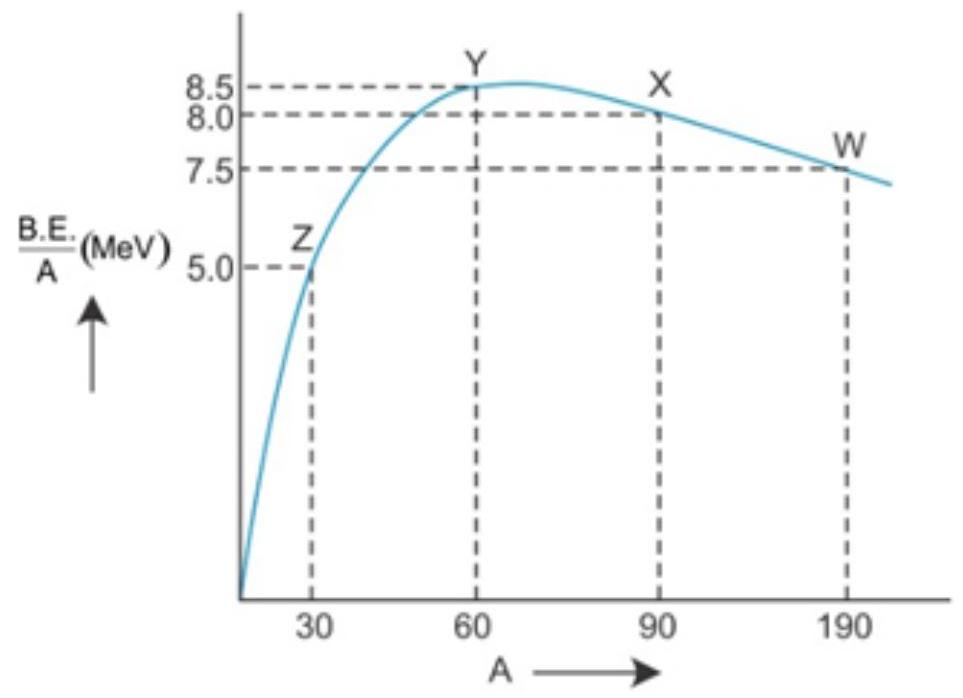
Question
Using the B.E. per nucleon curve, identify which nucleus suits (i) fission and (ii) fusion. Give a brief reason.
a) Fission-favoured nucleus
b) Fusion-favoured nucleus
Helpful Hints
Hint 1
Heavy nuclei far right, low B.E./A; splitting makes them more stable.
Hint 2
Light nuclei far left gain B.E./A when they merge toward the peak.
Hint 3
Compare how far W and Z lie below the Fe–Ni peak at \(A\approx56\).
Things to Consider
- Peak B.E./A at Fe–Ni signifies maximum nuclear stability.
- Energy released ∝ Δ(B.E./A)×A; larger gap yields more energy.
- Avoid choosing the peak itself for fission or fusion.
Related Concepts
Analytical Problem Solver
Electromagnetic Waves – Maxwell Correction
Problem Statement
A parallel-plate capacitor (area 0.001 m², gap 0.0001 m) is charged so that its voltage rises at \(10^{8}\,\text{V s}^{-1}\). Find the displacement current between the plates.
Given:
- Plate area \(A = 0.001\,\text{m}^2\)
- Separation \(d = 0.0001\,\text{m}\)
- \(\dfrac{dV}{dt}=10^{8}\,\text{V s}^{-1}\), \(\varepsilon_0 = 8.85\times10^{-12}\,\text{F m}^{-1}\)
To Find:
Magnitude of displacement current \(I_d\).
Solution Approaches
Direct Maxwell current
Use \(I_d=\varepsilon_0\frac{A}{d}\dfrac{dV}{dt}\).
Capacitance first
Find \(C=\varepsilon_0A/d\), then \(I_d=C\dfrac{dV}{dt}\).
Electric flux method
Employ \(I_d=\varepsilon_0\dfrac{d\Phi_E}{dt}\) for charging plates.
Logical Breakdown
Maxwell correction
Introduces \(I_d\) so Ampere’s law works for charging capacitors.
Capacitance
For parallel plates \(C=\varepsilon_0A/d\).
Voltage change
Charging causes \(\dfrac{dV}{dt}\neq0\) → time-varying electric field.
Numerical substitution
Insert values to obtain \(I_d\) in amperes.
Step-by-Step Solution
Calculate capacitance
\(C=\varepsilon_0\frac{A}{d}=8.85\times10^{-12}\times\frac{0.001}{0.0001}=8.85\times10^{-11}\,\text{F}\).
Apply charging relation
\(I_d=C\dfrac{dV}{dt}\).
Compute value
\(I_d = 8.85\times10^{-3}\,\text{A} = 8.85\,\text{mA}\).
Key Insights
-
Displacement current keeps Ampere’s law valid for time-varying fields.
-
For a capacitor, \(I_d\) matches the conduction current in the connecting wire.
-
Magnitude depends on area-to-gap ratio and \(\dfrac{dV}{dt}\) during charging.
Analytical Problem Solver
Electrostatic Potential & Capacitance
Problem Statement
Two parallel plates are separated by distance \(d\). Insert centrally a slab of
(a) dielectric constant \(k\) and thickness \(t<d\),
(b) metal thickness \(t\). Compare the resulting capacitances with the empty-plate value \(C_0\).
Given:
- Plate separation \(d\)
- Inserted slab thickness \(t\;(t<d)\)
- Dielectric constant \(k\) (case a)
To Find:
Ratios \(C_{\text{dielectric}}/C_0\) and \(C_{\text{metal}}/C_0\).
Solution Approaches
Series model for dielectric
Treat dielectric slab and two air gaps as three capacitors in series.
Metal reduces gap
Field vanishes inside metal; effective separation becomes \(d-t\).
Check consistency
For \(t\to0\) both results must return to \(C_0\).
Logical Breakdown
Air gaps
Each gap thickness \((d-t)/2\); permittivity \(\varepsilon_0\).
Dielectric slab
Permittivity \(k\varepsilon_0\); thickness \(t\).
Series combination
Add inverse capacitances to get \(C_{\text{dielectric}}\).
Metal insert
Inside metal \(E=0\) ⇒ only air gap \(d-t\) contributes.
Step-by-Step Solution
Equivalent for dielectric
Use series model: \( \frac{1}{C_d}= \frac{d-t}{2\varepsilon_0 A}+ \frac{t}{k\varepsilon_0 A} \).
Simplify ratio
Divide by \(C_0=\varepsilon_0 A/d\): \( \displaystyle \frac{C_d}{C_0}= \frac{1}{1-\frac{t}{d}+\frac{t}{kd}} \).
Metal case
Effective separation \(d-t\): \(C_m=\frac{\varepsilon_0 A}{d-t}= \frac{C_0}{1-\frac{t}{d}}\).
Key Insights
-
Partial dielectric acts like capacitors in series; metal deletes its own thickness.
-
Capacitance grows with decreasing effective gap: \(C\propto 1/\text{gap}\).
-
Avoid using \(k\) for metal; its permittivity is effectively infinite.
Analytical Problem Solver
Dual Nature of Radiation & Matter
Problem Statement
Three photoelectric I–V curves (A, B, C) for the same metal are given. Identify (i) the two curves with equal light intensity and (ii) the two with equal photon frequency.
Given:
- Same metal target and apparatus.
- Plateau current = saturation current \(I_{\text{sat}}\).
- Voltage where current becomes zero = stopping potential \(V_0\).
To Find:
Pairs with equal intensity and pairs with equal frequency.
Solution Approaches
Compare plateau heights
Equal \(I_{\text{sat}}\) ⇒ equal intensity.
Compare stopping potentials
Equal \(V_0\) ⇒ equal frequency (\(\nu\)).
Cross-check results
Use both criteria to avoid misclassification.
Logical Breakdown
Saturation current
Higher \(I_{\text{sat}}\) → more emitted electrons → greater intensity.
Stopping potential
\(V_0 = \frac{h\nu-\phi}{e}\); depends only on photon frequency.
Intensity inference
Curves with identical plateaus share light intensity.
Frequency inference
Curves with identical \(V_0\) correspond to equal frequency.
Step-by-Step Solution
Measure \(I_{\text{sat}}\)
Read the plateau current for A, B, C and note equal values.
Measure \(V_0\)
Locate the voltage where current becomes zero for each curve.
Draw conclusions
Match curves with equal \(I_{\text{sat}}\) for intensity and equal \(V_0\) for frequency.
Key Insights
-
\(I_{\text{sat}}\) signals intensity; it is frequency-independent.
-
\(V_0\) depends only on photon energy \(h\nu\).
-
Slopes before saturation carry no information for this analysis.
Analytical Problem Solver
Semiconductor Electronics • Bias Judgement
Problem Statement
A cell, ideal diode (anode to +), bulb and switch are in series. Will the bulb glow (a) when the switch is open, (b) when the switch is closed?
Given:
- Ideal diode: zero \(R_f\), infinite \(R_r\).
- Anode connected to cell’s positive terminal ⇒ forward bias possible.
- Bulb glows only when current ≠ 0.
To Find:
Glow status for each switch position.
Solution Approaches
Current-path check
Trace continuity with switch open and closed.
Bias analysis
Determine forward or reverse bias of the ideal diode.
Equivalent circuit view
Replace diode with short (forward) or open (reverse) to predict bulb behaviour.
Logical Breakdown
Switch state
Open ⇒ circuit broken. Closed ⇒ path may exist.
Diode bias
Anode at higher potential gives forward bias; reverse otherwise.
Current flow
Needs closed switch & plus forward-biased diode.
Bulb response
Glows only when \(I \gt 0\).
Step-by-Step Solution
Switch open
Circuit incomplete, current zero, diode bias irrelevant, bulb OFF.
Switch closed
Path complete. Anode is positive, so diode forward biased ⇒ behaves like short.
Result
Current flows, bulb glows. If diode were reverse biased, bulb would remain dark.
Key Insights
-
Ideal diode conducts only under forward bias; blocks completely in reverse bias.
-
An open switch mimics infinite resistance, stopping current regardless of diode state.
-
Always judge bulb glow by tracing current path and verifying diode bias together.
Analytical Problem Solver
Current Electricity
Problem Statement
A 100 V battery with internal resistance \(r = 1\,\Omega\) sends 10 A through a heater at \(20^{\circ}\text{C}\). When the heater reaches \(320^{\circ}\text{C}\) the current becomes steady. Calculate the power dissipated inside the battery at the higher temperature. Take temperature coefficient of resistance \( \alpha = 4.0 \times 10^{-3}\,^{\circ}\text{C}^{-1} \).
Given:
- Battery emf \(E = 100\text{ V}\)
- Internal resistance \(r = 1\,\Omega\)
- Initial current \(I_0 = 10\text{ A}\) at \(20^{\circ}\text{C}\)
- Final temperature \(T = 320^{\circ}\text{C}\)
- Temperature coefficient \( \alpha = 4.0 \times 10^{-3}\,^{\circ}\text{C}^{-1}\)
To Find:
Power lost in internal resistance after heating.
Solution Approaches
Direct α-method
Use \(R = R_0[1+\alpha\Delta T]\) to update heater resistance, then compute current and battery loss.
Graphical I–R analysis
Plot \(I\) vs \(R\) for fixed \(E,r\); read current for new \(R\).
Percent-change shortcut
Estimate current drop using small-change approximation for \(R\) increase.
Logical Breakdown
Initial heater resistance \(R_0\)
Derived from Ohm’s law using given current and internal resistance.
Temperature rise \(\Delta T\)
\(320^{\circ}\text{C} - 20^{\circ}\text{C} = 300^{\circ}\text{C}\).
New heater resistance \(R\)
Apply \(R = R_0(1+\alpha\Delta T)\) to include temperature coefficient.
Battery loss \(P_r\)
Use \(P_r = I^{2} r\) with updated current to quantify internal resistance power.
Step-by-Step Solution
Compute \(R_0\)
\(R_0 = \frac{E}{I_0} - r = \frac{100}{10} - 1 = 9\,\Omega\).
Update heater resistance
\(R = 9[1 + (4.0\times10^{-3})(300)] = 9 \times 2.2 = 19.8\,\Omega\).
Find current & battery loss
\(I = \frac{100}{19.8 + 1} \approx 4.8\,\text{A}\).
\(P_r = I^{2} r \approx (4.8)^{2}(1) \approx 23\,\text{W}\).
Key Insights
-
Resistance rises linearly with temperature for metal heaters: \(R \propto 1+\alpha\Delta T\).
-
Battery loss depends on internal resistance power \(I^{2}r\); lower current reduces unwanted heating.
-
Linking temperature coefficient to circuit analysis meets the learning goal: analyse temperature impact on battery efficiency.
Analytical Problem Solver
Electromagnetic Induction – AC Generator Equation
Problem Statement
Derive the instantaneous emf \( \varepsilon = N A B \omega \sin \omega t \) for a coil of \(N\) turns and area \(A\) rotating with angular speed \( \omega \) in a uniform magnetic field \(B\).
Given:
- Uniform magnetic field \(B\).
- Coil with \(N\) turns and area \(A\).
- Angular speed \( \omega \); plane makes angle \( \omega t \) with field.
To Find:
Expression for induced emf as a function of time.
Solution Approaches
Faraday derivative
Differentiate \( \Phi = N A B \cos \omega t \) to get emf.
Phasor shift
Emf leads flux by \(90^\circ\); cosine becomes sine.
Flux-cutting view
Sine arises from component of \(B\) cut per unit time.
Logical Breakdown
Flux expression
\( \Phi(t)= N A B \cos \omega t \).
Differentiate
\( d\Phi/dt = - N A B \omega \sin \omega t \).
Apply Faraday
\( \varepsilon = - d\Phi/dt \).
Result
\( \varepsilon = N A B \omega \sin \omega t \).
Step-by-Step Solution
Write magnetic flux
Flux through coil changes as cosine of angle.
Apply Faraday’s law
Induced emf equals negative time rate of flux change.
Differentiate & simplify
Derivative converts cosine to sine; negative signs cancel.
Key Insights
-
Emf leads magnetic flux by \(90^\circ\); hence sine form.
-
Sign errors or omitting \(N\) are common pitfalls.
-
Greater \(N, A, B,\) or \( \omega \) increases generator output.
Analytical Problem Solver
Ray Optics – Right-angled Prism & TIR
Problem Statement
A ray just grazes face AC of a right-angled prism. (a) Find the prism’s refractive index. (b) When AC is immersed in a liquid of \(n=\dfrac{2}{\sqrt{3}}\), will the ray undergo total internal reflection or refraction?
Given:
- Right-angled prism (\(45^\circ\), \(45^\circ\), \(90^\circ\))
- Ray grazes face AC ⇒ angle of refraction \(=90^\circ\)
- Initial surrounding: air \((n=1)\); later: liquid \(\displaystyle n=\frac{2}{\sqrt{3}}\)
To Find:
Prism refractive index and the ray’s fate (TIR or refraction) in the liquid.
Solution Approaches
Snell’s law at grazing
Set \(r=90^\circ\) at AC; solve \(n=\sin i/ \sin r\) for the prism.
Critical angle method
Use \(\sin C = \dfrac{n_{\text{out}}}{n_{\text{prism}}}\) with internal angle \(45^\circ\).
Graphical ray tracing
Sketch rays inside the right-angled prism to verify TIR condition.
Logical Breakdown
Prism geometry
Right-angled prism has \(45^\circ\) faces, so internal incidence on AC is \(45^\circ\).
Snell’s law
At grazing emergence, \(r=90^\circ\) ⇒ \(n_{\text{prism}}=\dfrac{1}{\sin 45^\circ}\).
Critical angle in liquid
With liquid outside, \(\sin C'=\dfrac{n_{\text{liq}}}{n_{\text{prism}}}\).
TIR condition test
If internal angle > critical angle ⇒ TIR; else ray refracts.
Step-by-Step Solution
Find \(n_{\text{prism}}\)
For grazing emergence, internal incidence = \(45^\circ\).
Critical angle in liquid
\(\sin C'=\dfrac{n_{\text{liq}}}{n}=\dfrac{\dfrac{2}{\sqrt{3}}}{\sqrt{2}}=\dfrac{2}{\sqrt{6}}\).
Decide ray’s fate
Internal angle \(45^\circ < C' (54^\circ)\). Condition for TIR unmet.
Key Insights
-
Grazing emergence fixes the internal angle at the critical angle.
-
Critical angle varies with the surrounding medium: \(\sin C = n_{\text{out}}/n_{\text{in}}\).
-
Right-angled prisms need \(n \ge \sqrt{2}\) for guaranteed TIR at 45° faces.
Analytical Problem Solver
Atoms – Rutherford Scattering Energy
Problem Statement
An \(\alpha\)-particle moves toward a nucleus with speed \(V\) and stops momentarily at closest approach \(d\). What speed is required for a new closest approach of \(d/2\)?
Given:
- \(\alpha\)-particle charge \(+2e\), mass \(m\) unchanged
- Nuclear charge \(+Ze\)
- Initial case: speed \(V\), closest approach \(d\)
To Find:
Required speed \(v\) for closest approach \(d/2\)
Solution Approaches
Energy Conservation
Set initial kinetic energy equal to electrostatic potential energy at minimum distance.
Dimensional Reasoning
Recognise \(KE\propto 1/d\) for identical charges; scale speed accordingly.
Numerical Substitution
Insert values after deriving the general relation to verify \(v=\sqrt{2}V\).
Logical Breakdown
Initial Kinetic Energy
\( KE_1=\frac12 mV^2 \)
Electrostatic PE at \(d\)
\( U_1=\frac{1}{4\pi\varepsilon_0}\frac{2Ze^2}{d} \)
Second Scenario PE
\( U_2=\frac{1}{4\pi\varepsilon_0}\frac{2Ze^2}{d/2}=2U_1 \)
Speed Relation
Set \(KE_2=U_2\Rightarrow\frac12 mv^2=2U_1=2KE_1\Rightarrow v=\sqrt{2}V\).
Step-by-Step Solution
Equate Energies (Case 1)
For closest approach \(d\): \( \frac12 mV^2 = \frac{1}{4\pi\varepsilon_0}\frac{2Ze^2}{d} \).
Set Up Case 2
For closest approach \(d/2\): \( \frac12 mv^2 = \frac{1}{4\pi\varepsilon_0}\frac{2Ze^2}{d/2} = 2U_1 \).
Take Ratio & Solve
\( \frac{v^2}{V^2} = \frac{KE_2}{KE_1}=2 \Rightarrow v = \sqrt{2}\,V \).
Key Insights
-
Closest approach varies inversely with initial kinetic energy in Rutherford scattering.
-
Halving distance requires doubling the kinetic energy, hence speed increases by \(\sqrt{2}\).
-
Always compare energies, not forces, to meet the learning outcome.
Key Take-aways
Formula Flash
Prepare a recap sheet. Memorise \(E=\frac{hc}{\lambda}\), \(V=IR\), \(v=u+at\) and similar core relations.
Unit Check
Top thing to remember: always convert to SI; dimensional checks catch errors instantly.
Vector & Sign
Remember directions. Apply right-hand rules and sign conventions to avoid negative surprises.
Diagram & Graph
Neat sketches of circuits, rays or motion graphs communicate logic and save explanation time.
Time Plan
Scan paper quickly, tackle sure shots first, reserve final five minutes for OMR or recheck.
Review & Present
Finish with a clean review—units, significant figures, and margins tidy—so no marks leak.