Physics Sample Paper Review Crack the 70-mark physics paper with confidence.

Question Distribution & Your Strength

See how the paper maps to your syllabus strengths.

Chapter Marks Weightage (%) Your Proficiency
Electrostatics 8 11 High
Current Electricity 7 10 Medium
Magnetism 6 8 Low
EM Induction & AC 7 10 Medium
EM Waves 3 4 High
Optics 14 19 Medium
Dual Nature & Matter 4 6 Low
Atoms & Nuclei 5 7 High
Semiconductor Electronics 6 8 Medium

Source: CBSE Sample Question Paper 2024-25 & your mock test analytics

Question with Hints and Nudges

Electric Charges & Fields – Challenge

Difficulty: hard
Self-Discovery

The Question:

State Gauss’s law and derive the electric field around an infinitely long, uniformly charged straight wire of linear charge density \( \lambda \).

No diagram provided

Helpful Concepts

  • Gauss’s surface symmetry
  • Flux–field relation
  • Cylindrical Gaussian surface
Gauss law Linear charge

Progressive Hints (Reveal only when needed)

Gentle Nudge

Choose a coaxial cylindrical Gaussian surface of radius \( r \) and length \( L \).

Direction Pointer

Only the curved surface contributes: \( \Phi_E = E(2\pi r L) \).

Guiding Framework

Set \( \Phi_E = \lambda L/\varepsilon_0 \) and solve: \( E = \dfrac{\lambda}{2\pi \varepsilon_0 r} \).

Thinking Strategies

Break It Down

Use symmetry: field is radial and uniform over the curved surface.

Connect to Prior Knowledge

Verify \( E \) has units of N C\(^{-1}\).

Visualize It

Sketch the wire and surrounding cylinder to see why only the curved surface matters.

Test a Simpler Case

If \( r \) doubles, the expression shows \( E \) halves. Does that make sense?

Struggle is normal! Try to solve on your own before checking the hints.

Question with Hints and Nudges

Physics | CBSE 12

Difficulty: Hard
Self-Discovery

The Question:

An electron moves in a uniform magnetic field describing a circle of radius \(r_0\) with period \(T_0\). What happen to the radius and time period if its speed becomes \(2v_0\)?
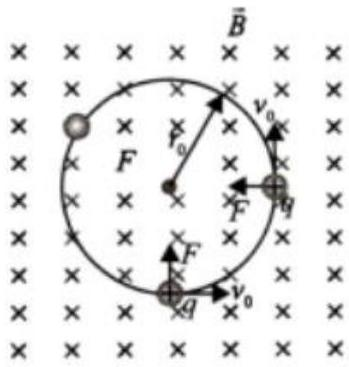
https://asset.sparkl.ac/pb/sparkl-vector-images/img_ncert/HwekryFoMsjimFCRQedENIGhC1iSyErTe4mDuLqm.png

Helpful Concepts

  • Lorentz force: \(F = qvB\)
  • Centripetal need: \(F = \frac{mv^{2}}{r}\)
  • Cyclotron frequency: \(\omega = \frac{qB}{m}\)
cyclotron motion radius-period relation

Progressive Hints (Reveal only when needed)

Relate Forces

Start with \(qvB = \frac{mv^{2}}{r}\) to express \(r\) in terms of \(v\).

Radius Ratio

Compute \(r_{new}/r_0\) after substituting \(2v_0\); it doubles.

Period Expression

Use \(T = \frac{2\pi m}{qB}\). Since \(v\) cancels, \(T_{new} = T_0\).

Thinking Strategies

Parameter Isolation

Hold \(q\) and \(B\) fixed; see how changing \(v\) alone affects each formula.

Common Mistake

Do not plug \(2v_0\) into \(T\); velocity is absent from the period expression.

Visualize It

Draw two circles; observe the radius doubles while rotation rate stays constant.

Test a Simpler Case

Imagine halving \(v\); predict \(r\) and \(T\) to check your reasoning pattern.

Alternating Current – Concept Test

Physics | CBSE 12

Difficulty: medium
Self-Discovery

The Question:

In a series LCR circuit \(V_R = V_C = V_L = 10\,\text{V}\). If the capacitor is short-circuited, what is the new voltage across the inductor?

No diagram required.

Helpful Concepts

  • Phasor addition of AC voltages
  • Resonance: \(X_L = X_C\)
  • Impedance of a series RL circuit
Alternating Current Impedance

Progressive Hints (Reveal only when needed)

Gentle Nudge

Equal voltages signal resonance, so \(X_L = X_C\).

Direction Pointer

Shorting the capacitor leaves an RL series circuit with \(Z=\sqrt{R^2+X_L^2}\).

Guiding Framework

Find \(I\) from \(V_R = I R\) (source voltage unchanged). Then compute \(V_L = I X_L\) using the same frequency.

Thinking Strategies

Break It Down

Contrast the circuit at resonance with the RL circuit after the short.

Connect to Prior Knowledge

At resonance \(Z=R\); remember \(I = V/R\).

Visualize It

Redraw the phasor triangle before and after removing \(C\).

Test a Simpler Case

Imagine \(R=0\) to see how \(V_L\) responds purely to \(X_L\).

Question with Hints and Nudges

Wave Optics – Multi-wavelength YDSE | Physics | CBSE 12

Difficulty: hard
Self-Discovery

The Question:

In a Young’s double-slit experiment, light of wavelengths 400 nm and 600 nm illuminate the same slits. Find the minimum distance \(y\) from the central bright fringe where both colours produce a dark fringe simultaneously. Express \(y\) in terms of slit separation \(d\) and screen distance \(D\).

No diagram provided

Helpful Concepts

  • Dark fringe condition: \( \Delta = (m+\tfrac{1}{2})\lambda \).
  • Use LCM to match path differences for two wavelengths.
  • Relation to screen: \( y = \frac{\Delta D}{d} \).
Wave Optics Interference

Progressive Hints (Reveal only when needed)

Dark Fringe Rule

For each colour, dark fringes satisfy \( \Delta = (m+\tfrac{1}{2})\lambda \).

Common Position

Find the smallest path difference that is a half-integer multiple of both wavelengths.

Translate to Screen

Once \(\Delta_{\text{min}}\) is known, use \( y = \frac{\Delta_{\text{min}}D}{d} \) to express the required distance.

Thinking Strategies

Break It Down

Write separate dark-fringe equations before combining them.

Connect to Prior Knowledge

LCM of numbers aligns repeating patterns—apply that to path differences.

Visualize It

Sketch the two fringe sets and mark overlaps for insight.

Test a Simpler Case

Imagine \(\lambda_2 = 2\lambda_1\) to see how common darks appear.

Struggle is normal! Try to solve on your own before checking the hints.

Question with Hints and Nudges

Physics | CBSE 12

Difficulty: Medium
Self-Discovery

The Question:

Using the B.E./A versus mass-number curve, decide which labelled nuclei (W, X, Y, Z) are most suitable for (i) fission and (ii) fusion, giving reasons.

No diagram required.

Helpful Concepts

  • Peak at \(A \approx 60\) gives maximum B.E./A.
  • Moving toward the peak releases energy.
  • Heavy nuclei split; light nuclei fuse to approach the peak.
Nuclear energy Fusion vs fission

Progressive Hints (Reveal only when needed)

Gentle Nudge

Check each label’s mass number relative to the \(A\approx60\) peak on the curve.

Direction Pointer

For fission, pick the heaviest labelled nucleus that still has a noticeably lower B.E./A than the peak.

Guiding Framework

For fusion, choose the lightest labelled nucleus far left of the peak; products should shift significantly toward \(A\approx60\).

Thinking Strategies

Energy Slope

Steeper rise toward the peak implies a larger possible energy gain.

Common Slip

Avoid picking nuclei already at or near the peak; they cannot release much extra energy.

Visualize It

Draw arrows from the chosen nuclei toward the peak to see the direction of energy release.

Test a Simpler Case

Recall how splitting \(^{235}\text{U}\) or fusing deuterons releases energy; apply the same idea here.

Struggle is normal! Try to solve on your own before checking the hints.

Electrostatic Potential & Capacitance – Dielectrics

Physics | CBSE 12

Difficulty: Hard
Self-Discovery

The Question:

Derive expressions for the capacitance of a parallel-plate capacitor of area \(A\) and plate separation \(d\) when (i) a dielectric slab of thickness \(t\) and permittivity \(\varepsilon\) and (ii) a metal slab of the same thickness (\(t<d\)) are inserted between the plates.

No figure provided

Helpful Concepts

  • Series capacitance model for layered media
  • Electric field is zero inside a perfect conductor
  • Capacitance is inversely proportional to effective plate gap
capacitor modification dielectric insertion

Progressive Hints (Reveal only when needed)

Gentle Nudge

Split the capacitor gap into two parts: the slab (\(t\)) and the remaining air (\(d-t\)).

Direction Pointer

For each region use \(C=\varepsilon A/\Delta x\). Take \(\varepsilon=\varepsilon_0\) for air, \(\varepsilon=\kappa\varepsilon_0\) for the dielectric.

Guiding Framework

Combine the two capacitances in series: \(1/C=1/C_1+1/C_2\). For a metal slab, the potential drop occurs only across the air gap \((d-t)\); effectively \(C=\varepsilon_0 A/(d-t)\).

Thinking Strategies

Compare Results

Metal removal of gap boosts capacitance more than any finite-κ dielectric.

Avoid Error

A conductor does not merely raise κ; it sets \(E=0\) inside, cancelling that part of the distance.

Check Limits

Verify your formula for \(t\to0\) and \(t\to d\) to detect algebra slips.

Visualize It

Sketch field lines and potential drop across each region to clarify the series model.

Struggle is normal! Try to solve on your own before checking the hints.

Question with Hints and Nudges

Electromagnetic Waves – Displacement Current

Difficulty: medium
Self-Discovery

The Question:

A parallel-plate capacitor of area 0.001 m² and plate separation 0.0001 m is connected to a source whose voltage rises at \(1\times10^{8}\,\text{V s}^{-1}\). Find the displacement current through the capacitor.

Helpful Concepts

  • \(I_d=\varepsilon_0 A\,\dfrac{dE}{dt}\)
  • \(E=\dfrac{V}{d}\)
  • \(\varepsilon_0=8.85\times10^{-12}\,\text{F m}^{-1}\)
Maxwell correction Capacitor charging

Progressive Hints (Reveal only when needed)

Gentle Nudge

Use \(E=V/d\); hence \(\dfrac{dE}{dt}=\dfrac{1}{d}\,\dfrac{dV}{dt}\).

Direction Pointer

Insert this \(dE/dt\) into \(I_d=\varepsilon_0 A dE/dt\) and substitute the numerical values.

Guiding Framework

Keep track of powers of ten; the final answer should be a few mA.

Thinking Strategies

Constant Mistake

Do not drop the area \(A\); forgetting it makes the answer 10⁴ times smaller.

Concept Link

Displacement current ensures Ampere–Maxwell law holds when the capacitor is charging.

Break It Down

List given values, write the formula, then substitute step by step.

Visualize It

Sketch field lines between plates to see how a changing field creates \(I_d\).

Struggle is normal! Try to solve on your own before checking the hints.

Dual Nature – Photoelectron Wavelength

Physics | CBSE 12

Difficulty: Medium
Self-Discovery

The Question:

Platinum (work function 5.63 eV) is illuminated by \(1.6\times10^{15}\,\text{Hz}\) light. Find the minimum de Broglie wavelength of the emitted electrons.

No diagram provided.

Helpful Concepts

  • \(K_{\text{max}} = h\nu - \phi\)
  • \(\lambda = \frac{h}{p}\)
  • Work function \(\phi\) sets the threshold
photoelectric effect matter waves

Progressive Hints (Reveal only when needed)

Gentle Nudge

Use \(E = h\nu\). Convert photon energy from joules to electron-volts.

Direction Pointer

Compute \(K_{\text{max}} = E - \phi\). Keep everything in SI units for accuracy.

Guiding Framework

Find \(p = \sqrt{2m_e K_{\text{max}}}\). Finally, \(\lambda = \frac{h}{p}\) gives the minimum wavelength.

Thinking Strategies

Unit Consistency

Work in SI until the last step to avoid conversion errors.

Common Slip

Do not use \(c = \lambda \nu\) for electrons—only photons follow that relation.

Visualize It

Draw an energy bar: photon energy, work function, and leftover kinetic energy.

Test a Simpler Case

Check what happens when \(\nu\) is just at the threshold to verify your method.

Question with Hints and Nudges

Semiconductor Electronics – Diode Logic

Difficulty: Hard
Self-Discovery

The Question:

An ideal diode, a cell, switch S, and a bulb are in series. Will the bulb glow (a) when S is open, (b) when S is closed? Justify each answer using band-diagram reasoning.

Helpful Concepts

  • Forward vs reverse bias
  • Circuit continuity
  • Band-diagram interpretation
pn-junction Ideal diode

Progressive Hints (Reveal only when needed)

Gentle Nudge

Which diode terminal is linked to the positive cell terminal?

Direction Pointer

With S open, ask: does any closed path exist for charge to reach and return from the bulb?

Guiding Framework

When S closes, check the diode's bias. If forward-biased, model it as a short; if reverse-biased, as an open. Then trace current through the bulb.

Thinking Strategies

Break It Down

Analyse the open-switch and closed-switch cases separately.

Connect to Prior Knowledge

Remember: forward bias ≈ short circuit, reverse bias ≈ open circuit for an ideal diode.

Visualize It

Sketch energy bands for forward and reverse bias to see carrier movement.

Test a Simpler Case

Assume zero diode drop and verify if current can complete the loop.

Struggle is normal! Try to solve on your own before checking the hints.

Question with Hints and Nudges

Physics | CBSE 12

Difficulty: Hard
Self-Discovery

The Question:

A 100 V battery (internal resistance 1 Ω) drives 10 A through a heater at 20 °C. After the heater reaches 320 °C, calculate the power dissipated inside the battery. Use \( \alpha = 3.7\times10^{-4}\,^{\circ}\mathrm{C}^{-1} \).

Helpful Concepts

  • \( R_T = R_0(1+\alpha \Delta T) \)
  • \( P_{\text{loss}} = I^{2} r \)
  • \( P = I^{2} R \) for resistive heating
temperature coefficient internal resistance

Progressive Hints (Reveal only when needed)

Gentle Nudge

First, find the heater’s hot resistance using \( R_T = R_0(1+\alpha \Delta T) \).

Direction Pointer

With the new \( R \), current is \( I = \frac{V}{R + r} \).

Guiding Framework

Finally, compute \( P_{\text{battery}} = I^{2} r \). Finish the arithmetic yourself.

Thinking Strategies

Separate Resistances

Keep the heater’s \( R \) and battery’s \( r \) distinct when forming equations.

Quick Estimate

Current should drop only slightly; a huge change signals an error.

Visualize It

Draw a simple circuit diagram with updated resistance values.

Test a Simpler Case

Set \( \alpha = 0 \) to verify your equations before using actual data.

Struggle is normal! Try to solve on your own before checking the hints.

Electromagnetic Induction – AC Generator

Physics | CBSE 12

Difficulty: medium
Self-Discovery

The Question:

A coil with \(N\) turns and area \(A\) rotates at angular speed \( \omega \) in a uniform field \(B\). Derive the instantaneous emf induced in the coil and name the energy source in an a.c. generator.

Helpful Concepts

  • Faraday’s law of electromagnetic induction
  • Magnetic flux \( \Phi = BA\cos\theta \)
  • Lenz’s law for sign convention
generator principle Faraday law

Progressive Hints (Reveal only when needed)

Gentle Nudge

Express magnetic flux through the rotating coil first.

Direction Pointer

Use \( \Phi = N B A \cos(\omega t) \).

Guiding Framework

Differentiate flux to get \( e = -\frac{d\Phi}{dt} = N B A \omega \sin(\omega t) \). Mechanical work from the prime mover is the energy source.

Thinking Strategies

Sign Convention

Apply Lenz’s law to decide the negative sign in \(e\).

Mistake Watch

Don’t forget the factor \(N\) while writing the emf expression.

Visualize It

Sketch coil positions at \( \omega t = 0^\circ \) and \(90^\circ\) to see flux change.

Test a Simpler Case

Check your formula for \( \omega t = 0 \) and \( \omega t = \pi/2 \).

Struggle is normal! Try to solve on your own before checking the hints.

Question with Hints and Nudges

Ray Optics – Telescope Magnification | Physics CBSE 12

Difficulty: hard
Self-Discovery

The Question:

A refracting telescope has an objective of focal length 15 m and an eyepiece of 1 cm. Calculate (i) its angular magnification in normal adjustment, and (ii) the diameter of the moon’s image formed at the objective.

No diagram required.

Helpful Concepts

  • \(M = \frac{f_o}{f_e}\)
  • \(y = \theta\,f_o\)
  • \(\theta \approx \frac{D}{R}\) for small angles
astronomical telescope angular size

Progressive Hints (Reveal only when needed)

Gentle Nudge

Put both focal lengths in metres before taking their ratio for magnification.

Direction Pointer

Use the small-angle formula \( \theta \approx \frac{3.48\times10^{6}}{3.8\times10^{8}} \) rad to estimate the moon’s angular size.

Guiding Framework

After finding \( \theta \), multiply it by the 15 m focal length to obtain the image diameter in metres, then convert to millimetres.

Thinking Strategies

Break It Down

Solve part (i) first; reuse its result to sanity-check part (ii).

Connect to Prior Knowledge

Recall that normal adjustment places the final image at infinity, so magnification is just the focal-length ratio.

Visualize It

Sketch parallel rays from the moon hitting the objective to see where the image forms.

Test a Simpler Case

Try using \( \theta = 0.01 \) rad to estimate image size, then refine with the exact angle.

Struggle is normal! Try to solve on your own before checking the hints.

Question with Hints and Nudges

Physics | CBSE 12 – Atoms

Difficulty: easy
Self-Discovery

The Question:

Why does a sample of hydrogen, with only one electron per atom, still show many distinct spectral lines in its emission spectrum?

Helpful Concepts

  • Many atoms → many excited states at once
  • Photon wavelength set by energy-level gap
  • Bohr’s quantised orbits in hydrogen
hydrogen spectrum energy levels

Progressive Hints (Reveal only when needed)

Population Variety

Different atoms can occupy different excited states at the same moment.

Transition Diversity

Each allowed drop, such as n = 4→2 or 3→1, releases its own unique wavelength.

Guiding Framework

Combine ideas: a large ensemble of identical one-electron atoms + all possible downward jumps predicted by Bohr → many discrete spectral lines.

Thinking Strategies

Common Mistake

One electron cannot jump multiple gaps at once; each photon comes from a single transition.

Link Back

Recall Bohr’s postulate: energy depends only on quantum numbers ni and nf.

Visualize It

Sketch the energy-level diagram and draw every downward arrow you can.

Test a Simpler Case

Imagine a single atom: one line per jump. Add many atoms, lines accumulate.

Struggle is normal! Try to solve on your own before checking the hints.

Key Take-aways

Formulas First

Quickly recap and write core formulas; remember them and avoid late corrections.

Units & SI

Always state answers with correct SI units—simple thing to remember for full marks.

Diagram Strategy

Draw neat, labeled diagrams; they earn instant points and clarify concepts.

Numerical Flow

Substitute symbols before numbers; compute step-wise to avoid arithmetic slips.

Time Management

Finish sure-shot questions first; return to lengthy ones with remaining time.

Presentation

Box the final result; examiner sees it instantly and awards marks quickly.