Question Distribution & Your Strength
| Chapter | Marks in Paper | Your Proficiency |
|---|---|---|
| Electrostatics | 8 | Strong |
| Current Electricity | 7 | Strong |
| Magnetic Effects of Current | 6 | Average |
| E.M. Induction & AC | 6 | Average |
| Optics | 14 | Strong |
| Dual Nature of Radiation | 7 | Needs Work |
| Atoms & Nuclei | 8 | Average |
| Semiconductor Electronics | 10 | Needs Work |
| Communication Systems | 4 | Needs Work |
Question with Hints and Nudges
Electric Fields
The Question:
Derive the electric field \(E\) at a distance \(r\) from an infinitely long straight wire carrying uniform linear charge density \(\lambda\) using Gauss’s law.
Helpful Concepts
- Cylindrical Gaussian surface
- Radial symmetry of field lines
- \(\Phi=\frac{q_{\text{enc}}}{\varepsilon_0}\) relation
Progressive Hints (Reveal only when needed)
Visualise Surface
Wrap a coaxial cylinder of length \(L\) and radius \(r\) around the wire. Charge enclosed \(= \lambda L\).
Flux Segments
Field is radial. The flat end-caps are perpendicular to \(E\), so their flux is zero; only the curved surface contributes.
Apply Gauss
\(\Phi = E(2\pi r L) = \frac{\lambda L}{\varepsilon_0}\). Therefore \(E = \frac{\lambda}{2\pi \varepsilon_0 r}\).
Thinking Strategies
Common Mistake
Adding flux from end caps doubles the area and yields an incorrect field.
Fix
Check field direction. Since \(E\) is radial, \(E \cdot dA = 0\) on the caps.
Visualize It
Draw outward field lines; they should be evenly spaced around the wire.
Test a Simpler Case
Double \(r\): your formula should halve \(E\). Quick sanity check.
Struggle is normal! Try to solve on your own before checking the hints.
Question with Hints and Nudges
Moving Charges & Magnetism
The Question:
Two identical particles of charge +q move parallel to the Y-axis with speed \(2.4 \times 10^{5}\, \text{m s}^{-1}\). Each starts 0.5 m from the axis but on opposite sides, heading toward it. Determine the direction and magnitude of a uniform magnetic field that makes the particles collide head-on at the axis.
No diagram provided
Helpful Concepts
- \( \vec{F}=q\vec{v}\times\vec{B} \)
- Opposite sides ⇒ forces must point inward simultaneously
- Uniform circular motion: \( r=\dfrac{m v}{q B} \)
Progressive Hints (Reveal only when needed)
Gentle Nudge
Each particle must experience a magnetic force directed toward the Y-axis.
Direction Pointer
Use the right-hand rule on the left and right particles. Which choice, \(+\hat{z}\) or \(-\hat{z}\), bends both paths inward?
Guiding Framework
Set the required curvature: \( r = 0.5\,\text{m} \). Apply \( r=\dfrac{m v}{q B} \) to find \( B \). Keep the sign that gave inward forces.
Thinking Strategies
Break It Down
Sketch each trajectory and mark its centre of curvature midway on the axis.
Connect to Prior Knowledge
Recall \( \vec{F}=q\vec{v}\times\vec{B} \) points perpendicular to both velocity and field.
Visualize It
Draw a top view showing the Y-axis and initial particle positions to test field directions quickly.
Test a Simpler Case
Consider only one particle first; choose \( \vec{B} \) so its path curves toward the axis.
Struggle is normal! Try to solve on your own before checking the hints.
Series LCR – Capacitance Shorted
Alternating Current
The Question:
In a series LCR circuit \(V_R = V_L = V_C = 10\text{ V}\). The capacitor is suddenly short-circuited. What is the new value of \(V_L\)?
Helpful Concepts
- Phasor triangles for series circuits
- At resonance, \(X_L = X_C\)
- Impedance after removing \(C\): \(Z=\sqrt{R^{2}+(\omega L)^{2}}\)
Progressive Hints (Reveal only when needed)
Before Change
Equal voltages across R, L, C mean resonance. Therefore \(X_L = X_C\) and \(Z=R\).
After Short
With \(C\) shorted, only \(R\) and \(L\) remain: \(Z'=\sqrt{R^{2}+X_L^{2}}\).
Voltage Division
Current rises from \(I=\frac{10}{R}\) to \(I'=\frac{10}{\sqrt{R^{2}+X_L^{2}}}\). New \(V_L = I'X_L\).
Thinking Strategies
Pitfall
Do not assume \(V_L\) stays 10 V; the current changes when \(C\) is removed.
Check
First find new current with updated impedance, then compute \(V_L\).
Break It Down
Treat the problem in two phases: before and after shorting the capacitor.
Visualize It
Draw phasor diagrams to see how current and voltage phasors rotate.
Struggle is normal! Try to solve on your own before checking the hints.
Two-Colour YDSE Dark Fringe
Wave Optics
The Question:
Two coherent sources in Young’s double-slit experiment emit light of wavelengths 400 nm and 600 nm. How far from the central bright fringe will the first common dark fringe appear on the screen?
No diagram provided
Helpful Concepts
- Common dark fringe: \(m_1\lambda_1 = m_2\lambda_2\)
- Least path difference = LCM of wavelengths
- Fringe position: \(y = \frac{\lambda D}{d} \times m\)
Progressive Hints (Reveal only when needed)
Gentle Nudge
Write \(m_1\lambda_1 = m_2\lambda_2\) for minima and look for the smallest non-zero integer pair.
Direction Pointer
The least common path difference equals the LCM of 400 nm and 600 nm, i.e. 1200 nm.
Guiding Framework
Convert \(Δ = 1200\text{ nm}\) to position: \(y = ΔD/d\). Since \(β_{400} = \lambda_1 D/d\), we get \(y = 3β_{400}\).
Thinking Strategies
Common Mistake
Students often average the two wavelengths. This never gives the correct common minimum.
Fix the Error
Use integer multiples so each wavelength independently satisfies the dark-fringe condition.
Break It Down
Step 1: find least common path difference. Step 2: translate that distance to screen position.
Visualise It
Sketch two fringe patterns; mark where dark bands coincide to see the pattern repeat every 3 bright spacings.
Struggle is normal! Try to solve on your own before checking the hints.
Binding-Energy Curve Analysis
Grade 12 Physics – Nuclei
Problem Context
Refer to the binding-energy-per-nucleon (B.E./A) versus mass number A graph labelled W, X, Y and Z.
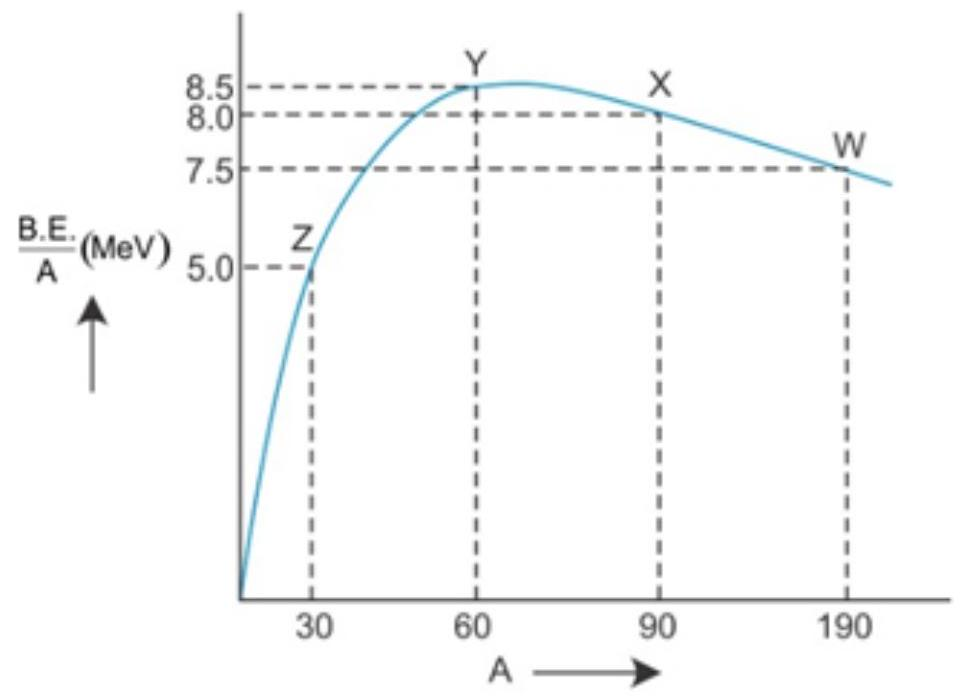
Binding energy per nucleon curve
Question
Identify which labelled nucleus is most suitable for (a) fission and (b) fusion. Justify using the features of the curve.
a) Likely fission nucleus: ______
b) Likely fusion nucleus: ______
Helpful Hints
Hint 1
Fission favours heavy nuclei with lower B.E./A.
Hint 2
Fusion is profitable when two light nuclei move up the curve.
Hint 3
Check slopes near A≈60 (peak) and A≈200 (valley).
Things to Consider
- Energy released ≈ Δ(B.E./A) × A.
- Peak stability occurs near iron (A≈56).
- Higher B.E./A means a more tightly bound nucleus.
Related Concepts
Question with Hints and Nudges
Electrostatic Potential & Capacitance
The Question:
Between parallel plates separated by distance \(d\) lies area \(A\). A slab of thickness \(t<d\) is inserted. (i) When the slab is a dielectric of relative permittivity \(\varepsilon_{r}\), derive the new capacitance \(C_{d}\). (ii) Repeat when the slab is a conductor and obtain \(C_{m}\). Express answers using \(A,d,t,\varepsilon_{0},\varepsilon_{r}\).
Helpful Concepts
- Capacitors in series share common charge.
- Dielectric introduces factor \(\varepsilon_{r}\) in field.
- A conductor nullifies electric field inside it.
Progressive Hints (Reveal only when needed)
Gentle Nudge
For the dielectric, treat the system as two capacitors: one filled with dielectric of thickness \(t\), the other air gap \(d-t\).
Direction Pointer
Write total potential as \(V=E_{1}t+E_{2}(d-t)\) with \(E_{1}= \frac{\sigma}{\varepsilon_{0}\varepsilon_{r}}\) and \(E_{2}= \frac{\sigma}{\varepsilon_{0}}\).
Guiding Framework
For the metal slab, the field inside it is zero, so effective plate spacing is \(d-t\). Hence \(C_{m}= \frac{\varepsilon_{0}A}{d-t}\), which is larger than \(C_{d}\).
Thinking Strategies
Slip-up Alert
Do not sum plate separations directly for a dielectric; treat potential drops separately.
Quick Fix
Write the electric field in each region, add the drops, then relate \(Q=CV\).
Visualize It
Sketch the slab between plates and label regions to see series arrangement.
Check Extremes
Let \(t=0\) and \(t=d\) to verify if your expressions reduce to known limits.
Struggle is normal! Try to solve on your own before checking the hints.
Question with Hints and Nudges
Electromagnetic Waves
The Question:
Match each band with its usual production mechanism:
(a) Infra-red (b) Radio (c) Visible light (d) Microwave
with
(i) molecular vibrations (ii) oscillating aerial electrons (iii) atomic electron transitions (iv) klystron/maser cavities.
Helpful Concepts
- Spectrum runs Radio → Microwave → IR → Visible → … (frequency rises).
- Sources depend on energy scale: bulk charges vs atomic events.
Progressive Hints (Reveal only when needed)
Recall Sources
Molecular vibrations emit IR; atom electron jumps give visible light.
Microwave
Microwaves are produced in resonant cavities such as klystrons or masers.
Radio
Radio waves arise from rapid oscillation of free electrons in an antenna.
Thinking Strategies
Common Mistake
Do not swap IR (low energy) with microwave sources.
Energy Check
Higher frequency bands require higher-energy processes; compare with frequency order.
Visualize It
Sketch the EM spectrum and label typical sources beside each region.
Test a Simpler Case
Ask: which source could you feel as heat? That guides IR placement.
Struggle is normal! Try to solve on your own before checking the hints.
Question with Hints and Nudges
Dual Nature (Photoelectric Effect)
The Question:
Three I–V curves A, B and C are obtained for the same metal. Rank the incident beams by (i) intensity and (ii) frequency. Explain your reasoning.
Curves not shown – focus on interpreting plateau and cut-off regions.
Helpful Concepts
- Saturation current indicates photon flux → intensity
- Stopping potential relates to photon energy → frequency
- Einstein equation \( eV_0 = h\nu - \phi \)
Progressive Hints (Reveal only when needed)
Gentle Nudge
First compare the plateau heights: a taller plateau means more emitted electrons.
Direction Pointer
Next, check which curve cuts off at the most negative voltage; that beam has the highest photon energy.
Guiding Framework
Identify any two curves with equal \( I_{\text{sat}} \): they share intensity. Any two with equal \( V_0 \) share frequency. Rank the odd one out accordingly.
Thinking Strategies
Common Error
Do not judge intensity from the stopping potential; they are unrelated.
Correct Approach
Treat current as a measure of how many electrons leave and voltage as how much energy each carries.
Visualize It
Sketch each curve, marking the plateau and zero-current points to see differences clearly.
Test a Simpler Pair
First compare just A and B. Once that pattern is clear, slot C into the order.
Struggle is normal! Try to solve on your own before checking the hints.
Full-Wave Rectifier Output
Semiconductor Electronics
The Question:
Identify blocks X and Y in an AC-DC converter and sketch their output waveforms. Predict what happens to the DC output when the transformer centre-tap is shifted toward diode \(D_{1}\).
No external diagram provided
Helpful Concepts
- Difference between rectifier and filter stages
- Each diode conducts during half of the input cycle
- Asymmetric secondary voltages change output amplitude and ripple
Progressive Hints (Reveal only when needed)
Block Roles
X contains the diodes that rectify; Y smooths the pulsating DC using a capacitor or inductor.
Ideal Output
First draw the full-wave pulsating DC from the bridge or centre-tap pair, then overlay the filtered, near-steady DC.
Tap Shift
If the centre-tap moves toward \(D_{1}\), one half-cycle gains voltage while the other loses it, giving a DC output with unequal peaks and a superimposed ripple bias.
Thinking Strategies
Common Mistake
Do not confuse amplitude change with frequency change; shifting the tap only alters voltage levels.
Fix
Sketch conduction intervals for each diode to visualise how unequal secondary voltages affect output.
Visualise It
Plot the original sine waves, then mark the rectified halves to see symmetry or lack of it.
Test a Simpler Case
Assume a small intentional offset in tap position and calculate resulting peak voltages before generalising.
Struggle is normal! Try to solve on your own before checking the hints.
Question with Hints and Nudges
Current Electricity
The Question:
A uniform 12 Ω wire is bent into a circle with points A, B, C and D marked clockwise. A 10 Ω resistor joins C and D, while an 8 V battery is connected between A and B. Find the current through arm A D.
Diagram not provided.
Helpful Concepts
- Symmetry in a circular resistor network
- Resistance ∝ subtended angle (\(60^{\circ}\Rightarrow2\,\Omega\))
- Kirchhoff’s loop & junction rules
Progressive Hints (Reveal only when needed)
Segment Resistances
Total 12 Ω over 360°. Each 60° arc is 2 Ω. Label A B, B C, C D, D A accordingly.
Bridge Equivalent
The four 2 Ω arms form a Wheatstone bridge; the 10 Ω resistor is the bridge between C and D.
Apply Kirchhoff
Write loop and junction equations for the two outer loops. Solve for branch currents, then read \(I_{AD}\).
Thinking Strategies
Pitfall
Don’t skip translating the circular geometry into resistances; symmetry only helps after that step.
Fix
First assign 2 Ω to each 60° segment, then reduce the network before writing equations.
Visualize It
Sketch the bridge with four equal arms and the 10 Ω resistor to see symmetry clearly.
Test a Simpler Case
Imagine the 10 Ω removed; check if currents split equally—then add it back to spot changes.
Struggle is normal! Try to solve on your own before checking the hints.
Question with Hints and Nudges
Electromagnetic Induction
The Question:
A coil with \(N\) turns and area \(A\) rotates at angular speed \( \omega \) in a uniform magnetic field \( B \). Derive an expression for the induced emf and state the physical source of this electrical energy.
No diagram provided
Helpful Concepts
- Faraday’s law: \( \varepsilon = -N \frac{d\phi}{dt} \)
- Flux: \( \phi = B A \cos(\omega t) \)
- Mechanical work converts to electrical energy
Progressive Hints (Reveal only when needed)
Gentle Nudge
Begin by writing magnetic flux through the coil as a time–dependent function.
Direction Pointer
Use \( \phi = B A \cos(\omega t) \) and apply Faraday’s law by differentiating with respect to time.
Guiding Framework
You should obtain \( \varepsilon = N B A \omega \sin(\omega t) \). Remember the energy comes from the external torque driving the coil.
Thinking Strategies
Break It Down
Express flux, then differentiate step-by-step; avoid sign errors.
Connect to Prior Knowledge
Recall Faraday’s minus sign indicates Lenz’s law.
Visualize It
Sketch coil at 0° and 90° to see how flux changes.
Test a Simpler Case
Analyse a single-turn loop; then extend to \(N\) turns.
Struggle is normal! Try to solve on your own before checking the hints.
Question with Hints and Nudges
Ray Optics — Total Internal Reflection
The Question:
A 45°–45°–90° prism has face AC immersed in a liquid of refractive index \( n=\frac{2}{\sqrt3} \). A ray enters normally at AB and strikes AC at \( 45^{\circ} \) inside the glass. Will it graze along AC, undergo total internal reflection, or refract into the liquid? Draw its path.
Diagram (if needed)
Helpful Concepts
- Snell’s law \( n_1 \sin i = n_2 \sin r \)
- Critical angle \( \sin \theta_c = \dfrac{n_2}{n_1} \) when \( n_1 > n_2 \)
- Relative refractive index \( \mu_\text{rel}= \dfrac{n_1}{n_2} \)
Progressive Hints (Reveal only when needed)
Find \( \mu_\text{prism} \)
For grazing emergence in air earlier, \( \sin 45^{\circ}=1/ \mu \). Hence \( \mu_\text{prism}= \sqrt2 \).
Compute \( \mu_\text{rel} \)
\( \mu_\text{rel}= \dfrac{\mu_\text{prism}}{n_l}= \dfrac{\sqrt2}{2/\sqrt3}= \frac{3}{2}=1.5 \).
Check critical angle
\( \sin \theta_c = 1/\mu_\text{rel}=2/3 \Rightarrow \theta_c \approx 41.8^{\circ} < 45^{\circ} \). The incident angle is larger—TIR occurs.
Thinking Strategies
Common Slip-up
Mixing up which medium is \( n_1 \) in Snell’s law.
How to Fix
Always write the incident side first: \( n_\text{incident}\sin i = n_\text{refracted}\sin r \).
Visualize Angles
Sketch the normal at AC and mark 45° to see if it exceeds \( \theta_c \).
Test a Simpler Case
Try \( n_l = 1 \) first. If TIR happens there, it must also happen for a denser liquid.
Struggle is normal! Try to solve on your own before checking the hints.
Question with Hints and Nudges
Atoms
The Question:
Explain why hydrogen, which has only one electron, still exhibits many spectral lines.
No diagram provided
Helpful Concepts
- Large ensemble of hydrogen atoms
- Discrete quantum energy levels
- Photon emission during level transitions
Progressive Hints (Reveal only when needed)
Population
Different atoms can start in different excited states.
Transitions
One electron may drop across many possible level gaps; each gap emits its own photon wavelength.
Series
Groups like Lyman, Balmer, and Paschen share a common lower level, so multiple photons form each series.
Thinking Strategies
Common Misconception
Do not assume a single electron gives only one line. Consider many atoms and many starting levels.
Clarify
Infinite atoms × multiple excited states produce a rich emission spectrum.
Visualize It
Sketch the energy level diagram and draw possible downward arrows.
Test a Simpler Case
Imagine only two upper levels; notice you already get several lines.
Struggle is normal! Try to solve on your own before checking the hints.
Key Take-aways
Formula Flash
Keep key relations ready: \(v=u+at\), \(E=h\nu\), \(Q=mc\Delta T\). No time for derivations.
Diagram First
Quick sketches of rays, fields, or circuits clarify data and earn method marks.
60-40 Split
Allocate 60 % time to short answers, 40 % to numericals; avoid last-minute panic.
Units & Sig-figs
Write SI units and correct significant figures; lose no easy marks.
Rough Work Code
Use side margins, label steps; evaluator spots each scoring point easily.
Mindful Review
Use last 10 min to check signs, powers, and decimals; rescue avoidable errors.