Atomic Hypothesis
Atoms in Perpetual Motion
All matter is made of tiny particles called atoms. These atoms move continuously, attract when slightly apart, and repel when forced together.
19th-century chemist John Dalton first used this idea to explain gas laws. Quiz: choose Dalton, Maxwell, Einstein, or Feynman.
Gas Molecules in Motion
Random motion and collisions build up gas pressure.
What the image shows
Straight-line motion is interrupted by collisions; wall hits transfer momentum as tiny pushes.
- Molecular motion is random but constant.
- Collisions are elastic—speed changes, energy conserved.
- Each wall collision exerts force; many together give pressure \(P\).
- Pressure formula: \(P = \frac{F}{A}\).
Tip: Hotter gas → faster molecules → more frequent, harder hits → higher pressure.
Ideal Gas Equation
Variable Definitions
Applications
Predict Gas Behaviour
Find new pressure or volume when a tyre heats up.
Cylinder Storage Design
Calculate volume needed to store industrial gases safely.
Micro-Macro Link
Relate molecular count \(N\) to macroscopic \(P\) and \(V\).
Boyle’s Law Snapshot
Pressure × Volume = constant (temperature fixed)
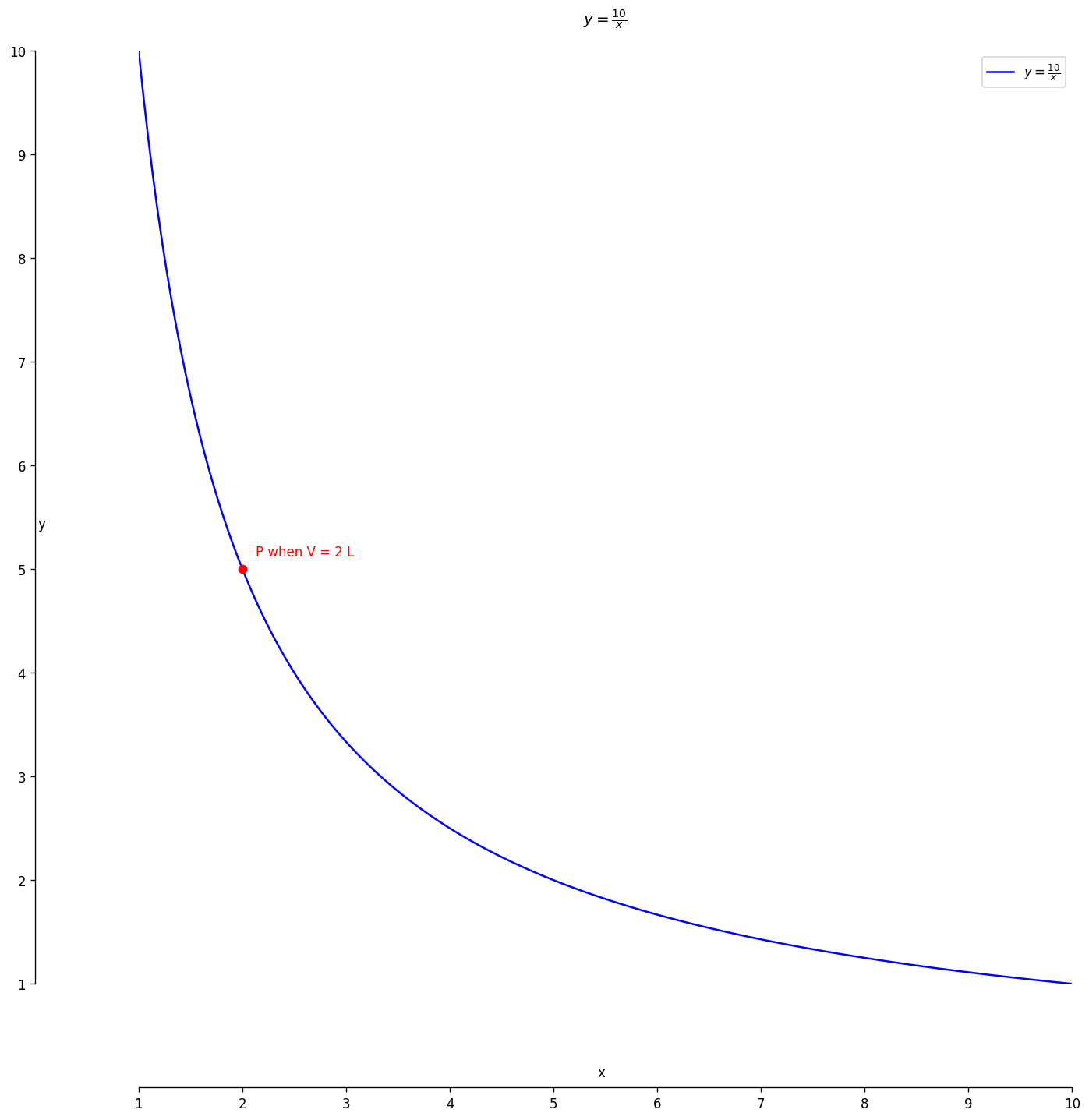
What the image shows
Keeping temperature steady, volume shrinks and pressure rises in exact inverse proportion.
- Temperature \(T\) remains constant.
- Volume ↓ ⇒ molecules hit walls more often.
- Law: \(P \propto \frac{1}{V}\) or \(PV = k\).
Tip: Double the volume and pressure halves—an easy way to spot Boyle’s Law in action.