Kinetic Theory Tiny particles, giant explanations.

Matter is Particles

Atomic Hypothesis

All matter is made of tiny particles—atoms or molecules—that move nonstop, attract a little when apart, and repel when crowded.

Think of three everyday objects that must be built from such moving particles.

Ideal Gas Law

\[P V = \mu R T\]

This single equation links a gas’s pressure, volume, moles and absolute temperature.

Variable Definitions

\(P\) Pressure of the gas (Pa)
\(V\) Volume of the gas (m³)
\( \mu \) Amount of gas in moles
\(R\) Universal gas constant (8.31 J mol⁻¹ K⁻¹)
\(T\) Absolute temperature (K)

Applications

Solve Unknowns

Rearrange to find any missing variable in gas-law problems.

Tyre Pressure vs Heat

Predict how driving warms tyres and raises pressure.

Laboratory to STP

Convert measured volumes to standard temperature and pressure.

Real vs Ideal

deviation curves

Deviation Curves & Ideal Behaviour

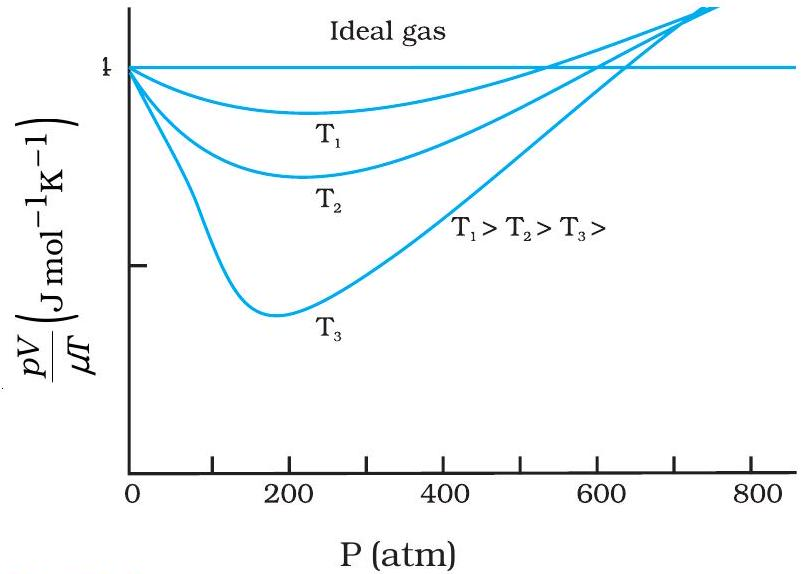
Plot of compressibility factor \(Z\) against pressure shows real-gas deviation curves.

At very low pressure and high temperature, the curve meets the straight ideal line \(Z = 1\), so the gas behaves ideally.

Key Points:

  • Deviation curve dips below ideal line: \(Z < 1\) due to attractive forces.
  • Curve rejoins at low \(P\) & high \(T\) when forces and collision frequency drop.
  • Rise at high \(P\) (\(Z > 1\)) comes from finite molecular volume.

Boyle’s Law

Follow these three quick steps to predict how pressure changes when volume changes at constant temperature.

1

State the Law

At constant \(T\), gas pressure is inversely proportional to volume: \(P \propto \frac{1}{V}\).

2

Change the Volume

Halve the volume: \(V \rightarrow \frac{V}{2}\).

3

Predict the Pressure

Because \(P \propto \frac{1}{V}\), halving \(V\) doubles the pressure: \(P \rightarrow 2P\).

Pro Tip:

Quiz yourself: If the volume doubles instead, pressure drops to half. Why?

Pressure Explained

https://asset.sparkl.ac/pb/sparkl-vector-images/img_ncert/se6cLiiWIpAIWKWyrWMgFJsFihGEXtzzY3jcjVPV.png

From Collisions to Pressure

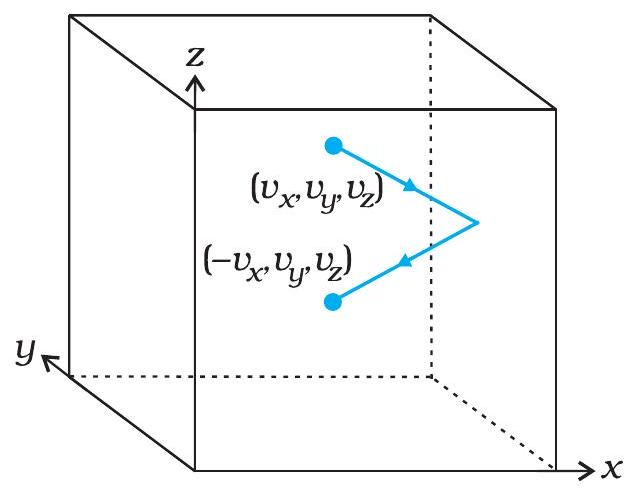
Gas molecules move randomly, making countless molecular collisions with the container walls.

Each collision flips the molecule’s perpendicular velocity, delivering a tiny impulse to the wall.

Key Points:

  • Momentum change \( \Delta p \) on each hit gives the wall an impulse.
  • Many impulses per second create a steady force \( F \).
  • Pressure \( P = \frac{F}{A} \) links these wall hits to observable gas pressure.

Temp = Kinetic Energy

1

Measure Temperature (K)

Record gas temperature in kelvin to link it directly with energy.

2

Relate KE to T

Use \( \tfrac{1}{2} m v^{2} = \tfrac{3}{2} k_{B} T \); therefore \( KE \propto T \).

3

Infer Molecular Speed

Higher \( T \) raises \( v^{2} \); molecules move faster in hotter gas.

Multiple Choice Question

Question

If the absolute temperature of an ideal gas triples, what happens to the root-mean-square speed of its molecules?

1
Remains the same
2
Becomes three times
3
\(\sqrt{3}\) times the original value
4
Reduces to one-third

Hint:

Remember: \(v_{\text{rms}} \propto \sqrt{T}\).

Key Takeaways

Gas is a collection of randomly moving molecules.

Equation \(PV = \mu RT\) links pressure, volume and absolute temperature.

Low pressure and high temperature give near-ideal behaviour.

Pressure arises from molecules hitting container walls.

Higher temperature means higher average molecular speed.

Thank You!

We hope you found this lesson informative and engaging.