What Is ‘Invictus’?
Invictus
Latin for “unconquered”. The poem declares that no matter the struggle, our spirit can remain undefeated.
The title itself sums up the poem’s purpose: to inspire unbreakable resolve.
Poem in 4 Steps
Think of each stanza as one quick move in a four-part journey.
Facing Darkness
The speaker stands firm in night and hardship, setting the theme of inner resilience.
Unbowed Spirit
Blows may fall, yet the voice does not wince or cry—pain tests but cannot break resolve.
Beyond Fear
Even the thought of death’s gates cannot scare the speaker; courage extends past life itself.
Self-Mastery
The journey ends with the bold claim: “I am the master of my fate, captain of my soul.”
Pro Tip:
Match each stanza to its “step” to recall the poem’s flow and focus in seconds.
Big Idea: Resilience
Resilience
Resilience means bouncing back when life knocks you down.
Key Characteristics:
- Key theme in “Invictus”: the spirit stays unbowed.
- Everyday picture: a spring pops back after pressure.
Example:
“I am the master of my fate”—the speaker stands tall, refusing to stay down.
Multiple Choice Question
Question
“Invictus” mainly urges us to:
Hint:
Use your immediate comprehension: the poem praises resilient self-belief.
Correct!
Yes — the poem celebrates unbreakable inner strength and self-mastery.
Incorrect
Review the poem: it praises inner resilience, not fear or luck.
Simile in Action
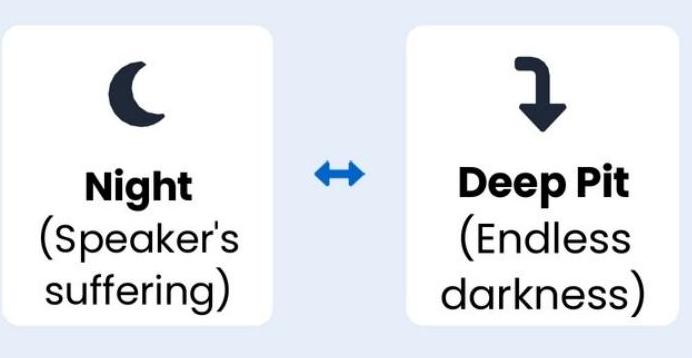
Line 2 Simile: “Black as the pit”
The phrase “Black as the pit from pole to pole” uses as to compare night to a deep, endless pit.
It shows the speaker’s struggle feels world-wide and bottomless, painting a vivid picture of total darkness.
Key Points:
- A simile compares two things using “like” or “as”.
- Here, endless darkness = deep pit → struggle feels global and inescapable.
Match Line to Meaning
Line comprehension and vocabulary practice: drag each poem line to the box that states its meaning.
Draggable Items
Drop Zones
Inner strength
Outside trouble
Hope for future
Tip:
Look for key words like “fate”, “chance”, or “wrath” to spot each theme.
Results
Key Takeaways
Invictus means “unconquered” — remember the title.
Theme: inner resilience defeats outer hardship.
Closing line: “I am the master of my fate; I am the captain of my soul.”
Next Steps
Read the poem aloud and feel its steady beat.
Thank You!
We hope you found this lesson informative and engaging.