Friction Basics Where motion meets resistance—and sparks understanding.

What is Friction?

Friction

Friction is a contact force that acts parallel to the common surface and always opposes impending or actual relative motion between the surfaces.

Pause & think: Could you walk if friction suddenly vanished?

Static vs Kinetic

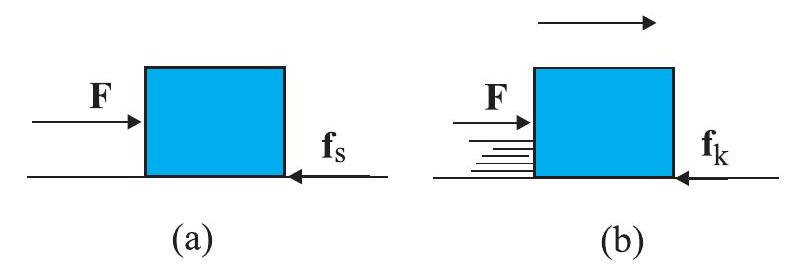
Block showing static and kinetic friction forces

Spot the difference

Static friction \(f_s\) rises from zero up to its maximum value \((f_s)_{\text{max}}=\mu_s N\) to keep the body at rest.

After motion starts, kinetic friction \(f_k=\mu_k N\) acts; it stays nearly constant and is smaller than \((f_s)_{\text{max}}\).

Key Points:

  • \((f_s)_{\text{max}} > f_k\); extra push needed to start motion.
  • Both forces act parallel to surfaces, opposite to motion or its tendency.
  • Magnitudes depend on surface pair via coefficients \(\mu_s\) and \(\mu_k\).

μ — The Friction Factor

Coefficient of Friction (μ)

Dimensionless ratio of limiting friction to the normal reaction between two surfaces.

Key Characteristics:

  • Static: \( \mu_s = \frac{f_s^{\text{max}}}{N} \)
  • Kinetic: \( \mu_k = \frac{f_k}{N} \)
  • Depends only on material pair and surface condition.
  • Usually \( \mu_s > \mu_k \).
  • Independent of mass and apparent contact area.

Example:

Dry wood on wood: \( \mu_s \approx 0.4 \), \( \mu_k \approx 0.3 \).

Friction on an Incline

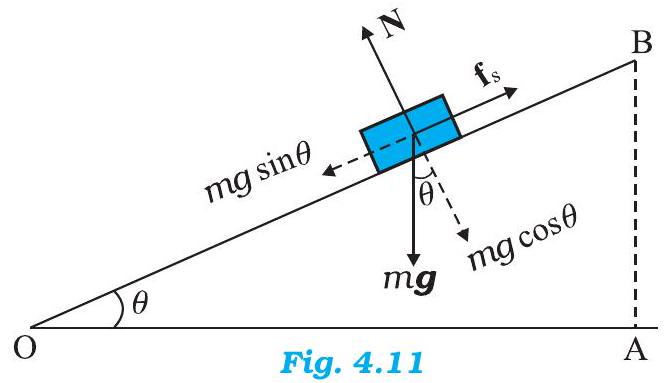
Block on an inclined plane forces diagram

Block on inclined plane showing weight components and friction

Forces on the Block

A block of mass \(m\) rests on a rough incline at angle \(\theta\).

Its weight splits into \(mg\cos\theta\) (normal) and \(mg\sin\theta\) (down-slope).

Key Points:

  • Static friction \(f_s\) acts up the plane, balancing \(mg\sin\theta\) while \(f_s \le \mu_s N\).
  • Limiting case: \(f_s^{\text{max}} = \mu_s N = mg\sin\theta_r\) with \(N = mg\cos\theta_r\).
  • Angle of repose: \(\theta_r = \tan^{-1}\mu_s\); beyond it the block begins to slide.

Force vs Friction Curve
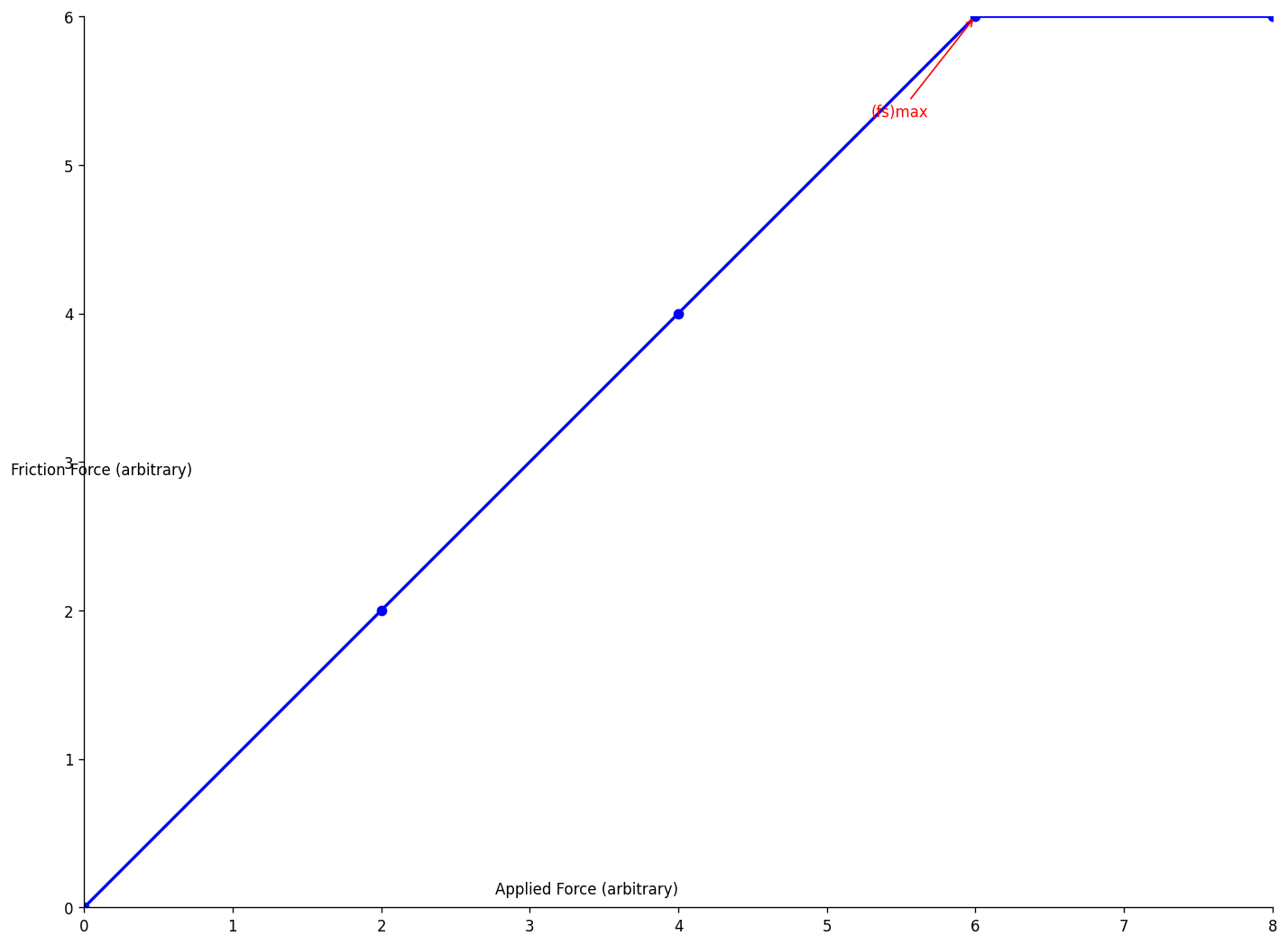
Force vs Friction Curve

Static–Kinetic Transition

In the static region, friction \(f_s\) equals the applied force, giving a straight 45° line.

At \((f_s)_{\text{max}}\) the object slips; friction drops to the lower, nearly constant kinetic value \(f_k\).

Key Points:

  • \(f_s\) rises linearly with applied force.
  • Peak \((f_s)_{\text{max}}\) marks the breakaway point.
  • Post-slip friction ≈ constant kinetic value \(f_k\).

Multiple Choice Question

Question

A 5 kg box stays at rest when a 12 N horizontal force pushes it. Which statement is true?

1
Static friction on the box is 12 N opposite to the push.
2
Kinetic friction on the box is 12 N opposite to the push.
3
No friction acts because the box does not slide.
4
The box moves because 12 N exceeds maximum static friction.

Hint:

Since the box is at rest, think about static friction matching the applied force up to its limit.

Key Takeaways

Definition

Friction is a parallel contact force opposing imminent or actual sliding.

Coefficient \( \mu \)

Magnitude \(F = \mu N\); μ reflects material pair, surface finish, temperature, and contaminants.

Static vs Kinetic

Static friction rises to \( (\!f_s)_{\max} = \mu_s N\); once moving, \(f_k = \mu_k N\) stays lower.

Graph Shape

Curve climbs linearly, peaks, then drops abruptly to a nearly constant kinetic level.

Applications

Lubricants, bearings, brakes, and tyre treads let engineers reduce or exploit friction as needed.