Let’s Meet Friction Where surfaces meet, motion meets resistance.

What is Friction?

Friction

Friction is a contact force that opposes the relative motion, or the tendency to move, between two surfaces in contact.

Cause: Microscopic roughness makes the surfaces interlock, generating the resisting force. Quick check—slide your palm across the desk; which contact force pushes back?

Static vs Kinetic

https://asset.sparkl.ac/pb/sparkl-vector-images/img_ncert/va9FCDQTW0jh5tmw0xgLL5.png

Static vs Kinetic Friction

When you push a resting crate, friction first matches your effort and keeps it still.

Once the crate slides, a weaker but steady friction resists its motion.

Key Points:

  • Static friction: variable, equals applied force up to \(f_s^{\text{max}}\).
  • Kinetic friction: constant \(f_k\) after motion starts, and \(f_k < f_s^{\text{max}}\).
  • Direction: always opposite to intended or actual motion.

Laws of Friction

\[f_s \le \mu_s N,\; \qquad f_k = \mu_k N\]

(with \(\mu_k < \mu_s\))

Variable Definitions

\(f_s\) static friction force
\(f_k\) kinetic friction force
\(\mu_s\) coefficient of static friction
\(\mu_k\) coefficient of kinetic friction
\(N\) normal reaction force

Applications

Predict Motion Start

Compare applied force with \(f_s^{max} = \mu_s N\) to see if the body moves.

Calculate Sliding Force

Use \(f_k\) to find net force and acceleration once motion begins.

Design Safety

Select high-\(\mu_s\) materials for better grip in tyres and shoes.

Friction vs Load

https://asset.sparkl.ac/pb/sparkl-vector-images/img_ncert/NKNKridIlgakcy8oCjOvT4YiI6a1b6GfxmnUYG4V.png

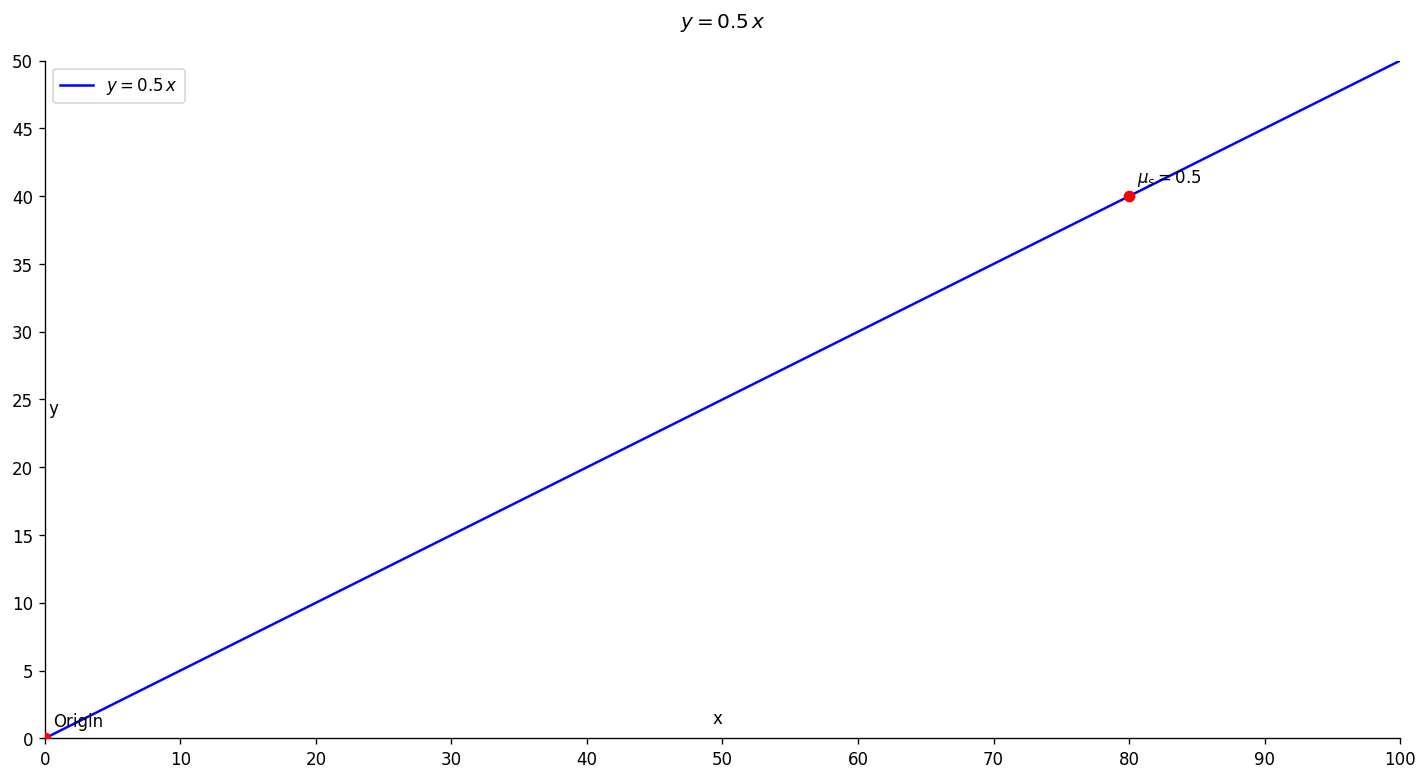
Graph of limiting static friction (Flim) versus normal force (N)

Graphical insight

The straight line starts at the origin, so limiting static friction \(F_{\text{lim}}\) is zero when normal force \(N\) is zero.

Slope of the line equals coefficient of static friction: \( \mu_s = \frac{F_{\text{lim}}}{N} \).

Key Points:

  • Linear graph shows direct proportionality \(F_{\text{lim}} \propto N\).
  • Double \(N\) ⇒ double \(F_{\text{lim}}\).
  • Gradient gives \( \mu_s \), a constant for the contact pair.

Key Takeaways

Quick recap before practice problems.

🖐️

Contact force

Acts only when two surfaces are in contact.

🛑

Static first

Static friction self-adjusts up to \( \mu_s N \) to block motion.

➡️

Kinetic next

Once motion starts, kinetic friction stays \( \mu_k N \) with \( \mu_k < \mu_s \).

📈

Proportional

Magnitude of friction is directly proportional to normal reaction \( N \).

🎮

Control factors

Changing surface pair \( \mu \) or load \( N \) alters frictional limits.