What is an Ellipse?
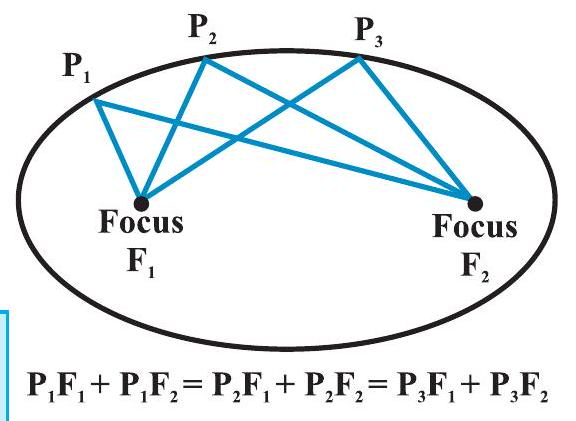
Fig 10.20 | Ellipse with foci \(F_1,F_2\); blue segments keep constant sum.
Formal Definition (Definition 4)
Definition 4: An ellipse is the locus of points whose distances to two foci add to a constant.
Thus, for every point \(P\), \(PF_1 + PF_2 = 2a\), a fixed length greater than \(F_1F_2\).
Key Points:
- \(F_1\) and \(F_2\) are the fixed foci.
- Blue segments in Fig 10.20 mark \(PF_1\) and \(PF_2\).
- Their sum stays constant (\(2a\)), keeping \(P\) on the ellipse.
Key Parts of an Ellipse
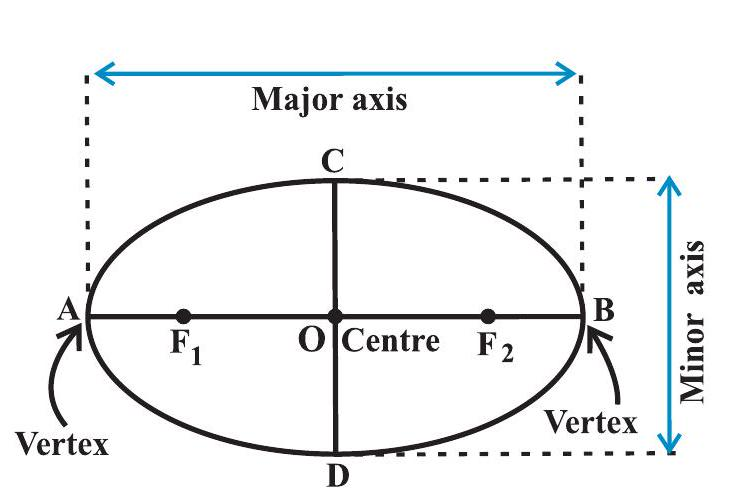
Fig 10.21 — Ellipse showing major and minor axes
Centre, Axes & Vertices
Look at Fig 10.21 and match each label. After this, you should name the centre, vertices, major and minor axes with ease.
Key Points:
- Major axis — longest line through both foci.
- Minor axis — shortest line, perpendicular to major axis at the centre.
- Vertices — two endpoints of the major axis.
- Centre — midpoint of the line joining the foci.
Meet a, b and c
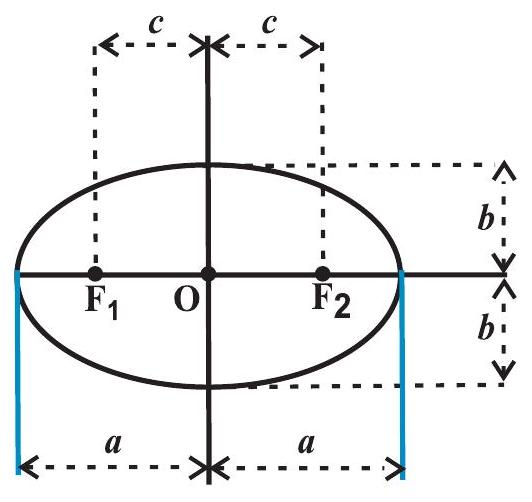
Parameters of an Ellipse
In Fig 10.22 and Fig 10.23, three numbers fully describe any ellipse drawn with centre O.
Know them, and you can link the semi-axes to the focus distance.
Key Points:
- \(a\): semi-major axis
- \(b\): semi-minor axis
- \(c\): centre \(\rightarrow\) focus distance
- Relationship: \(a^{2}=b^{2}+c^{2}\)
Standard Equations
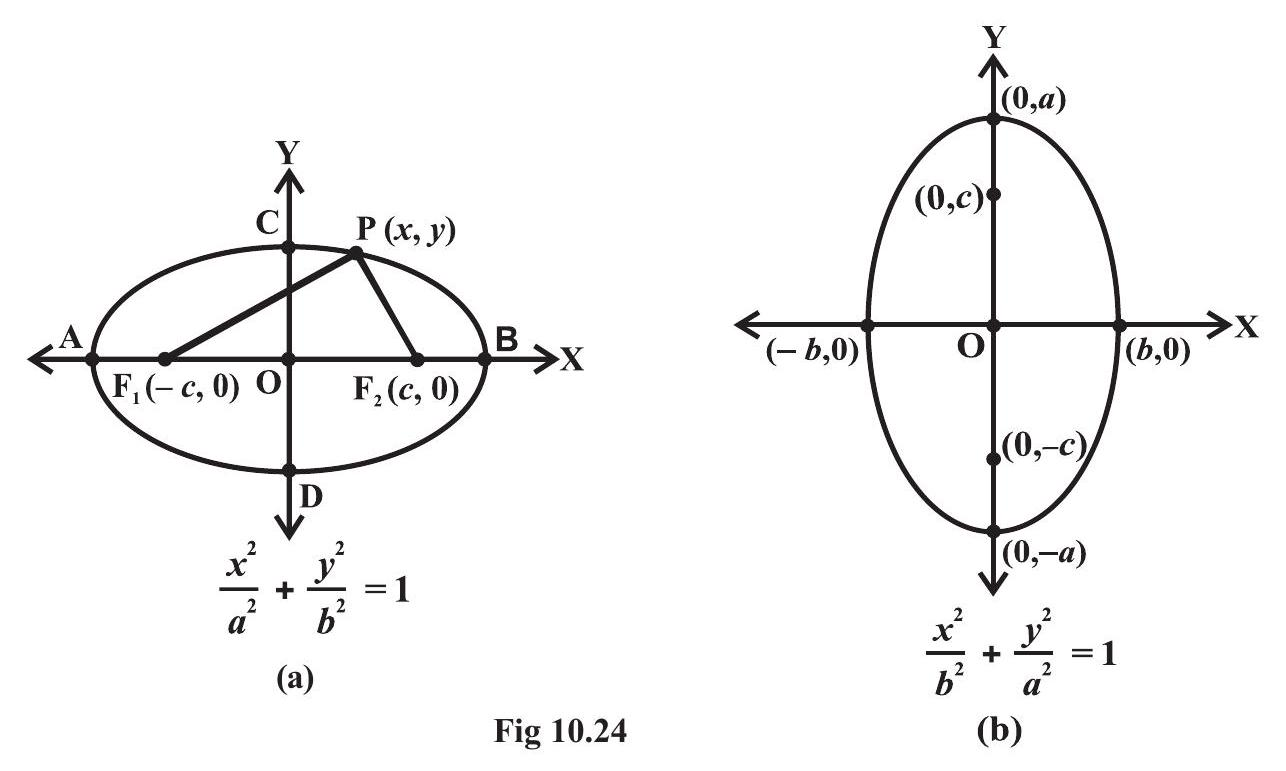
Fig 10.24 • Ellipse with centre at O(0,0)
Centre at (0, 0)
A centred ellipse has two orientations decided by its major axis.
Here \(a\) is the semi-major length and \(b\) the semi-minor, with \(a > b\).
Key Points:
- Major axis on x-axis: \( \frac{x^{2}}{a^{2}} + \frac{y^{2}}{b^{2}} = 1 \)
- Major axis on y-axis: \( \frac{x^{2}}{b^{2}} + \frac{y^{2}}{a^{2}} = 1 \)
Deriving x²/a² + y²/b² = 1
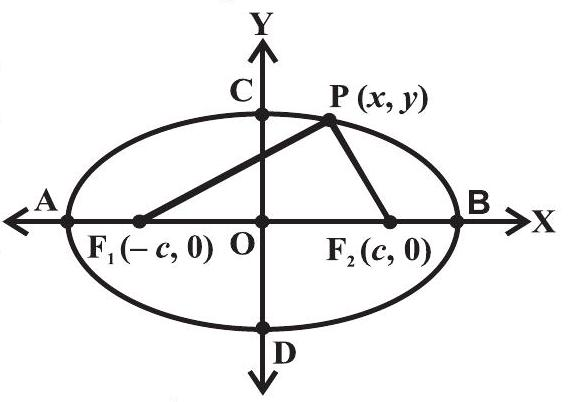
Fig 10.25 – Point P on an ellipse with foci \(F_1,F_2\)
From Distance Rule to Standard Equation
Fig 10.25 places \(P(x,y)\) on an ellipse whose foci are \(F_1(-c,0)\) and \(F_2(c,0)\).
By definition, the sum of distances satisfies \(PF_1 + PF_2 = 2a\).
Key Steps:
- Substitute \(PF_1=\sqrt{(x+c)^2+y^2}\) and \(PF_2=\sqrt{(x-c)^2+y^2}\).
- Square once to remove one root; rearrange terms.
- Square again to clear remaining radical.
- Use \(b^{2}=a^{2}-c^{2}\) to obtain \( \frac{x^{2}}{a^{2}} + \frac{y^{2}}{b^{2}} = 1\).
Latus Rectum
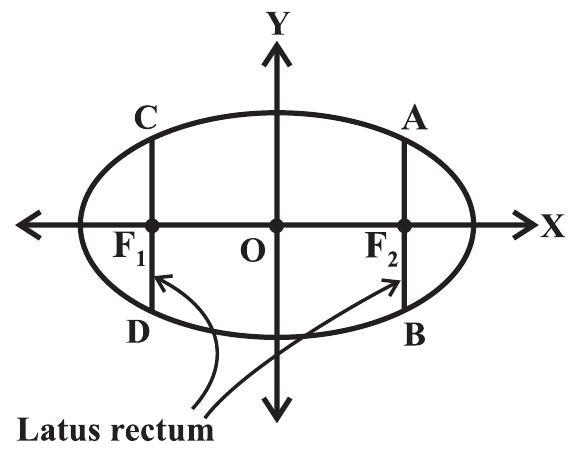
Chord Through the Focus
The latus rectum is the chord that passes through a focus and is perpendicular to the major axis.
Knowing its length lets us quickly compare the “width” of different ellipses at their foci.
Key Points:
- Length \(= 2\frac{b^{2}}{a}\)
- Uses semi-major axis \(a\) and semi-minor axis \(b\).
- Referenced in Sec. 10.5.4 and Fig 10.26.