What Is a Cell?
Cell
Smallest living unit that can grow, reproduce, and perform all chemical reactions needed for life.
Unicellular: one cell manages every task. Multicellular: many specialised cells share the work.
Cell Theory
1
Matthias Schleiden (1838)
Every plant is built of cells; the cell is the basic structural unit.
2
Theodor Schwann (1839)
All animals are also cellular, revealing a universal “unit of life.”
3
Rudolf Virchow (1855)
New cells originate only from pre-existing cells—Omnis cellula e cellula.
Pro Tip:
Remember these three pillars—structure, universality, continuity—to quickly recall NCERT § 8.2 and restate cell theory.
Inside a Typical Cell
Main Points
- 1 Plasma membrane
- 2 Cytoplasm
- 3 Nucleus
Key Highlights
-
Selective barrier controlling what enters/leaves.
-
Fluid matrix hosting organelles and reactions.
-
DNA vault; issues genetic instructions.
-
Detailed in NCERT §8.3.
Two Cell Worlds (8.4 & 8.5)
Prokaryote
Size : 1–5 µm
No membrane-bound nucleus
70S ribosomes
Rapid binary fission
Eukaryote
Size : 10–20 µm
True, membrane-bound nucleus
80S ribosomes
Membrane-bound organelles
Key Similarities
Both have a plasma membrane
Both contain DNA
Both perform metabolism
Sizing Up Cells
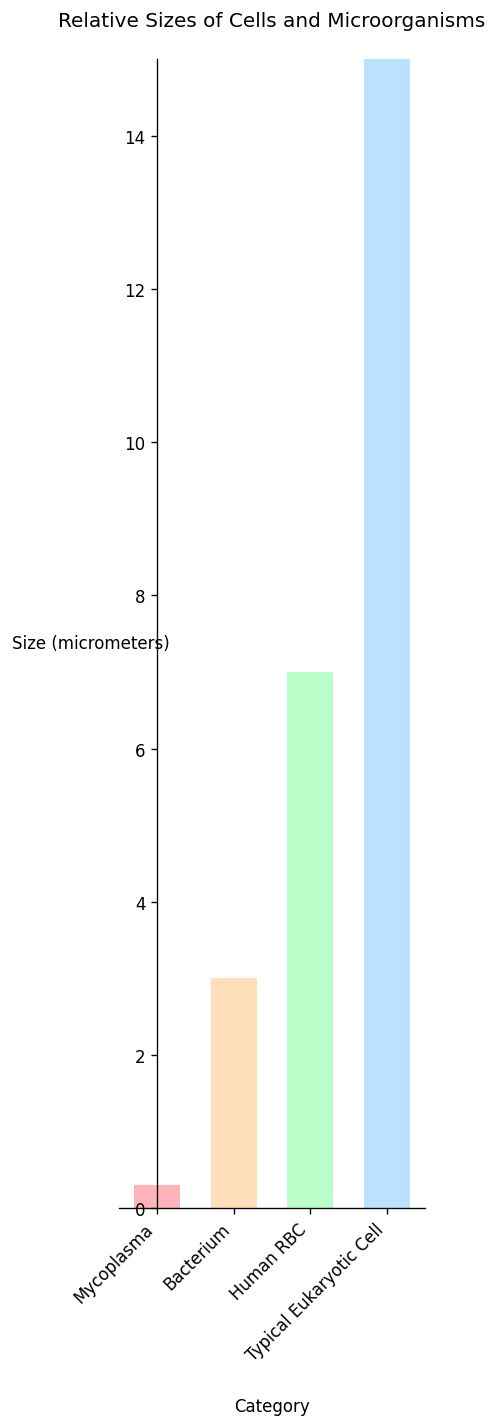
Relative sizes of various cells (log scale)
Cell size spans several powers of ten
Section 8.4 shows that cells vary from sub-micrometre microbes to egg cells large enough to see.
Comparing familiar examples helps you visualise this extraordinary range.
Key Points:
- Mycoplasma — ~0.1 µm, one of the smallest living cells.
- Escherichia coli — ~1 µm rod-shaped bacterium.
- Human red blood cell — ~7 µm diameter.
- Typical plant/animal cell — 20–30 µm.
- Ostrich egg — ~170 mm, the largest known single cell.