Meet the Parabola
Parabola
A parabola is the characteristic U-shaped graph of any quadratic function \(y = ax^{2} + bx + c\) with \(a \neq 0\).
Quick check: Which coefficient guarantees the curve is quadratic?
Basic Upward Curve
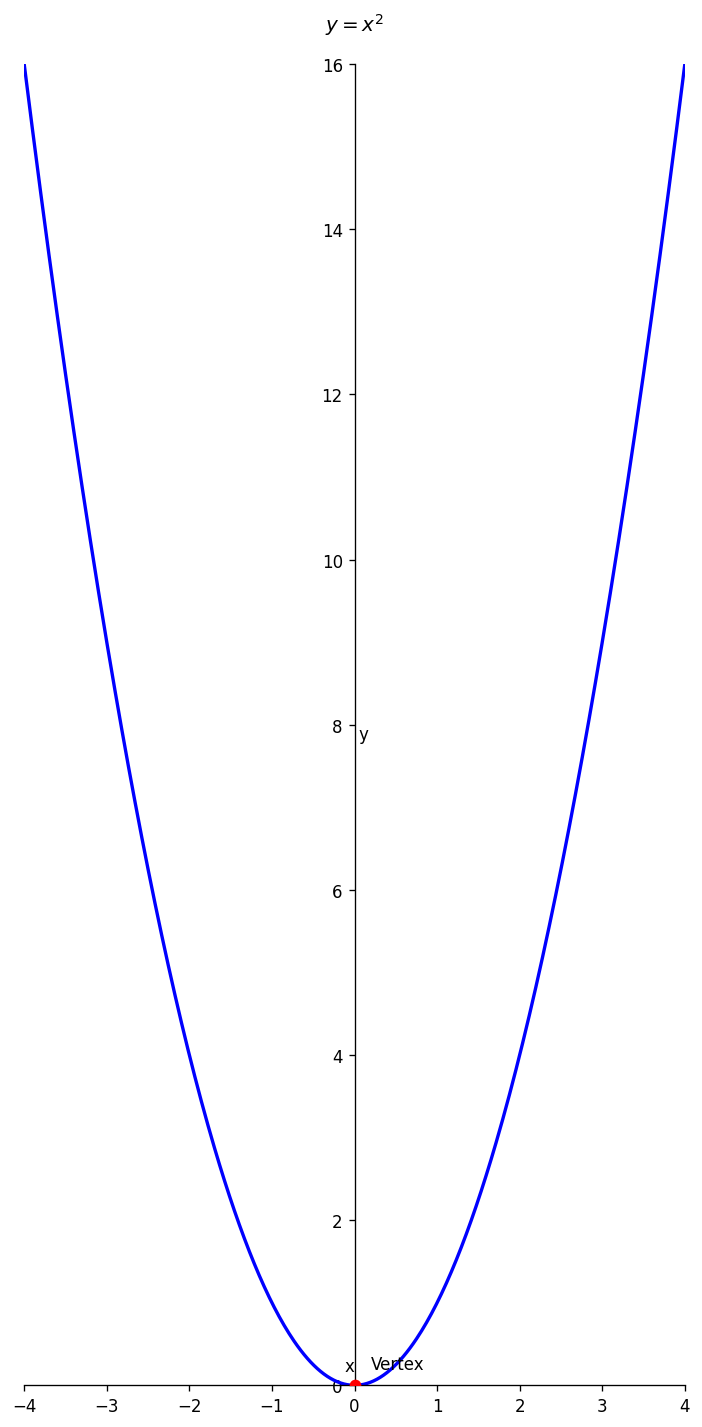
Graph of \(y = x^{2}\)
Graph of \(y = x^{2}\)
The curve \(y = x^{2}\) is the base graph for all quadratic functions.
It opens upward, is symmetric about the y-axis, and its vertex—the lowest point—lies at the origin \((0,0)\).
Key Points:
- Base graph for quadratic functions
- Vertex at \((0,0)\)
- Symmetric about the y-axis
Opening Downward
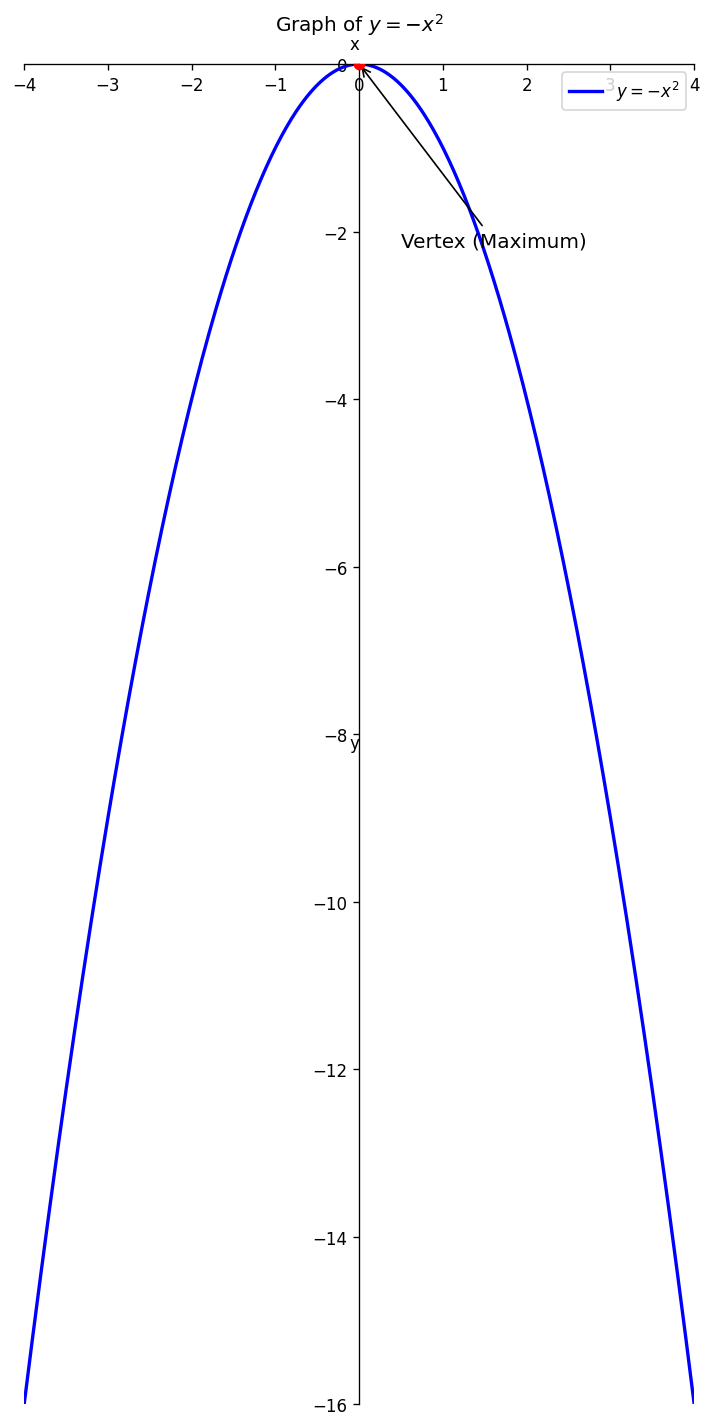
Effect of Negative \(a\)
When \(a < 0\), the parabola opens downward.
The graph is a reflection of the upward curve across the \(x\)-axis.
Its vertex now marks the maximum value of the quadratic.
Key Points:
- Coefficient \(a < 0\) ⇒ concave down.
- Vertex becomes the maximum point.
- Downward graph mirrors the \(a > 0\) case.
Finding the Vertex
Start with the general quadratic.
Factor out \(a\) from the \(x\) terms.
Complete the square inside the bracket.
Simplify the constant term.
Set the squared term to zero to get the x-coordinate.
Key Insight:
Completing the square reveals the vertex formula \(x = -\frac{b}{2a}\), essential for graphing any quadratic.
Shifted & Stretched
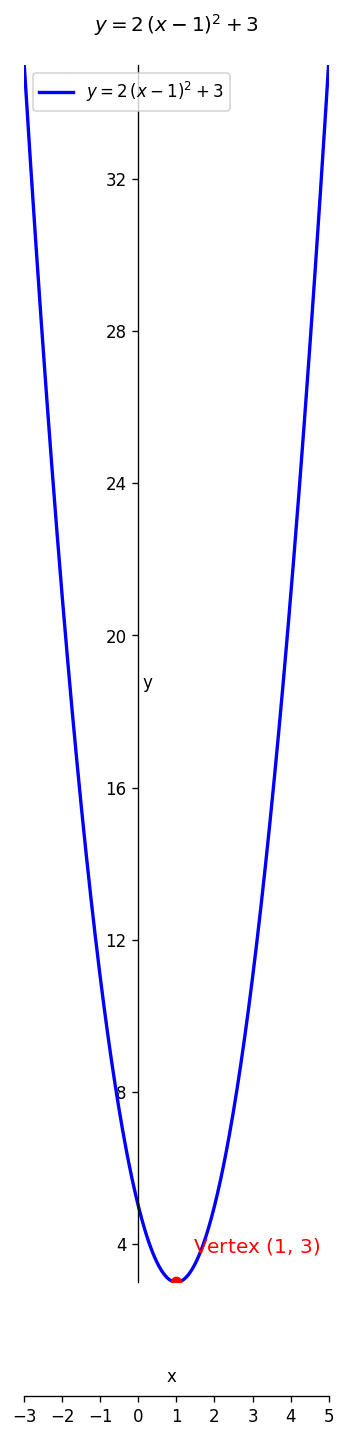
Graph of \(y = 2(x-1)^2 + 3\)
Translation & Dilation Explained
Compare the parent curve \(y = x^{2}\) to \(y = 2(x-1)^{2}+3\).
The new coefficients show how far the graph slides and how much it stretches.
Key Points:
- Horizontal translation: \(x \rightarrow x-1\) moves the graph 1 unit right.
- Vertical translation: \(+3\) lifts every point 3 units up.
- Dilation: coefficient \(a = 2\) causes a vertical stretch, making the parabola narrower.
- Resulting vertex: \((1,\,3)\).