What is a Parabola?

Parabola

A parabola is a smooth, U-shaped curve produced by the graph of any quadratic equation \(y = ax^{2} + bx + c\).

Key Characteristics:

  • Symmetric about its vertex.
  • Opens up when \(a > 0\); down when \(a < 0\).
  • Represents every quadratic equation.

Example:

The curve of \(y = x^{2}\) is an upward-opening parabola.

General Quadratic Form

\[y = ax^2 + bx + c\]

Identify \(a\), \(b\), \(c\) to predict how the parabola looks.

Variable Definitions

a Opens up/down & sets width
b Moves axis of symmetry
c Y-intercept (vertical shift)
x Independent variable
y Dependent output value

Applications

Quick Sketch

Use signs of \(a, b, c\) to foresee opening and intercept before drawing.

Physics Trajectories

Changing coefficients alters a projectile’s height, range, and symmetry.

```html

Base Shape y = x²

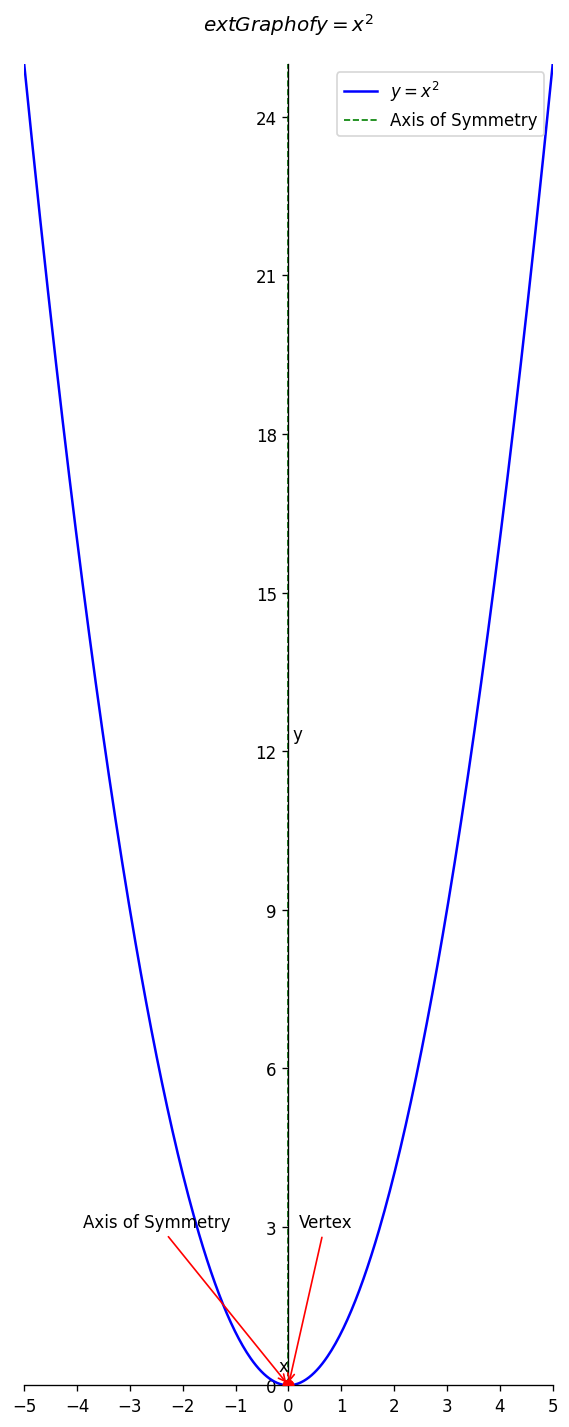
Graph of y = x^2

Graph of \(y = x^{2}\)

Parent Quadratic Graph

The parent curve \(y = x^{2}\) forms a smooth U-shape called a parabola.

It is perfectly symmetric about the y-axis.

The lowest point, or vertex, is at the origin \((0,0)\).

Key Points:

  • Opens upward, creating a U-shape.
  • Axis of symmetry: \(x = 0\).
  • Vertex at \((0,0)\) is the minimum.
  • Passes through \((\pm1,1)\).
``````html

Changing 'a' − Stretch & Flip

https://asset.sparkl.ac/pb/sparkl-vector-images/img_ncert/ZlVFJCnGw2rX8WnX9bTE505OybXJmqkbacO0XMgX.png

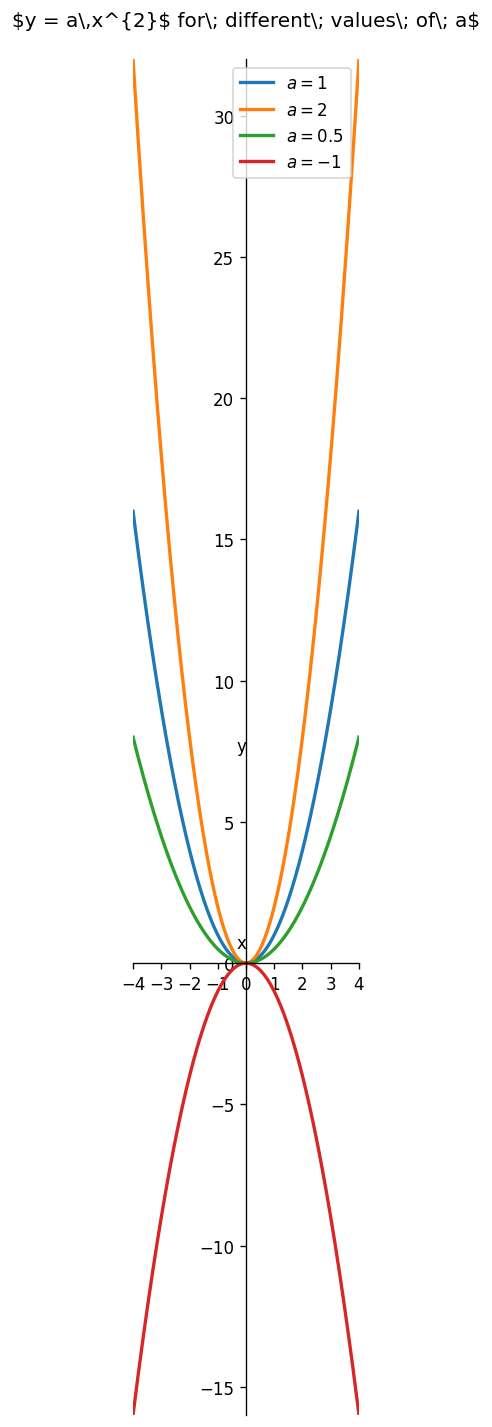
Parabolas for varying values of \(a\)

Effect of coefficient \(a\)

Magnitude decides the width; sign decides the opening.

Key Points:

  • \(|a| > 1\): Narrow, vertically stretched.
  • \(0 < |a| < 1\): Wide, vertically shrunk.
  • \(a < 0\): Parabola reflects and opens downward.
``````html

Upward vs Downward

Opens Up (a > 0)

Sign of \(a\) is positive.
U-shaped; arms rise as \(|x|\) increases.
Vertex gives the minimum \(y\)-value.

Opens Down (a < 0)

Sign of \(a\) is negative.
∩-shaped; arms fall as \(|x|\) increases.
Vertex gives the maximum \(y\)-value.

Key Similarities

Both are parabolas of \(y = ax^{2} + bx + c\).
Axis of symmetry at \(x = -\frac{b}{2a}\).
Vertex is the graph’s extreme point.
``````html

Role of 'c' − Y-Intercept

https://asset.sparkl.ac/pb/sparkl-vector-images/img_ncert/ViSR6jG3olNOfU9Bavh6EVlSjJV7OIqbcFJVzuO0.png

Constant Term ‘c’

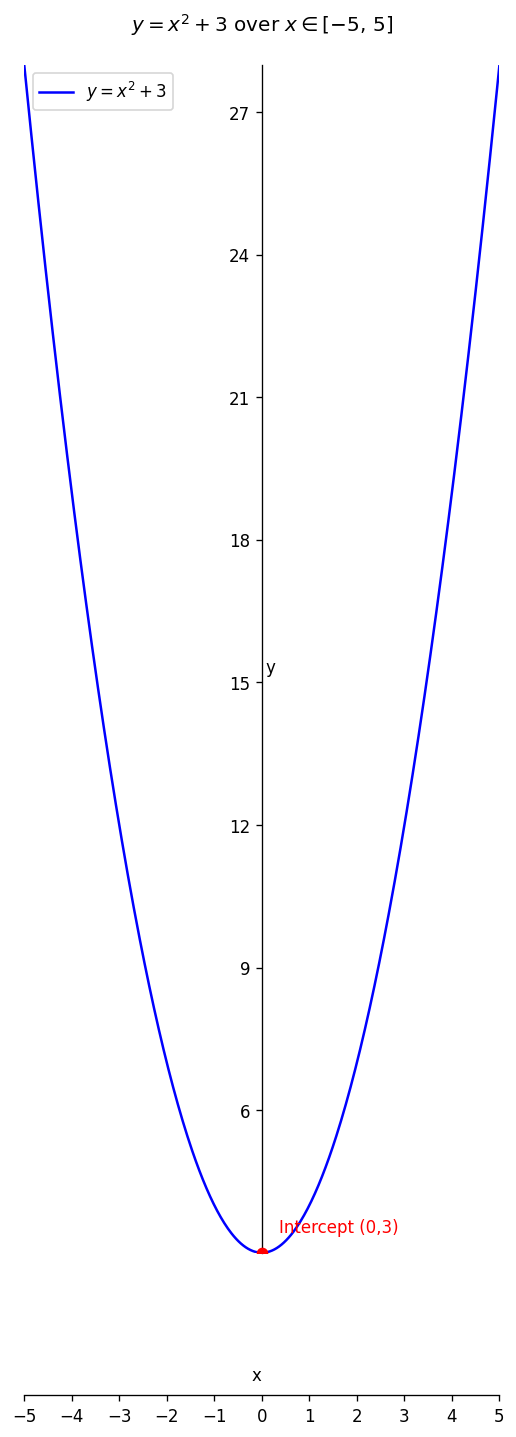
In \(y = ax^2 + bx + c\), the constant term sets the graph’s vertical position.

It equals the y-value when \(x = 0\); this fixes the y-intercept.

Key Points:

  • Increase c → graph slides up; width and direction unchanged.
  • Decrease c → graph slides down; same shape remains.
  • Only the y-intercept and vertex height shift by c.
```

Quick Check

Question

For the parabola \(y = x^{2} + 4x + 1\), what is the x–coordinate of its axis of symmetry?

1
\(x = -4\)
2
\(x = -2\)
3
\(x = 2\)
4
\(x = 4\)

Hint:

Use the formula \(-\frac{b}{2a}\) to locate the axis of symmetry.

Key Takeaways

Coefficient \(a\): sign flips the opening; larger \(|a|\) narrows, smaller widens.

Coefficient \(b\): shifts the vertex sideways, giving the graph its horizontal position.

Coefficient \(c\): raises or lowers the whole parabola; the y-intercept is \((0,c)\).

Master these three moves to sketch any quadratic quickly and accurately.

Thank You!

We hope you found this lesson informative and engaging.