Meristematic Tissue
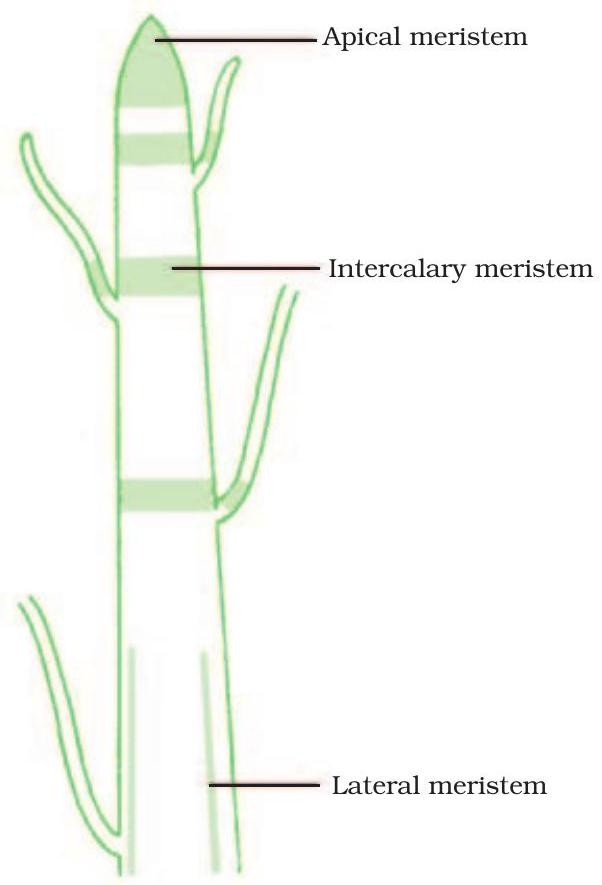
Types of Meristem & Their Growth
Meristem is a living plant tissue where cells divide continuously, driving growth.
Its position in the plant decides what kind of growth follows.
Spot the apical meristem in the diagram—does it make the plant longer or wider?
Key Points:
- Apical – at shoot & root tips; adds length (primary growth).
- Intercalary – at nodes & leaf bases; quickly lengthens internodes, repairs grazed parts.
- Lateral – along sides of stems & roots; adds girth (secondary growth).
Simple Permanent Tissues
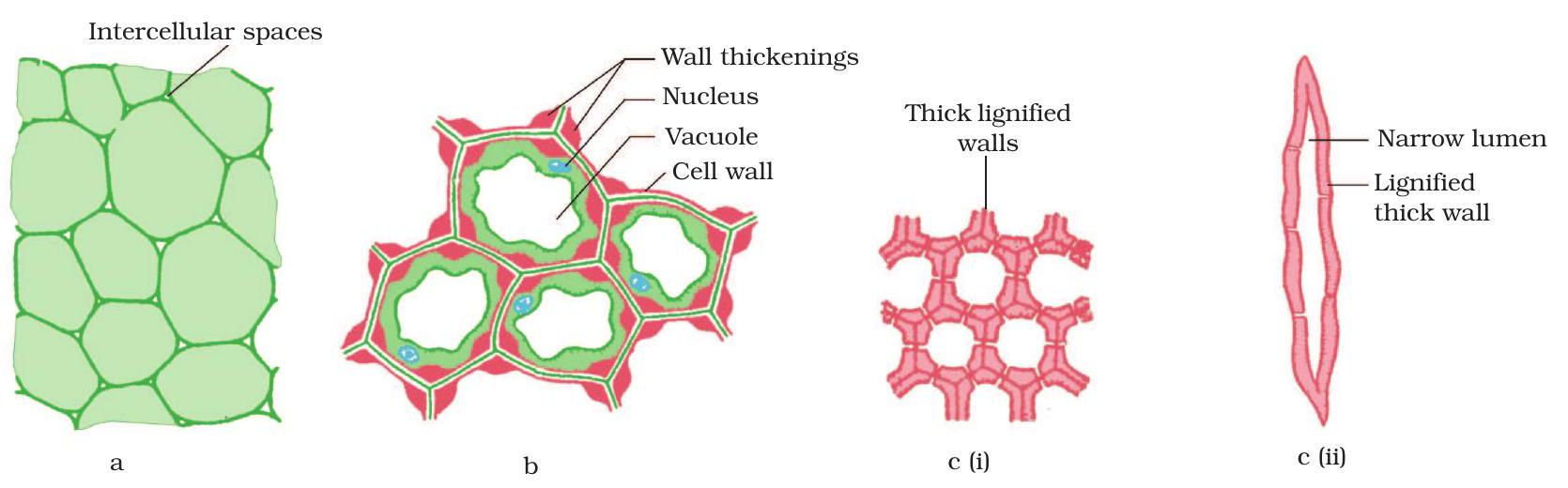
Parenchyma, Collenchyma & Sclerenchyma
Simple permanent tissues comprise similar plant cells that stay mature and perform a shared task.
They are classified into parenchyma, collenchyma and sclerenchyma based on cell wall and function.
Key Points:
- Parenchyma: living, thin-walled; stores food or performs photosynthesis.
- Collenchyma: living, unevenly thick walls; offers flexible support to stems, leaves.
- Sclerenchyma: dead, heavily lignified; provides hard, rigid support.
- Quiz ➜ Which tissue imparts toughness to coconut husk?
Epidermis & Stomata

Protective tissue & gas exchange
A single epidermal layer forms the plant’s protective skin, often coated with a waxy cuticle that limits water loss and blocks microbes.
Stomata are adjustable pores. Guard cells swell to open for CO₂ intake, and shrink to close, conserving water.
Key Points:
- Epidermis is the first defensive barrier on all plant organs.
- Desert plants thicken the cutin layer to curb evaporation.
- Guard cells fine-tune gas exchange while saving water.
Complex Tissues

Xylem & Phloem in Vascular Bundles
Complex permanent tissues form the plant's vascular bundle.
Two main parts: xylem lifts water & minerals upward; phloem distributes food in all directions.
Key Points:
- Xylem: vessels & tracheids form hollow pipes; move water and minerals from roots to leaves.
- Phloem: sieve tubes with companion cells push sugars and amino acids to growing or storage sites.
- Both tissues unite as a vascular bundle linking stem, leaf and root.