Truck Tank Mystery
Spot the Shapes
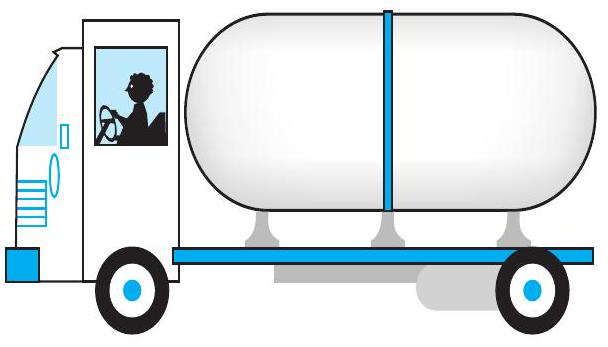
Observe this fuel truck on the road.
Its tank combines a straight cylinder and two perfectly matching hemispheres.
Recognising this composite solid helps us calculate how much metal covers it.
Key Points:
- Real-world example: fuel truck tank
- Shapes recognised: 1 cylinder + 2 hemispheres
- Aim: find total outer surface area
What is a Composite Solid?
Composite Solid
A three-dimensional figure formed by joining two or more basic solids so that some of their faces become internal and disappear from view.
Surface Area Game-Plan
Follow these checkpoints to avoid double-counting and reveal every exposed face.
Decompose & Sketch
Draw the composite figure and label each basic solid clearly.
Highlight Exposed Faces
Shade only faces visible after joining; ignore internal contact areas.
Write Area Formulae
List the correct formula for each highlighted face with its dimensions.
Adjust for Overlaps
Subtract hidden or common areas, or add extra caps, to prevent double-counting.
Sum & State Units
Add all adjusted areas and write the answer with correct units, e.g., cm2.
Pro Tip:
Write a short note explaining every subtraction—examiners award marks for the reasoning.
Capsule Formula
Add the curved area of the cylinder \(2\pi r h\) to the surface of two hemispheres \(4\pi r^{2}\).
Variable Definitions
Applications
Medicine Capsules
Designing gelatin shells for pills uses this formula.
Storage Tanks
LPG and compressed-air vessels often have hemispherical ends.
Submersibles
Pressure-resistant crew modules combine cylindrical and hemispherical sections.
Play with Dimensions
Capsule Surface Explorer
Drag the sliders for radius \(r\) and height \(h\). Watch the capsule sketch, numbers, and bar chart change instantly. Observe how boosting \(r\) raises both hemispheres and cylinder area, while increasing \(h\) affects only the cylinder. Use these visuals to predict the total surface area.
Challenge: adjust \(r\) and \(h\) until the hemispheres make 60 % of the total surface area.
Worked Example
Cone-hemisphere toy
Example: Cone + Hemisphere Surface Area
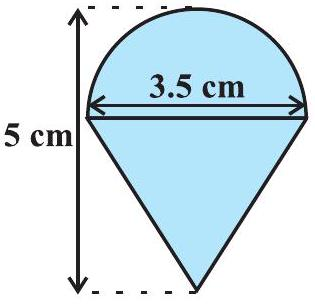
A spinning top is formed by fixing a cone of radius 3 cm and slant height 5 cm on a hemisphere of the same radius.
Find the curved surface area to be polished using \( \text{CSA} = \pi r l + 2\pi r^{2} \). Apply the procedure for a cone-hemisphere combination.
Key Steps:
- Identify common radius \( r = 3\text{ cm} \).
- Cone area \( = \pi r l = \pi \times 3 \times 5 \,\text{cm}^2 \).
- Hemisphere area \( = 2\pi r^{2} = 2\pi \times 3^{2} \,\text{cm}^2 \).
- Add the two results for total curved surface area.