Question Distribution & Your Strength
| Chapter | Paper Weightage (%) | Your Score (%) | Strength |
|---|---|---|---|
| Motion | 15 | 85 | Strong |
| Force & Laws of Motion | 12 | 70 | Moderate |
| Gravitation | 10 | 55 | Needs Revision |
| Work & Energy | 12 | 80 | Strong |
| Sound | 8 | 60 | Moderate |
Source: Sample Question Paper – Physics (XII) 2024-25 & Self-Assessment Data
Analytical Problem Solver
Gauss’s Law – Field of an Infinite Wire
Problem Statement
Using Gauss’s theorem, derive the electric-field magnitude \(E(r)\) at a distance \(r\) from a very long straight wire carrying uniform linear charge density \(\lambda\).
Given:
- Linear charge density \(=\lambda\)
- Cylindrical symmetry about wire
- Observation point at radius \(r\)
To Find:
Expression for \(E(r)\)
Solution Approaches
Cylindrical Gaussian surface
Use symmetry so flux crosses only the curved surface of a coaxial cylinder.
—
—
—
—
Logical Breakdown
Choose surface length \(L\)
Creates closed cylinder coaxial with wire.
Enclosed charge \(Q_{\text{enc}}\)
\(Q_{\text{enc}}=\lambda L\)
Flux through surface
\(\Phi =E(2\pi r L)\)
Apply Gauss’s law
\(\Phi=Q_{\text{enc}}/\varepsilon_0\)
Step-by-Step Solution
Compute flux
Only the curved surface contributes.
Enclosed charge
Charge inside cylinder equals linear density times length.
Equate and solve
Set \(\Phi =Q_{\text{enc}}/\varepsilon_0\) and isolate \(E\).
Key Insights
-
\(E\propto 1/r\); the field weakens linearly with distance.
-
Direction is radially outward for positive \(\lambda\) and inward for negative \(\lambda\).
-
Result is independent of chosen cylinder length \(L\).
Electron in Uniform Magnetic Field
Moving Charges & Magnetism
Problem Context
An electron travels with speed \(v_0\) in a circular path of radius \(r_0\) under a uniform magnetic field \(B\).
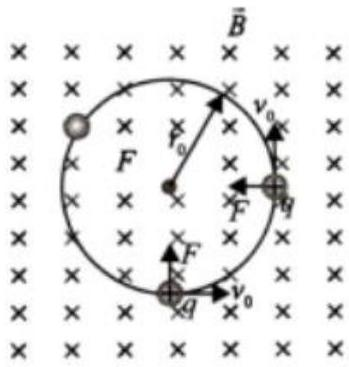
Question
Predict how (a) the radius and (b) the time period change when the electron’s speed doubles to \(2v_0\).
Helpful Hints
Hint 1
Use the centripetal balance: \(qvB = \dfrac{mv^{2}}{r}\).
Hint 2
Time period \(T = \dfrac{2\pi m}{qB}\) does not involve the speed.
Hint 3
Cyclotron frequency \(f = \dfrac{qB}{2\pi m}\) stays constant for a given particle and field.
Things to Consider
- Mass \(m\) and charge \(q\) of the electron are constant.
- Magnetic field \(B\) is uniform and steady.
- The field does no work; only the path geometry changes with speed.
Related Concepts
Analytical Problem Solver
Voltage Across L After C is Shorted
Problem Statement
A series LCR circuit is at resonance with \(V_R = V_L = V_C = 10\,\text{V(rms)}\). After the capacitor is short-circuited, find the new rms voltage across the inductor.
Given:
- R, L and C connected in series
- Initial resonance so \(X_L = X_C\)
To Find:
New \(V_L\) after the capacitor is removed
Solution Approaches
Impedance Method
Compare total impedance before and after shorting and redraw phasor diagram.
—
—
Logical Breakdown
Resonance Condition
At resonance \(X_L = X_C\) and \(Z = R\).
After Shorting C
Impedance becomes \(Z' = \sqrt{R^{2}+X_L^{2}}\).
—
—
Step-by-Step Solution
Determine R
At resonance \(I_0 = \frac{V_R}{R} = \frac{10}{R}\).
Compute New Current
With \(X_L = R\), \(Z' = R\sqrt{2}\) so \(I' = \frac{10}{R\sqrt{2}} = \frac{I_0}{\sqrt{2}}\).
Find \(V_L'\)
\(V_L' = I' X_L = \frac{I_0}{\sqrt{2}}\times R = 10\sqrt{2}\,\text{V(rms)}\).
Key Insights
-
Shorting the capacitor destroys resonance and raises impedance to \(R\sqrt{2}\).
-
Circuit current falls by a factor \(1/\sqrt{2}\).
-
Inductor voltage rises to \(10\sqrt{2}\,\text{V}\) despite lower current because reactance is unchanged.
Analytical Problem Solver
First Common Dark Fringe (400 nm & 600 nm)
Problem Statement
Two wavelengths — 400 nm and 600 nm — shine on a Young’s double-slit. Find the nearest distance from the central maximum where both produce a dark fringe.
Given:
- \( \lambda_1 = 400 \text{ nm} \)
- \( \lambda_2 = 600 \text{ nm} \)
To Find:
Smallest \(y\) where minima coincide.
Solution Approaches
Match order numbers
Set \(m\lambda_1=(m+\tfrac12)\lambda_2\) and search smallest integer \(m\).
—
—
—
—
Logical Breakdown
Find integer \(m\)
Solve the equality for the smallest positive \(m\).
Distance formula
Use \(y=m\lambda_1\frac{L}{d}\) once \(m\) is known.
—
—
—
—
Step-by-Step Solution
Set equality
Coincidence condition: \(m\lambda_1=(m+\tfrac12)\lambda_2\).
Solve for \(m\)
Smallest integer solution is \(m=3\).
Distance from centre
\(y=3\lambda_1\frac{L}{d}=3(400\text{ nm})\frac{L}{d}\).
Key Insights
-
Choose the lowest integer orders that satisfy both wavelengths.
-
Using ratios eliminates slit separation and screen distance during calculation.
-
Result: common dark at \(y=3\lambda_1L/d\).
Analytical Problem Solver
Fission vs Fusion on B.E./A Curve
Problem Statement
Four nuclei W(190), X(90), Y(60) and Z(30) lie on the binding-energy-per-nucleon curve. Identify which one is expected to undergo (a) fission and (b) fusion, and justify your choice.
Given:
- Relative \( \text{BE}/A \) values from the curve
- Mass numbers: 190, 90, 60, 30
To Find:
Most probable fission and fusion candidates
Solution Approaches
Energy-gain check
A reaction is favored if the products shift toward higher \( \text{BE}/A \); compare with the peak at \(A\approx56\).
Alternative not required
First method fully resolves the task.
—
No further approach needed.
Logical Breakdown
Heavy nuclei → fission
Splitting a very heavy nucleus raises its \( \text{BE}/A \).
Light nuclei → fusion
Combining light nuclei moves them toward the peak.
Peak at \(A\approx56\)
Iron region has the maximum \( \text{BE}/A \).
Energy release = BE gain
Greater \( \text{BE}/A \) means lower mass, releasing energy.
Step-by-Step Solution
Rank mass numbers
W 190 > X 90 > Y 60 > Z 30.
Read slope of curve
\( \text{BE}/A \) rises to the peak at \(A\approx56\) then decreases for heavier nuclei.
Apply energy-gain rule
Splitting W moves fragments toward the peak ⇒ fission. Merging two Z nuclei moves left side nuclei toward the peak ⇒ fusion.
Key Insights
-
W (A = 190) sits on the downward slope; fission raises its \( \text{BE}/A \).
-
Z (A = 30) lies left of the peak; fusion propels it upward on the curve.
-
Energy released equals the gain in total binding energy per nucleon.
Analytical Problem Solver
Capacitance with Slabs Inside
Problem Statement
Derive expressions for the capacitance of a parallel-plate capacitor
(plate area \(A\), separation \(d\)) when
(i) a dielectric slab of thickness \(t\) and relative permittivity \(k\),
(ii) a perfect-conductor slab of thickness \(t\;(t<d)\) are inserted between the plates.
Given:
- Dielectric constant \(k\)
- Metal behaves as an equipotential conductor
To Find:
Capacitances \(C_{\text{dielectric}}\) and \(C_{\text{metal}}\)
Solution Approaches
Series combination of gaps
Treat the slab and remaining air gap as two capacitors in series.
—
—
—
—
Logical Breakdown
Air gap
Thickness \(d-t\) behaves as capacitor with permittivity \(\varepsilon_0\).
Inserted slab
Thickness \(t\); either dielectric (\(k\varepsilon_0\)) or perfect conductor.
Series model
Capacitances add as \(\frac{1}{C}=\frac{1}{C_1}+\frac{1}{C_2}\).
Effective separation
Metal slab removes field, reducing gap to \(d-t\).
Step-by-Step Solution
Dielectric slab
Capacitances in series: \(C_1=\dfrac{\varepsilon_0 A}{d-t}\), \(C_2=\dfrac{k\varepsilon_0 A}{t}\).
Metal slab
Field exists only in air gap of thickness \(d-t\).
Comparison
Because \(d-t<d\) and no series addition, the metal slab gives the higher capacitance.
Key Insights
-
Use series-capacitor formula when different media share the field path.
-
A perfect conductor removes electric field within it, shortening the effective plate gap.
-
Reducing effective separation increases capacitance more than adding a dielectric alone.
Analytical Problem Solver
Displacement Current Through Capacitor
Problem Statement
A \(0.001\;\text{m}^2\) parallel-plate capacitor with \(1\times10^{-4}\,\text{m}\) gap experiences a voltage rise of \(1\times10^{8}\,\text{V s}^{-1}\). Find the displacement current \(I_d\).
Given:
- \( \varepsilon_0 = 8.85\times10^{-12}\;\text{C}^2\text{N}^{-1}\text{m}^{-2} \)
- Area \(A = 1.0\times10^{-3}\;\text{m}^2\)
- \(\dfrac{dV}{dt}=1.0\times10^{8}\;\text{V s}^{-1}\)
To Find:
Displacement current \(I_d\)
Solution Approaches
Maxwell relation
Use \(I_d = \varepsilon_0 A \dfrac{dV}{dt}\).
—
Not required.
—
Not required.
Logical Breakdown
Multiply constants
Compute \( \varepsilon_0 A \) first.
Unit check
Confirm result in amperes.
—
—
—
—
Step-by-Step Solution
Insert numbers
Substitute given values into the formula.
Calculate
Multiply to get the current.
State answer
Displacement current ≈ \(0.885\,\mu\text{A}\).
Key Insights
-
Changing electric field produces current; no charges move across the gap.
-
Displacement current equals conduction current in the external leads.
-
Ensures continuity in the Ampère–Maxwell law.
Analytical Problem Solver
Electron de Broglie Wavelength from Platinum
Problem Statement
Platinum with work function \( \phi = 5.63\,\text{eV} \) is hit by light of frequency \( 1.6\times10^{15}\,\text{Hz} \). Find the minimum de Broglie wavelength of the emitted electrons.
Given:
- \(h = 6.63\times10^{-34}\,\text{J s}\)
- \(\phi = 5.63\,\text{eV}\)
- \(f = 1.6\times10^{15}\,\text{Hz}\)
To Find:
Minimum de Broglie wavelength \( \lambda_{min} \)
Solution Approaches
Photoelectric equation
Use \( hf = \phi + K_{max} \) to obtain electron kinetic energy.
—
No alternate method required.
—
—
Logical Breakdown
Compute photon energy
Find \(E = hf\) in joules and electron-volts.
Convert to kinetic energy
Subtract work function to get \(K_{max}\).
Use \( \lambda = h/\sqrt{2mK} \)
Relate momentum to de Broglie wavelength.
Interpret result
Quote \( \lambda_{min} \) and check plausibility.
Step-by-Step Solution
Photon Energy
Calculate energy carried by one photon.
Maximum Kinetic Energy
Subtract work function of platinum.
Minimum de Broglie Wavelength
Apply de Broglie relation to fastest electrons.
Key Insights
-
Higher photon frequency increases \(K_{max}\) and shortens \( \lambda_{min} \).
-
Work function is the energy barrier; surplus energy becomes kinetic.
-
de Broglie relation bridges wave–particle duality for electrons.
Analytical Problem Solver
Identify Blocks in Full-Wave Rectifier
Problem Statement
In the AC-to-DC circuit, name blocks X and Y, draw their output waveforms, and state how the waveform changes if the centre-tap shifts toward diode D₁.
Given:
- Input: sinusoidal AC
To Find:
Names of X and Y and their output wave shapes
Solution Approaches
Block naming method
Identify transformer and rectifier stages; match expected outputs.
—
—
—
—
Logical Breakdown
Transformer action
Step-down coil with centre-tap provides two equal but opposite half-cycles.
Diode conduction
D₁ conducts during positive half, D₂ during negative half, flipping polarity.
—
—
—
—
Step-by-Step Solution
Output of X
Lower-voltage sine appears across the secondary.
Output of Y
Both half-cycles are rectified, giving pulsating DC.
Shifted centre-tap
Positive pulses (D₁) grow, negative pulses (D₂) shrink; ripple and DC level rise.
Key Insights
-
Centre-tap position controls symmetry of the full-wave output.
-
Adding a capacitor filter converts pulsating DC into smoother DC.
-
Unequal half-cycles increase ripple and DC offset.
Analytical Problem Solver
Current Through Arm AD in Circular Bridge
Problem Statement
A uniform 12 Ω wire is bent into a complete circle. The ends of one diameter, C and D, are connected by a 10 Ω resistor. A battery of 8 V (negligible internal resistance) is connected across another pair of opposite points, A and B. Find the current flowing through the arc AD.
Given:
- Wire resistance uniformly distributed
- Battery internal resistance ≈ 0
To Find:
Current in arm AD, \(I_{AD}\)
Solution Approaches
Symmetry split
Replace each arc by resistance proportional to its angle; treat the circle as an unbalanced Wheatstone bridge.
—
—
—
—
Logical Breakdown
Arc AB = 60°
Resistance \(R_{AB}= \frac{12}{360}\times60 = 2\;\Omega\).
Bridge structure
Circular arcs form four arms; the 10 Ω resistor is the bridge branch.
Unequal arms
Arms adjoining AB have 2 Ω each; opposite arms are 4 Ω each.
Kirchhoff equations
Apply loop and junction laws to find branch currents.
Step-by-Step Solution
Convert arcs to resistances
Each 60° arc equals \(2\;\Omega\); each 120° arc equals \(4\;\Omega\).
Redraw as bridge
Two 2 Ω arms (AB) opposite two 4 Ω arms, with 10 Ω across CD.
\| 10 Ω \|
Apply Kirchhoff & solve
Solving simultaneous equations gives \(I_{AD}\approx0.67\;\text{A}\).
Key Insights
-
Uniform wire lets resistance scale directly with angle.
-
Unbalanced Wheatstone bridges require Kirchhoff analysis.
-
Symmetry arguments can simplify complex circular networks.
Analytical Problem Solver
Emf Expression for AC Generator
Problem Statement
A coil of \(N\) turns and area \(A\) rotates with angular speed \( \omega \) in a uniform field \( B \). Derive its instantaneous emf.
Given:
- Magnetic flux \( \Phi = N B A \cos \omega t \)
- —
- —
To Find:
\( \varepsilon(t) \)
Solution Approaches
Faraday’s Law
Apply \( \varepsilon = -\dfrac{d\Phi}{dt} \)
—
Single approach sufficient.
—
—
Logical Breakdown
Differentiate cosine
Convert \( \cos \) to \( \sin \) with factor \( \omega \).
Peak emf \( \varepsilon_0 \)
\( \varepsilon_0 = N B A \omega \)
—
—
—
—
Step-by-Step Solution
Differentiate flux
Using Faraday’s law, take time derivative of \( \Phi \).
Account for sign
Negative sign obeys Lenz’s law, opposing change in flux.
Energy source
Mechanical work from the turbine is converted to electrical energy.
Key Insights
-
Frequency of emf equals rotational frequency \( \omega/2\pi \).
-
Peak emf rises with turns, area, field strength, and speed.
-
Average emf over one full cycle is zero; power comes from mechanical input.
Analytical Problem Solver
Right-Angled Prism with Liquid
Problem Statement
A ray grazes face AC of a right-angled prism (∠C = 45°). (a) Find the prism’s refractive index. (b) Decide the ray’s fate when face AC is immersed in a liquid of index \(n = \frac{2}{\sqrt{3}}\).
Given:
- Incidence equals grazing angle 45° (critical condition).
- Ray initially undergoes total internal reflection.
To Find:
1. Prism index \(n_{\text{prism}}\). 2. Whether the ray reflects or refracts after immersion.
Solution Approaches
Critical-angle method
Use grazing condition to equate 45° with critical angle and compute \(n\).
Snell comparison
Compare incident angle with new critical angle when liquid surrounds the face.
Ray-tracing check
Visualise ray path to confirm decision on TIR vs refraction.
Logical Breakdown
Snell law at grazing
Grazing ray ⇒ incident angle equals critical angle.
Index comparison
Compute new critical angle using \(n_{\text{liq}}\) and compare with 45°.
—
—
Step-by-Step Solution
Find prism index
For grazing incidence, 45° = critical angle \(c\).
Compute new critical angle
Liquid now surrounds the interface.
Decide ray’s fate
45° < \(c' \approx 53^\circ\) → no TIR.
Key Insights
-
Immersion raises surrounding index, increasing critical angle.
-
When incident angle < new critical angle, TIR disappears and refraction occurs.
-
Grazing incidence is a quick test for determining refractive index via critical angle.
Analytical Problem Solver
Many Lines from One‐Electron Atom
Problem Statement
Why does a hydrogen atom, which has only one electron, still produce many distinct spectral lines in its emission spectrum?
Given:
- Sample contains a very large number of hydrogen atoms.
To Find:
Reason for multiplicity of lines in hydrogen spectrum.
Solution Approaches
Ensemble view
Different atoms are excited to different energy levels; each emits its own transition photon.
—
—
—
—
Logical Breakdown
Excitation causes varied n→n′ transitions
Energy input lifts electrons to many quantum numbers \(n>1\).
Each transition gives unique photon
Photon energy \(E=h\nu\) equals the difference between two levels.
Step-by-Step Solution
Population of levels
Excitation distributes electrons among levels \(n=2,3,4,\dots\).
Return paths
Atoms relax by one or more jumps; each drop emits a photon.
Key Insights
-
Each allowed \(n \rightarrow n'\) transition produces a unique wavelength.
-
Large ensembles contain atoms in many excited states at once.
-
One atom emits one photon, but millions together reveal the full spectral series.
Key Take-aways
Formula Flash
Memorise core laws: \(v = f\lambda\), \(F = ma\), \(P = VI\). Write them first in exam.
Diagram & Graph Snaps
Quickly sketch ray diagrams or motion graphs to visualise and avoid wordy descriptions.
Unit Check
Always cross-verify units; convert cm→m early to stop last-minute errors.
60-40 Rule
Spend 60% time on sure-shot questions, 40% on tricky ones to maximise marks.