Question Distribution & Your Strength
Match chapter-wise question load with your proficiency to target revision smartly.
| Chapter (Syllabus) | Questions in Paper | Your Strength |
|---|---|---|
| Electric Charges & Fields | 3 | Low |
| Moving Charges & Magnetism | 4 | Low |
| Alternating Current | 2 | Low |
| Wave Optics | 3 | Low |
| Nuclei | 2 | Low |
| Electrostatic Potential & Capacitance | 2 | Med |
| Magnetism & Matter | 0 | Med |
| Electromagnetic Waves | 1 | Med |
| Dual Nature of Radiation & Matter | 2 | Med |
| Semiconductor Electronics | 3 | Med |
| Current Electricity | 4 | High |
| Electromagnetic Induction | 1 | High |
| Ray Optics & Optical Instruments | 3 | High |
| Atoms | 1 | High |
Source: CBSE Grade 12 Self-assessment, 2024 Paper
Question with Hints and Nudges
Electric Charges & Fields – Gauss’s Law Application
The Question:
Using Gauss’s law, derive the electric field \(E(r)\) at distance \(r\) from an infinitely long straight wire carrying linear charge density \( \lambda \).
Imagine a coaxial cylindrical Gaussian surface.
Helpful Concepts
- Gauss’s law \( \Phi = \dfrac{Q_{\text{encl}}}{\varepsilon_0} \)
- Cylindrical symmetry → radial & uniform field
- Curved area of cylinder: \( 2\pi r L \)
Progressive Hints (Reveal only when needed)
Gentle Nudge
Think of a Gaussian surface that shares the wire’s cylindrical symmetry.
Direction Pointer
Enclose length \(L\) of wire inside a coaxial cylinder of radius \(r\); ignore the flat caps.
Guiding Framework
Apply \( \Phi = E(2\pi r L) = \lambda L / \varepsilon_0 \). Solve to get \( E = \dfrac{\lambda}{2\pi \varepsilon_0 r} \). Do not count end-caps.
Thinking Strategies
Break It Down
Identify symmetry, choose surface, compute flux, then isolate \(E\).
Connect to Prior Knowledge
Recall the Gauss’s-law derivation for an infinite plane to spot parallels.
Visualize It
Sketch the wire and a dashed cylindrical surface to see where flux exits.
Test a Simpler Case
Check if \(E \propto 1/r\); doubling \(r\) should halve your answer.
Struggle is normal! Try to solve on your own before checking the hints.
Question with Hints and Nudges
Grade 12 Physics – Moving Charges & Magnetism
The Question:
A \(+10\;\text{mC}\), \(10\;\text{g}\) sphere inside a vertical insulating tube stays at rest while the tube slides horizontally east → west through a uniform \(2\;\text{T}\) magnetic field. Find (i) the minimum tube speed and (ii) the field direction that keeps the sphere suspended.
No diagram required
Helpful Concepts
- Magnetic force on a moving charge: \(F_B = qvB\) (perpendicular case).
- Equilibrium condition: \(qvB = mg\).
- Right-hand rule: direction of \(q\,\mathbf{v}\times\mathbf{B}\).
Progressive Hints (Reveal only when needed)
Gentle Nudge
Identify all forces and set their vector sum to zero.
Direction Pointer
Use \(qvB\) upward to cancel \(mg\) downward; thus \(qvB = mg\).
Guiding Framework
Solve \(v = \frac{mg}{qB} = \frac{0.01 \times 9.8}{0.01 \times 2} = 4.9\;\text{m s}^{-1}\). For a westward \( \mathbf{v} \) and positive \(q\), \( \mathbf{B} \) must point south so that \( \mathbf{v}\times\mathbf{B} \) is upward.
Thinking Strategies
Break It Down
List forces: gravity (down) and magnetic (unknown). No tension or normal force acts.
Connect to Prior Knowledge
Recall the Lorentz force expression and its dependence on speed and field.
Visualize It
Sketch \( \mathbf{v} \) west, choose \( \mathbf{B} \) south, verify \( \mathbf{v}\times\mathbf{B} \) points up.
Test a Simpler Case
Set \(q = 1\;\text{C}\) mentally to see how speed scales with charge.
Struggle is normal! Try to solve on your own before checking the hints.
Alternating Current – Toughest Question
LCR Circuit Surprise
The Question:
In a series LCR circuit \(V_R = V_C = V_L = 10\,\text{V}\). The capacitor is short-circuited. What is the new rms voltage across the inductor?
Helpful Concepts
- Series resonance: \(X_L = X_C\); net reactance zero.
- At resonance, supply voltage equals \(V_R\).
- Shorting \(C\) leaves an \(L\!-\!R\) series path with the same \(X_L\).
Progressive Hints (Reveal only when needed)
Gentle Nudge
Equal voltages on \(R, L, C\) indicate the circuit is at resonance.
Direction Pointer
At resonance, \(V_{\text{supply}} = V_R = 10\text{ V}\). So \(I = 10 / R\) and \(X_L = R\).
Guiding Framework
With \(C\) shorted, \(Z = \sqrt{R^{2}+X_L^{2}} = R\sqrt{2}\). New \(I = 10/(R\sqrt{2})\). Hence \(V_L = I X_L = 10/\sqrt{2} \approx 7.1\text{ V}\).
Thinking Strategies
Break It Down
First decide what resonance tells you about \(X_L\) and \(X_C\).
Connect to Prior Knowledge
Recall impedance triangles to combine \(R\) and \(X_L\).
Visualize It
Sketch phasors for \(V_R, V_L, V_C\) before and after removing \(C\).
Test a Simpler Case
Try \(R = 10\,\Omega, X_L = 10\,\Omega\) numerically to verify the formula.
Struggle is normal! Try to solve on your own before checking the hints.
Question with Hints and Nudges
Wave Optics – Young’s Double-Slit
The Question:
Light of 400 nm and 600 nm passes through a double-slit. How far from the central maximum will the first common dark fringe appear?
Diagram not required for this calculation.
Helpful Concepts
- Dark fringe: path difference \( \delta =(m+\tfrac12)\lambda \).
- Common darkness when \( (m+\tfrac12)\lambda_{400}=m\lambda_{600} \).
- Screen position: \( y=\delta \,D/d \) for the interference pattern.
Progressive Hints (Reveal only when needed)
Gentle Nudge
Write the dark-band condition for each colour, then set the path differences equal.
Direction Pointer
Assume \( (m+\tfrac12)\lambda_{400}=m\lambda_{600} \). Solve for the smallest positive integer \( m \).
Guiding Framework
You get \( m=1 \), so \( \delta =600\text{ nm} \). Insert this into \( y=\delta D/d \) for the required distance.
Thinking Strategies
Break It Down
Handle each wavelength separately, then combine results.
Connect to Prior Knowledge
Remember bright-overlap rules; here add the half-order shift for darkness.
Visualize It
Sketch both fringe sets; mark where the first overlap vanishes.
Test a Simpler Case
Try λ ratio 1 : 2 to see the pattern before tackling 400 : 600 nm.
Struggle is normal! Try to solve on your own before checking the hints.
Nuclei – Toughest Question
Fission vs Fusion Decision
The Question:
On the binding-energy per nucleon graph, points W(190), X(90), Y(60) and Z(30) are marked. Which nucleus can release energy by fission and which by fusion? Give a brief reason.
Binding energy per nucleon vs mass number (schematic)
Helpful Concepts
- Binding energy per nucleon (B.E./A) gauges stability.
- Curve peaks near A ≈ 56–60 (iron–nickel region).
- Systems move toward the peak to release nuclear energy.
Progressive Hints (Reveal only when needed)
Gentle Nudge
First, see how far each A value lies from the peak around 60.
Direction Pointer
Heavy nuclei to the right split; very light nuclei to the left combine—both moves aim for A ≈ 60.
Guiding Framework
W(190) can increase B.E./A by splitting into fragments near 90 → fission. Z(30) can gain B.E./A by joining another light nucleus to reach ~60 → fusion.
Thinking Strategies
Break It Down
Order the four A values, then compare each with 60.
Connect to Prior Knowledge
Recall that iron-nickel are most stable due to highest B.E./A.
Visualize It
Sketch the B.E./A curve and plot W, X, Y, Z.
Test a Simpler Case
Think of uranium fission and hydrogen fusion as extreme examples.
Struggle is normal! Try to solve on your own before checking the hints.
Electrostatic Potential & Capacitance – Toughest Question
CBSE Grade 12 Physics
The Question:
Parallel-plate capacitor: plates area \(A\), air gap \(d\). Case 1 – dielectric slab thickness \(t\), permittivity \(\varepsilon_r\). Case 2 – metal slab thickness \(t<d\). Derive capacitances \(C_1, C_2\) and decide which is larger.
Helpful Concepts
- \(C=\frac{\varepsilon_0 A}{d}\) for a parallel-plate capacitor.
- Series dielectrics: \(C=\frac{\varepsilon_0 A}{\sum d_i/\varepsilon_{ri}}\).
- Inside a conductor \(E=0\); it simply shortens the effective gap.
Progressive Hints (Reveal only when needed)
Gentle Nudge
Treat the slab and remaining air as two capacitors in series.
Direction Pointer
Write \(V=E_1 t + E_2(d-t)\) and substitute \(E=\sigma/\varepsilon\).
Guiding Framework
Obtain \(C_1=\frac{\varepsilon_0 A}{d - t + t/\varepsilon_r}\). For the metal slab \(E=0\) inside, so \(C_2=\frac{\varepsilon_0 A}{d-t}\). Compare denominators.
Thinking Strategies
Break It Down
Separate the problem into slab region and air region.
Connect to Prior Knowledge
Remember electric field behaviour inside conductors and dielectrics.
Visualize It
Draw a side view labelling \(t\), \(d-t\), and field directions.
Test a Simpler Case
Check results for \(t=0\) or \(\varepsilon_r=1\) to build confidence.
Struggle is normal! Try to solve on your own before checking the hints.
Magnetism & Matter – Representative Question
Field Inside a Current-Carrying Wire
The Question:
For a long solid wire of radius \(a\) carrying uniform current \(I\), find the ratio \(B_{\text{above}}:B_{\text{below}}\) where “above” is \(\frac{a}{2}\) outside the surface and “below” is \(\frac{a}{2}\) inside the surface.
No diagram required
Helpful Concepts
- Ampère’s law: \( \oint \mathbf{B}\cdot d\mathbf{l}= \mu_{0} I_{\text{enc}}\).
- Inside (\(r<a\)): \(B(r)=\frac{\mu_{0} I r}{2\pi a^{2}}\) — linear magnetic field distribution.
- Outside (\(r>a\)): \(B(r)=\frac{\mu_{0} I}{2\pi r}\) — inverse magnetic field distribution.
Progressive Hints (Reveal only when needed)
Gentle Nudge
Identify whether each point lies inside or outside the wire by calculating its distance from the axis.
Direction Pointer
Use \(B(r)=\frac{\mu_{0} I r}{2\pi a^{2}}\) for \(r=\frac{a}{2}\) and \(B(r)=\frac{\mu_{0} I}{2\pi r}\) for \(r=\frac{3a}{2}\).
Guiding Framework
Compute \(B_{\text{below}}=\frac{\mu_{0}I}{2\pi a^{2}}\cdot\frac{a}{2}\) and \(B_{\text{above}}=\frac{\mu_{0}I}{2\pi}\cdot\frac{2}{3a}\). Then form the ratio.
Thinking Strategies
Break It Down
Draw the wire cross-section, label \(r=\frac{a}{2}\) and \(r=\frac{3a}{2}\).
Connect to Prior Knowledge
Recall that inside a uniformly current-filled region \(B\propto r\); outside \(B\propto 1/r\).
Visualize It
Sketch concentric circular field lines with varying spacing inside and outside the wire.
Test a Simpler Case
Evaluate \(B\) at the centre and at the surface to verify you are using the correct formula.
Struggle is normal! Try to solve on your own before checking the hints.
Question with Hints and Nudges
EM Spectrum (Grade 12 Physics)
The Question:
Match each electromagnetic wave with its usual production mechanism.
1. Radio waves a) Rapid oscillation of conduction electrons in an aerial
2. Microwaves b) Klystron / magnetron valve
3. Infra-red c) Vibrations of atoms & molecules in matter
4. Visible light d) Electronic transitions within atoms
Write the correct 1-a, 2-b … pairs.
Helpful Concepts
- EM spectrum orders waves by increasing frequency.
- Different frequency bands arise from different physical processes.
- Recall antenna currents, vacuum tubes, molecular heat, and atomic jumps.
Progressive Hints (Reveal only when needed)
Gentle Nudge
Start with the extremes: radio waves come from antenna currents.
Direction Pointer
Think of the device that powers radar and microwave ovens—the klystron/magnetron.
Guiding Framework
Map now: conduction electrons → radio, vacuum tube → microwave, molecular vibration → IR, atomic transition → visible.
Thinking Strategies
Break It Down
List the four mechanisms, then match one wave at a time.
Connect to Prior Knowledge
Recall how your radio and microwave oven generate waves.
Visualize It
Sketch the EM spectrum and label each source.
Test a Simpler Case
If you only knew radio waves, what mechanism might the next higher band use?
Struggle is normal! Try to solve on your own before checking the hints.
Dual Nature – Toughest Question
Decoding Photoelectric Curves
The Question:
Three photoelectric I–V curves A, B and C are recorded with different monochromatic lights on the same metal. For every pair (A,B), (A,C) and (B,C), state whether the two lights share intensity, frequency or neither, and justify from the curves.
Curve sketch goes here if provided
Helpful Concepts
- Saturation current ∝ photon flux → beam intensity.
- Stopping potential \(V_{0}= \frac{h\nu - \phi}{e}\) tracks photon frequency.
- Plateau height & horizontal intercept reveal intensity and frequency on I–V graphs.
Progressive Hints (Reveal only when needed)
Gentle Nudge
Match curves whose plateaus reach the same current; those beams have identical intensity.
Direction Pointer
Equal stopping potentials mean equal photon energy, hence same frequency.
Guiding Framework
Identify pairs with matching plateau → same intensity; matching intercept → same frequency. If neither matches, both differ.
Thinking Strategies
Break It Down
Examine current plateau and cutoff voltage separately before combining clues.
Connect to Prior Knowledge
Recall Einstein’s explanation linking photon energy to electron kinetic energy.
Visualize It
Sketch vertical lines from each plateau to see overlaps quickly.
Test a Simpler Case
Imagine two identical lamps with different filters to predict graph changes.
Struggle is normal! Try to solve on your own before checking the hints.
Semiconductor Electronics – Toughest Question
Grade 12 Physics | Rectification
The Question:
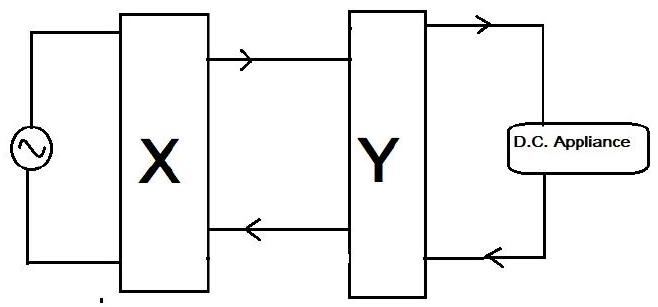
In the AC → X → Y → DC block, name X and Y. Sketch the voltage after each stage. How will the DC waveform change if the transformer’s centre-tap moves closer to \(D_1\)?
Helpful Concepts
- Full-wave bridge and centre-tap rectifiers
- Transformer: step-down & isolation
- Capacitive filter to cut ripple
Progressive Hints (Reveal only when needed)
Gentle Nudge
First, identify what lowers AC voltage before diodes take over.
Direction Pointer
X = step-down transformer. Y = full-wave rectifier followed by a smoothing capacitor.
Guiding Framework
Draw sine after X. After Y, both half-cycles become positive (pulsating DC). Moving the tap toward \(D_1\) enlarges one half-cycle and shifts average DC upward, adding ripple.
Thinking Strategies
Break It Down
Match each block to its role: transform, rectify, filter.
Connect to Prior Knowledge
Recall lab work on bridge and centre-tap rectifiers.
Visualize It
Sketch voltage across the load after each stage.
Test a Simpler Case
Assume ideal diodes and equal halves before considering tap shift.
Question with Hints and Nudges
Current Electricity – Network Analysis
The Question:
A uniform wire of total resistance 12 Ω is bent into a circle. A 10 Ω resistor joins the opposite points C and D. A battery of emf 8 V is connected across another pair of opposite points A and B. Determine the current through the arc A → D.
Sketch the equivalent Wheatstone bridge on your notepad.
Helpful Concepts
- Kirchhoff’s current and loop laws for network analysis.
- Wheatstone bridge equivalence and balance condition.
- Series–parallel reduction of resistors to simplify circuits.
Progressive Hints (Reveal only when needed)
Gentle Nudge
Think of the circle as two equal 6 Ω semicircular arcs between A–C–B and A–D–B.
Direction Pointer
Redraw the arrangement as a Wheatstone bridge where the 10 Ω resistor is the bridge arm CD.
Guiding Framework
Apply Kirchhoff’s loop law to two independent loops or test for bridge balance, then solve for branch currents without yet computing the final numeric answer.
Thinking Strategies
Break It Down
Convert the circular layout into a four-resistor Wheatstone bridge diagram.
Connect to Prior Knowledge
Recall that equal opposite arms can balance a bridge, potentially nullifying current through the 10 Ω path.
Visualize It
Label currents in each branch and mark assumed directions before writing \( \sum V = 0 \) equations.
Test a Simpler Case
Imagine removing the 10 Ω resistor; predict current split, then re-introduce it to see the change.
Struggle is normal! Try to solve on your own before checking the hints.
Electromagnetic Induction – Toughest Question
Grade 12 Physics – CBSE
The Question:
A coil with \(N\) turns and area \(A\) rotates at angular speed \( \omega \) in a uniform magnetic field \(B\). Using Faraday’s law, derive the instantaneous emf \( \varepsilon = N A B \omega \sin \omega t \). Also state the practical source of this electrical energy.
No diagram provided
Helpful Concepts
- Faraday’s law: \( \varepsilon = -\dfrac{d\Phi}{dt} \)
- Magnetic flux: \( \Phi = B A \cos \theta \)
- Lenz’s law (negative sign)
Progressive Hints (Reveal only when needed)
Gentle Nudge
Express the magnetic flux as \( \Phi = B A \cos (\omega t) \).
Direction Pointer
Differentiate \( \Phi \) with respect to time and apply Faraday’s law: \( \varepsilon = -\dfrac{d\Phi}{dt} \).
Guiding Framework
You should arrive at \( \varepsilon = N A B \omega \sin \omega t \) with peak value \( \varepsilon_0 = N A B \omega \). In real generators, mechanical work from turbines supplies the energy.
Thinking Strategies
Break It Down
First write flux, then differentiate—two clear steps.
Connect to Prior Knowledge
Recall Faraday’s and Lenz’s laws determine magnitude and sign.
Visualize It
Picture the coil’s plane sweeping through the magnetic field lines.
Test a Simpler Case
Try one loop (\(N=1\)) to confirm the sinusoidal nature of \( \varepsilon \).
Struggle is normal! Try to solve on your own before checking the hints.
Question with Hints and Nudges
Ray Optics – Prism
The Question:
A right-angled prism (\(C = 45^{\circ}\)) receives a ray as shown. Side AC is immersed in a liquid of refractive index \(n = \frac{2}{\sqrt{3}}\). Will the emerging ray graze, refract, or undergo total internal reflection? Draw its path.
[Diagram as given in paper]
Helpful Concepts
- Critical angle \(C\) : \(\sin C = \dfrac{n_{\text{medium}}}{n_{\text{prism}}}\)
- Total internal reflection when incident angle > critical angle.
- Snell’s law links angles and refractive indices.
Progressive Hints (Reveal only when needed)
Gentle Nudge
Recall the prism’s refractive index you found earlier when the ray just grazed in air.
Direction Pointer
Compute new critical angle at AC: \(\sin C = \dfrac{n_{\text{liquid}}}{n_{\text{prism}}}\).
Guiding Framework
Compare \(45^{\circ}\) with the critical angle. If \(45^{\circ}\) < \(C\), TIR; if equal, grazing; if >, refraction into liquid.
Thinking Strategies
Break It Down
Calculate critical angle first, then decide the ray’s fate.
Connect to Prior Knowledge
You earlier assumed air outside—update that step for liquid.
Visualize It
Draw normals at AC and mark incident \(45^{\circ}\) angle.
Test a Simpler Case
Imagine liquid is air to see why outcome changes.
Struggle is normal! Try to solve on your own before checking the hints.
Question with Hints and Nudges
Grade 12 Physics – Bohr Model
The Question:
Hydrogen has only one electron. Why does its emission spectrum still show many discrete lines?
Energy-level diagram could be sketched here
Helpful Concepts
- Bohr levels: \(E_n=-13.6\,\text{eV}/n^2\)
- Photon energy: \(h\nu = E_i-E_f\) during a downward jump
- A discharge tube contains billions of atoms acting independently
Progressive Hints (Reveal only when needed)
Gentle Nudge
Consider how many hydrogen atoms are present in a glowing sample.
Direction Pointer
Different atoms can have their lone electron in different excited states at the same time.
Guiding Framework
Each occupied excited level \(n_i\) can decay through several lower levels \(n_f\). Every allowed transition emits a photon with a unique energy, producing multiple spectral lines.
Thinking Strategies
Break It Down
List energy levels, then count possible downward jumps.
Connect to Prior Knowledge
Recall the Balmer lines and their level diagram.
Visualize It
Sketch Bohr levels and draw arrows for transitions.
Test a Simpler Case
Imagine only two levels and observe how one line appears.
Struggle is normal! Try to solve on your own before checking the hints.
Key Take-aways
Symmetry Saves Time
Quick recap: use symmetry with Gauss’s law and Ampère’s rule to write fields instantly.
Spot Resonance
Remember: at resonance current peaks as \(X_L = X_C\); reactances switch sign beyond this point.
Interference Pits
Dark fringes shift for two colours; recall \(d\sin\theta=(m+1/2)\lambda\) separately.
Binding Energy Peak
Remember: nuclei are most stable at \(A \approx 60\); fusion below and fission above release energy.
Rectifier Chain
Recap power-supply sequence: transformer → rectifier → filter conditions voltage for circuits.
Sketch Before Math
Thing to remember: sketch and label angles before equations; clarity prevents sign errors.