Newton's Second Law More force, more speed—feel the surge!

What is Momentum?

Momentum

Momentum is the “oomph” a moving object carries. It equals the product of its mass and velocity: \(p = m \times v\). Bigger mass or faster speed creates greater momentum.

At the same speed, which has more momentum—a truck or a bicycle? Cast your vote!

The Second Law

Newton’s Second Law of Motion

The rate of change of momentum is proportional to the applied external force and occurs along the force’s direction.

Key Characteristics:

  • Links cause (force) with effect (momentum change).
  • Greater force → faster momentum change.

Example:

Kick a football harder; it speeds up faster.

Key Equation

Second Law gives:

\[F = m\,a\]

Variable Definitions

F Net force (Newtons)
m Mass of the body (kg)
a Acceleration produced (m/s²)

Applications

Kicking a Football

Same kick gives greater acceleration to a lighter ball.

Pushing a Loaded Cart

More mass demands more force to reach the same speed change.

Shopping Cart Example

1

Same Push

You apply equal force \(F\) to an empty and a loaded cart.

2

Different Masses

The loaded cart has greater mass \(m\) than the empty one.

3

Compare Acceleration

Because \(F = m a\), the heavier cart accelerates less; the empty cart races ahead.

Quick Check

When force stays the same, which factor must change—mass or acceleration?

Force vs Acceleration
https://asset.sparkl.ac/pb/sparkl-vector-images/img_ncert/8g4RzpqvtJ0QZCGiB0nY2a8kGyvNpJZ7KYxPxI6K.png

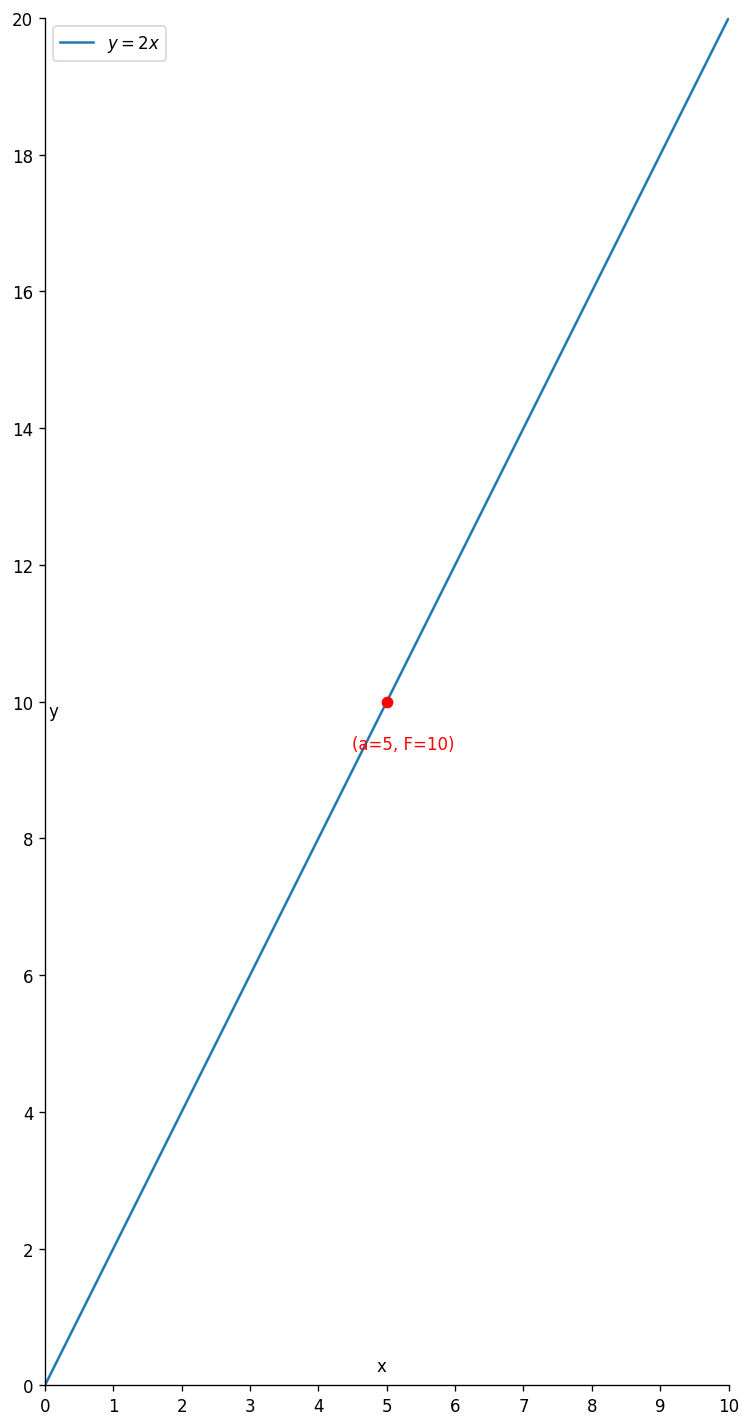
Straight-line F–a graph for a 2 kg body

Straight-line relationship

Plot force (F) on the x-axis and acceleration (a) on the y-axis for a 2 kg mass.

All points lie on a straight line through the origin, proving direct proportionality.

Key Points:

  • Doubling force doubles acceleration.
  • Slope equals \(1/m\); here it is \(1/2\).
  • Graph offers clear visual proof of the second law.

Key Takeaways

Momentum

Quantity of motion: \(p = m \times v\). Keep it handy for problems.

Role of Force

Unbalanced force changes momentum’s size or direction.

Second Law Formula

Law links force and acceleration: \(F = m \times a\).

Mass Matters

Greater mass needs larger force for same acceleration—remember this during exercises.