Everyday Push
Push Harder = Faster Cart
Concrete example: A gentle push moves the grocery cart slowly.
Observation: A stronger push speeds it up more—greater force gives greater acceleration.
Key Points:
- Push = force acting on the cart.
- Acceleration is the change in speed.
- Double the push ≈ double the acceleration. What happens to the cart?
Force vs Acceleration
Mass fixed at 2 kg
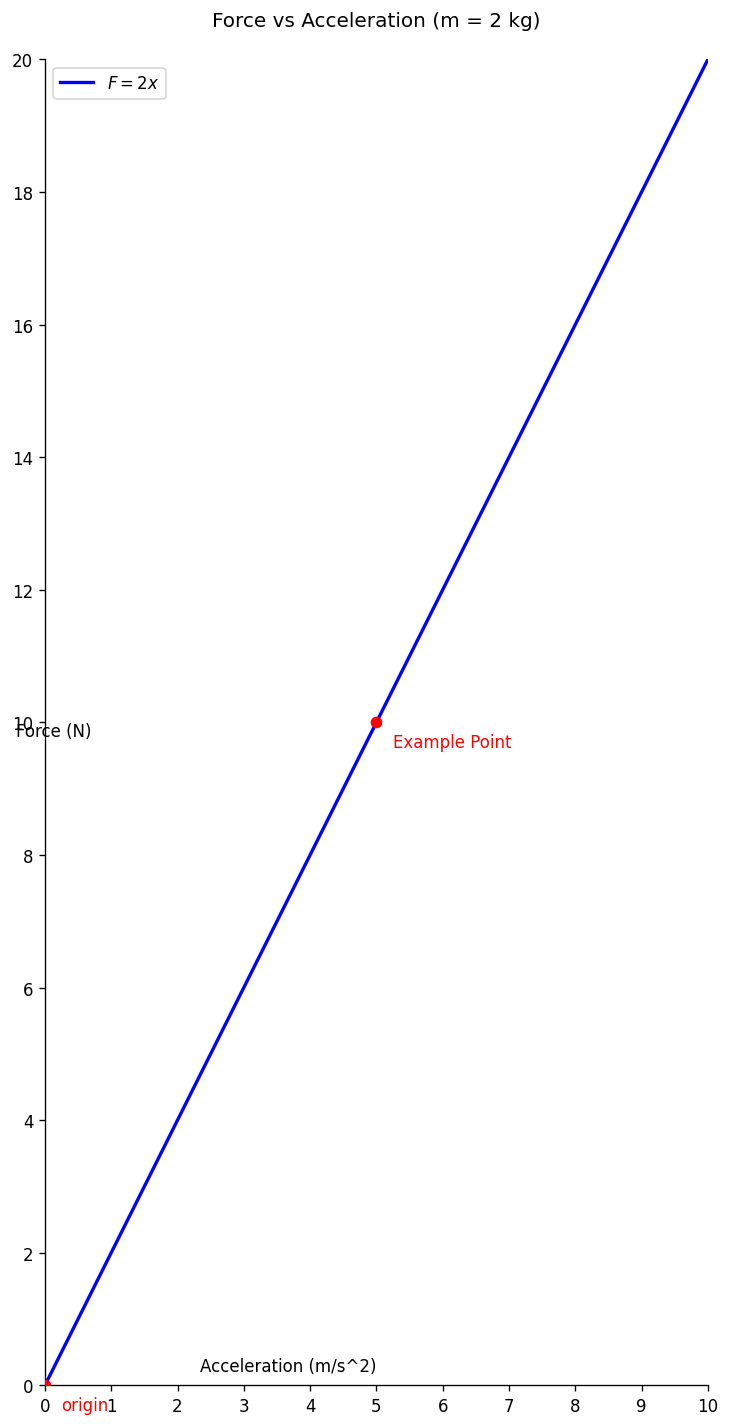
Straight-line graph for a 2 kg object
Mass fixed at 2 kg
Because \(F = m a\), keeping mass constant makes force grow linearly with acceleration.
Key Points:
- Graph is a straight line through the origin.
- Slope equals mass: 2 N per m/s².
- Double the acceleration → force doubles.