Master the Sample Paper Your roadmap to 70/70 begins with one paper.

Paper Anatomy

CBSE Physics Sample-Paper Structure

Blueprint: five sections (A–E), 33 questions, 70 marks. A: 18 MCQs ×1 mark. B: 7 very-short answers ×2 marks. C: 5 short answers ×3 marks. D: 2 case-based questions ×4 marks. E: 1 long answer ×5 marks. Question style evolves from objective to descriptive. Time tip: spend about one minute per mark. That budgets 18-14-15-8-5 minutes, leaving 10 spare.

Know the map, spot easy marks quickly.

Navigate Sections

Treat the paper like stairs—each section needs its own stride.

1

Map Marks ⇒ Minutes

List marks for Sections A–E, then assign roughly 1.2 minutes to each mark.

2

Section A – MCQ Blitz

Attempt 1-mark MCQs first; 30 seconds each builds quick momentum.

3

B & C – Short Answer Depth

For 2–3 mark questions, spend ~2.5 min per mark; include key formula and unit.

4

D & E – Case Study Reasoning

Invest 3 min per mark analysing data, structuring logic, and quoting evidence.

5

10-Minute Buffer

Use leftover time to review diagrams, units, and flagged doubts.

Pro Tip:

Reading time + buffer yields 25 minutes of calm thinking—guard it fiercely.

Multiple Choice Question

Question

A uniform electric field points along +X. Compare the electric potential at A (x = 0) and B (x = +1 cm). Choose the logically correct statement.

1
\(V_A < V_B\)
2
\(V_A > V_B\)
3
\(V_A = V_B\)

Hint:

Electric potential decreases in the direction of the field—use this trend, not memorised sign rules.

Diagram Decoding

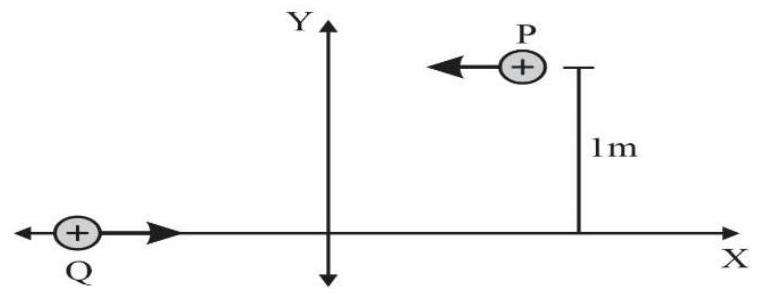
magnetic field diagram with charges P and Q

Head-On Collision Mystery

P and Q are identical positive charges moving left at equal speed.

Your task: deduce the unseen magnetic field from their curved tracks.

Key Points:

  • Lorentz force: \( \mathbf{F}=q\mathbf{v}\times\mathbf{B} \) ⟂ velocity, so paths turn circularly.
  • Use Fleming’s left-hand rule to decide if \( \mathbf{B} \) is into or out of the page.
  • Field magnitude formula: \( B = \frac{m v}{q r} \).

Section C Sketch
https://asset.sparkl.ac/pb/sparkl-vector-images/img_ncert/5aY4Q3xvy1pYojrhoCADGy9CkWQX7fdR0ekIzSm5.png

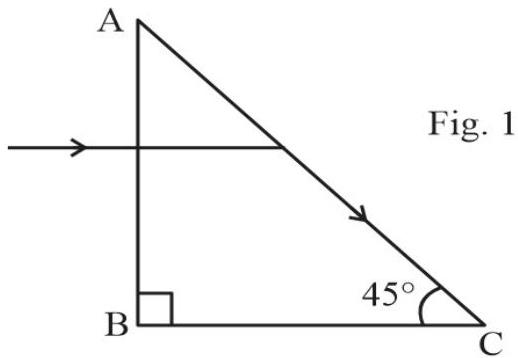
Grazing Ray in Right-Angle Prism

Goal: translate prism geometry into its refractive index.

A horizontal ray meets the 45° face and refracts to travel along the base.

Key Points:

  • Snell’s law at play: \(1\sin 45^{\circ}=n\sin 90^{\circ}\Rightarrow n=\sqrt{2}\).
  • Critical angle check: grazing ray implies \(r=90^{\circ}\) so \(C=45^{\circ}\).
  • Identical reasoning earns 3 marks in CBSE Section C.

Case Study Tactics
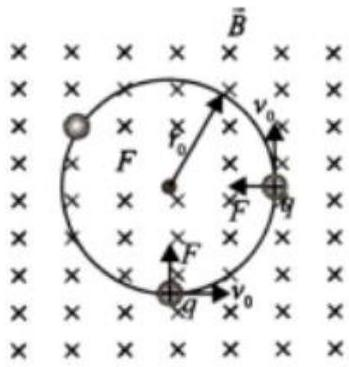
Electron path in uniform magnetic field

Electron path in uniform magnetic field

Electron’s Motion in Magnetic Field

Decide if motion is circular or helical. Then predict how speed alters radius, pitch, but never period.

Key Points:

  • \(v \perp B\) only ⇒ circle; \(r=\frac{mv}{qB}\).
  • Add \(v_{\parallel}\) ⇒ helix; pitch \(p=v_{\parallel}T\).
  • Doubling \(v\) doubles \(r\) & \(p\); \(T=\frac{2\pi m}{qB}\) stays same.
  • Spot these patterns to ace motion-in-field questions.

Sort the Questions

Drag every sample question to the section box you expect, predicting its mark weight.

Draggable Items

MCQ on Ohm’s law
Diagram-based 3 marks
Case study graph
Long derivation 5 marks

Drop Zones

Section A

Section B

Section C

Section D

Section E

Tip:

A: MCQ 1 mark, B: very short 1 mark, C: short 3 marks, D: long 5 marks, E: case study.

Graph Questions

https://asset.sparkl.ac/pb/sparkl-vector-images/img_ncert/CZ15d4kGXGFtYIVNG3SABXzsmogKfNcBA9MWOQGW.png

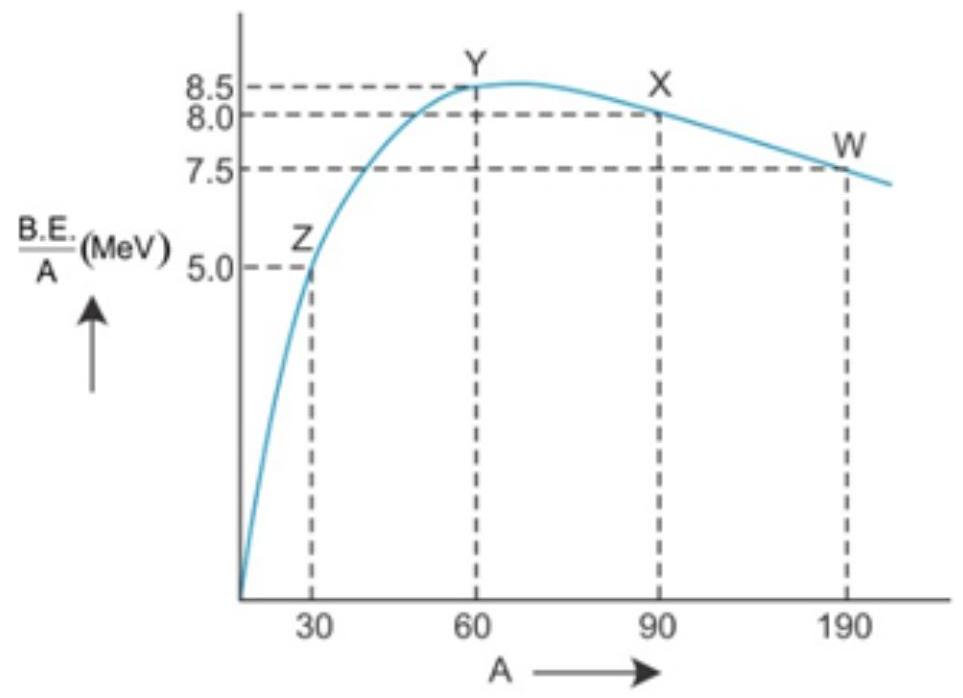
Reading the Binding-Energy Peak

Binding energy per nucleon rises and peaks near iron, then slowly falls.

Reactions that move nuclei uphill on this curve release the energy gap.

Key Points:

  • Heavy nuclei (A > 200) split—fission drives fragments toward the peak, releasing ≈ 200 MeV.
  • Light nuclei (A < 20) fuse—fusion climbs the slope and powers stars.
  • Iron–nickel peak is a stability plateau; further change yields almost no energy.

Your Action Plan

Follow the practice order: Section A (15 min) → Section B → long answers.

Use self-timing: keep a stopwatch visible and write target times beside questions.

Sketch diagrams in pencil first; ink only after labels and proportions look right.

Finish with error analysis: match marks to time spent, list weak topics, re-solve them.

Thank You!

Use this checklist to drive every practice session.