Kinetic Theory Kick-off When molecules move, gas laws groove.

What is an Ideal Gas?

Ideal Gas

Imaginary gas of point particles, no intermolecular forces, perfectly elastic collisions; therefore obeys \(PV=nRT\) at every \(T\) and \(P\).

Assumptions: molecules occupy zero volume, exert no attraction, and collide elastically. Average kinetic energy equals \(\tfrac{3}{2}k_{\rm B}T\); Boltzmann constant \(k_{\rm B}\) links single-molecule energy to temperature.

Pressure from Collisions
https://asset.sparkl.ac/pb/sparkl-vector-images/img_ncert/FnQp095U22y5XAgTdceQTGH45jfmYIK2LLjsZRzA.png

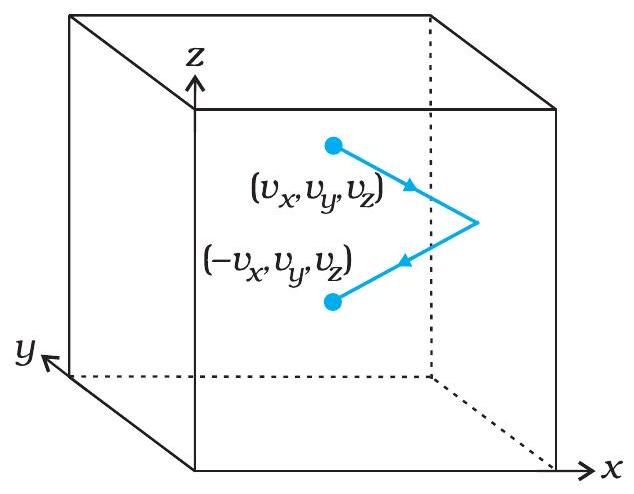
Molecule rebounds elastically from wall

How impacts create pressure

Gas molecules strike the wall in elastic collisions, reversing their normal velocity.

Each hit changes momentum by \(2 m v_x\) toward the wall.

The cumulative impulse of countless \(2 m v_x\) events per second manifests as steady gas pressure.

Key Points:

  • Only \(v_x\) matters because the wall is perpendicular to the x-axis; \(v_y\) and \(v_z\) slide along the surface.
  • Greater molecular speed or collision rate increases pressure.

Pressure Equation Build-up

1
\[\Delta p = 2 m v_x\]

One molecule hits the wall; its x-momentum reverses, giving change \(2m v_x\).

2
\[F = n A m v_x^{2}\]

Collision rate is \(n A v_x/2\). Multiply by \(\Delta p\) to obtain force on the wall.

3
\[P = n m v_x^{2}\]

Pressure is force per area; still expressed with the x-component only.

4
\[P = \frac{1}{3} n m \langle v^{2} \rangle\]

Isotropy gives \(\langle v_x^{2}\rangle = \langle v^{2}\rangle/3\), inserting the missing \(1/3\).

Key Insight:

The factor \(1/3\) emerges because, in an isotropic gas, momentum and energy split equally among x, y, and z directions.

When Real Meets Ideal

https://asset.sparkl.ac/pb/sparkl-vector-images/img_ncert/rKO2zeDLf95EXfMhN0dZcJID9zr9go2QCZJ7d5I1.png

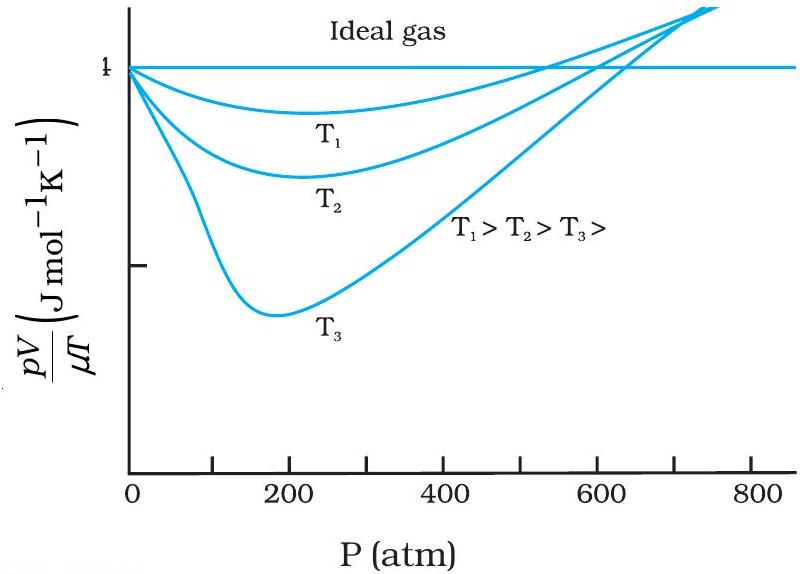
PV vs P curves for a real gas at three temperatures

Temperature tunes deviation

An ideal gas shows a flat \( PV \)-vs-\( P \) line; \( PV \) stays constant.

Experimental real-gas curves bend away from that line, marking deviation from ideal behaviour.

Higher temperature pushes molecules apart, so the curve flattens and approaches the ideal line.

Key Points:

  • Ideal line: horizontal because \( PV = RT \).
  • Real-gas curves dip then rise, revealing attractive and repulsive forces.
  • Liquefaction is most likely along the lowest curve \( T_3 \).

Temperature ↔ Kinetic Energy

\[\frac{1}{2} m v^2_{\text{avg}} = \frac{3}{2} k_B T\]

Equipartition: each degree of freedom carries \( \tfrac{1}{2} k_B T \) energy.

So absolute temperature fixes microscopic kinetic energy scale.

Variable Definitions

m mass of a molecule
\(v_{\text{avg}}\) root-mean-square speed
\(k_B\) Boltzmann constant
T absolute temperature

Applications

Explains why lighter gases move faster

For the same \(T\), smaller \(m\) gives larger \(v_{\text{avg}}\).

Basis for estimating stellar core temperatures

Observed particle speeds back-calculate \(T\) using \( \frac{3}{2} k_B T \).

Key Takeaways

Lock these in!

📦

Gas ≈ Busy box of bullets

Pressure arises from countless molecular hits on walls; momentum change per second equals \(P A\).

📈

PV ∝ T

For an ideal gas \(PV = nRT\); fix \(n\), any two variables determine the third.

T measures energy

Absolute temperature tracks mean kinetic energy: \(\frac{3}{2}kT = \langle \tfrac{1}{2}mv^{2}\rangle\).

🎯

Ideal vs Real

Model fails at high pressure or low temperature where intermolecular forces matter.

Test Your Insight

Question

At 300 K, which gas has the highest rms speed?

1
O₂
2
N₂
3
He
4
CO₂

Hint:

\(v_{\text{rms}} \propto \frac{1}{\sqrt{M}}\)