All Points with Equal Sum
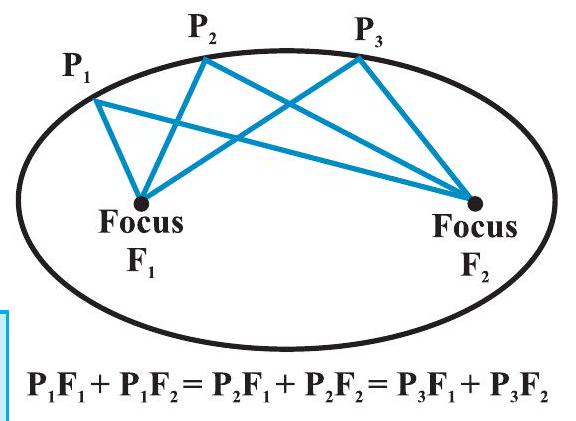
Ellipse: points whose distances to two foci add to a constant.
Geometric Definition of an Ellipse
Place two fixed points called foci, \(F_1\) and \(F_2\).
Any point \(P\) where \(PF_1 + PF_2\) stays constant lies on the ellipse.
Thus, an ellipse is the locus defined by this constant-sum rule.
Key Points:
- Constant value must be greater than the distance \(F_1F_2\).
- Closer foci make the ellipse rounder; farther foci stretch it.
- Quiz: Which everyday running track follows this two-focus rule?
Name the Parts
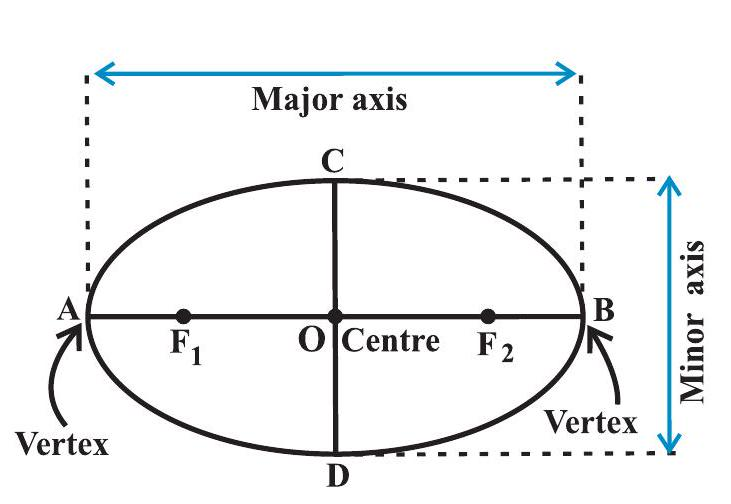
Locate each feature on an ellipse
Find the centre first, then use it to spot every other part.
Key Points:
- Major axis: longest chord through the centre.
- Minor axis: shorter chord perpendicular to the major axis.
- Vertices: endpoints of each axis.
- Centre: intersection of the two axes.
- Foci: two fixed interior points on the major axis.
Meet a, b and c
In any origin-centred ellipse, the three parameters relate like Pythagoras.
Variable Definitions
Applications
Consistency Check
Test numbers: does \(4^{2}=5^{2}-3^{2}\)? Yes, so they form an ellipse.
Locate Foci
Compute \(c=\sqrt{a^{2}-b^{2}}\) then plot points \((\pm c,0)\).
Visualising a, b, c
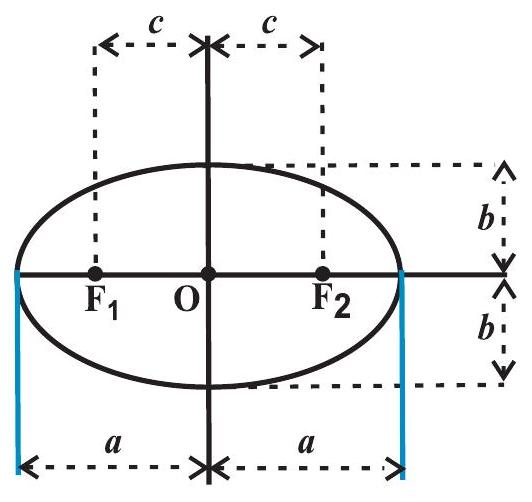
Ellipse annotated with \(2a, 2b\) and \(c\).
From Symbols to Lengths
An ellipse has three key lengths measured from its centre.
Seeing them on the graph links symbols to real distances.
Key Points:
- \(2a\): full major-axis length.
- \(2b\): full minor-axis length.
- Foci are \(c\) units from centre on the major axis.
Standard Equation
Start with the constant-sum definition of an ellipse.
Express each distance using the distance formula.
Square, simplify, and rearrange to obtain the standard form.
Key Insight:
Any \((x,y)\) that satisfies the equation lies on the ellipse.
Latus Rectum
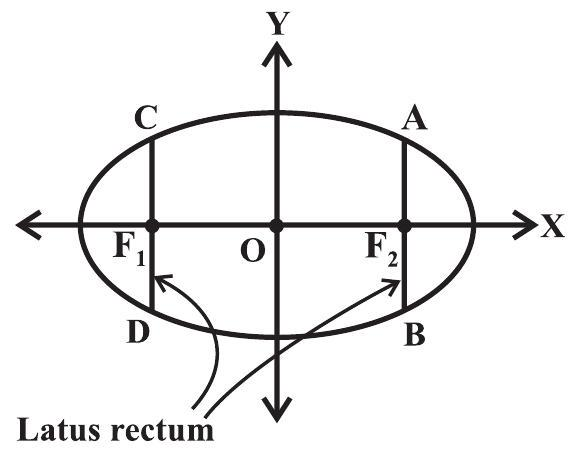
Definition & Formula
The latus rectum is a special chord that passes through a focus and is perpendicular to the major axis.
Its length is \(2\,\frac{b^{2}}{a}\).
Example: with \(a = 5\) and \(b = 3\), length = \(2\,\frac{3^{2}}{5} = \frac{18}{5}\) units.
Key Points:
- Chord through a focus
- Perpendicular to the major axis
- Length \(2b^{2}/a\)