Formal Definition
Ellipse
An ellipse is all points in a plane whose distances to two fixed foci add to the same constant.
Quick check: If the constant sum is 10 cm and one focus is 6 cm from point P, how far is P from the other focus? Answer: 4 cm
Constant-Sum Property
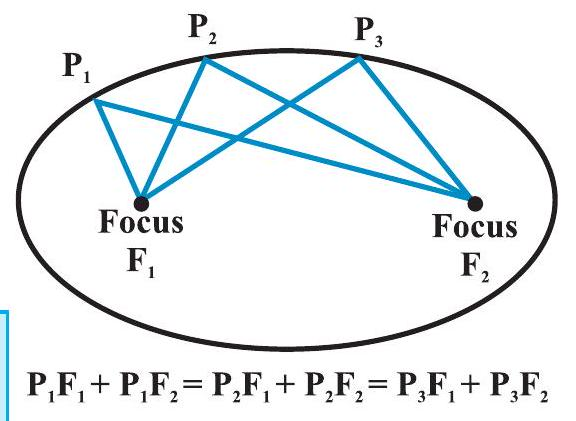
Red segments: \(PF_1 + PF_2\) stays constant
One Simple Rule Shapes the Ellipse
An ellipse is the set of all points \(P\) for which the sum of distances to two fixed points—the foci \(F_1\) and \(F_2\)—is constant.
Watch point \(P\) move. As \(PF_1\) shortens and \(PF_2\) lengthens, their combined length never changes, so the path naturally traces the curve.
Key Points:
- Two fixed points are the foci \(F_1, F_2\).
- For any point \(P\), \(PF_1 + PF_2 = 2a\) (a constant).
- Fixing this sum draws the complete ellipse.
Key Parts
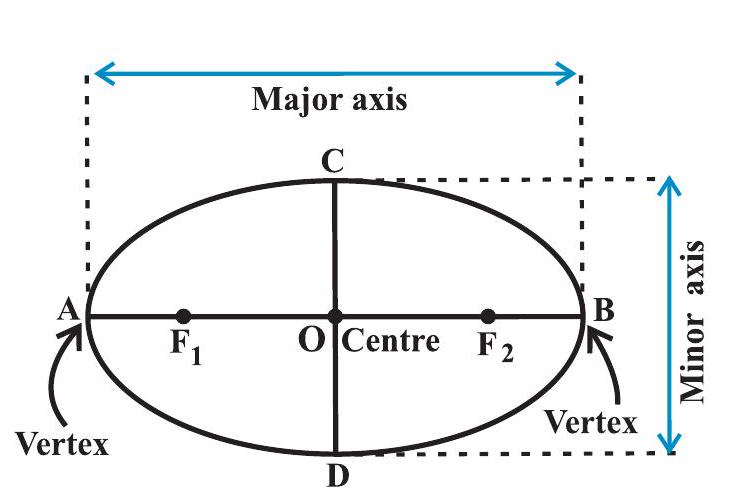
Ellipse with labelled axes and vertices
Parts of an Ellipse
Two perpendicular axes cross at centre \(O\), defining the key components of the ellipse.
Key Points:
- Major axis: longest diameter; runs through widest points.
- Minor axis: shortest diameter; perpendicular to major axis.
- Vertices: four points where axes meet the curve.
- Centre \(O\): midpoint where axes cross; symmetry point.
Semi-Lengths & Focus Gap
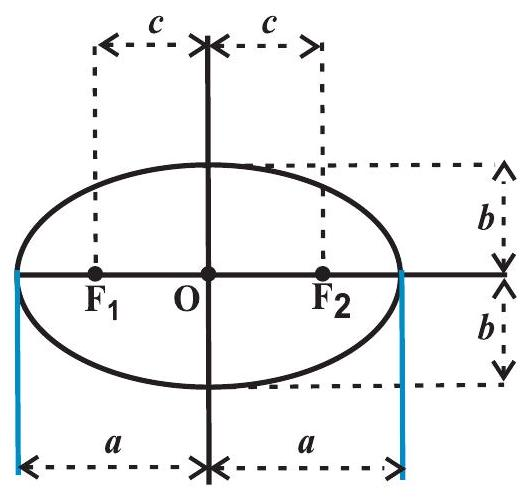
Relating \(a\), \(b\) and \(c\)
An ellipse is governed by three parameters.
Semi-major \(a\) and semi-minor \(b\) are half the major and minor axes.
Focal distance \(c\) measures the centre-to-focus gap.
Key Points:
- \(a \ge b > 0\)
- Relation: \(c = \sqrt{a^{2}-b^{2}}\)
- Flatter ellipse when \(b/a\) is smaller
Why \(a^{2}=b^{2}+c^{2}\)?
Goal: derive the relation linking semi-axes \(a, b\) and focal distance \(c\).
Distance formula
Write \(PF_{1}=\sqrt{(x+c)^{2}+y^{2}}\) and \(PF_{2}=\sqrt{(x-c)^{2}+y^{2}}\).
Ellipse definition
Set \(PF_{1}+PF_{2}=2a\).
Square & simplify
Isolate a radical, square twice, then collect like terms.
Relation revealed
\(x\) and \(y\) cancel, leaving \(a^{2}=b^{2}+c^{2}\).
Pro Tip:
Imagine a right triangle with legs \(b\) and \(c\); its hypotenuse is \(a\).
Standard Equations
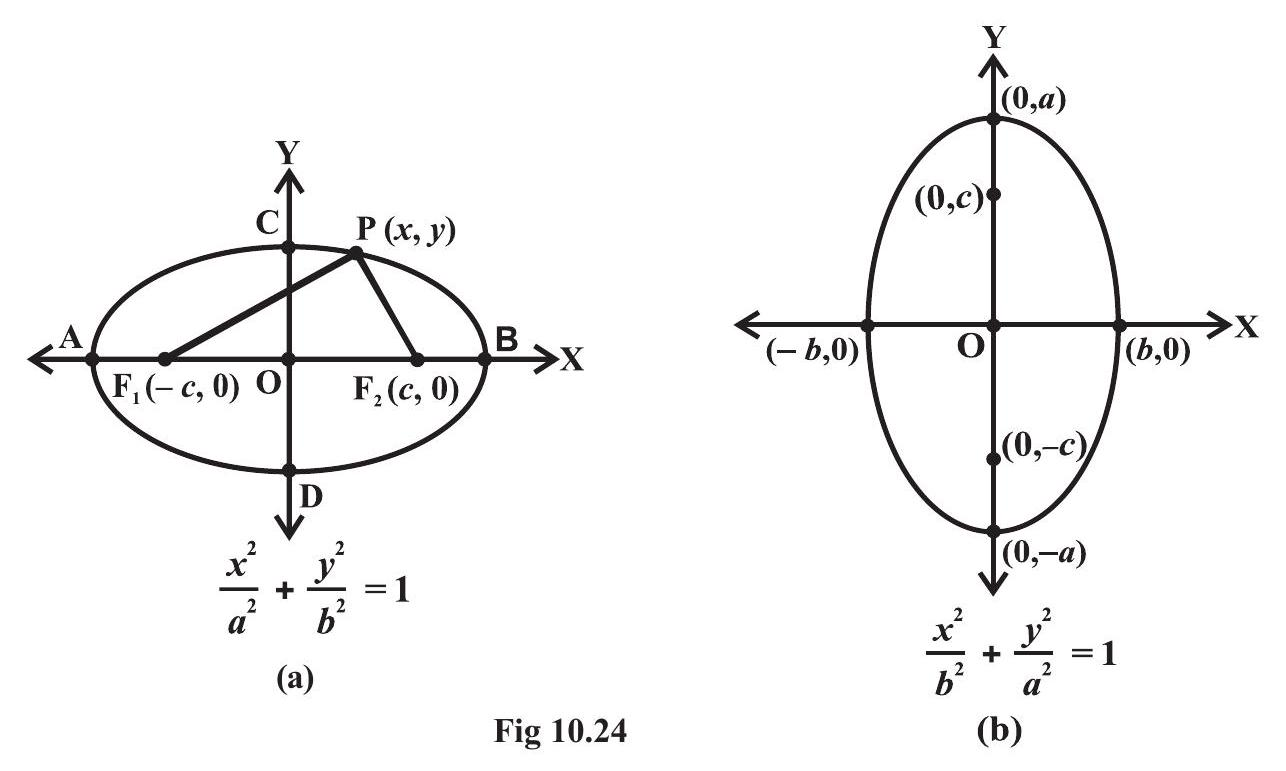
Horizontal vs Vertical major axis
Which axis gets \(a^{2}\)?
Both forms satisfy \( \frac{x^{2}}{a^{2}} + \frac{y^{2}}{b^{2}} = 1\) with \(a \ge b\).
If \(a^{2}\) sits under \(x^{2}\), the major axis is horizontal; if under \(y^{2}\), it is vertical.
Key Points:
- Horizontal major axis: \( \frac{x^{2}}{a^{2}} + \frac{y^{2}}{b^{2}} = 1\)
- Vertical major axis: \( \frac{x^{2}}{b^{2}} + \frac{y^{2}}{a^{2}} = 1\)