String-Pin Definition
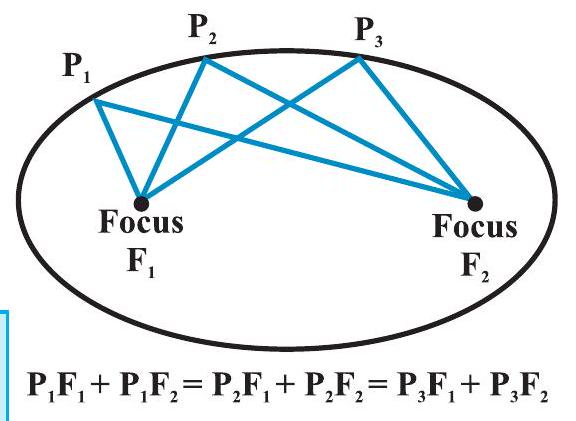
Constant-Sum Property
An ellipse is the locus of all points \(P\) such that \(PF_{1}+PF_{2}\) remains constant.
Key Points:
- Constant string length gives \(PF_{1}+PF_{2}=2a\).
- Two foci are needed; one focus would form a circle.
Naming the Parts
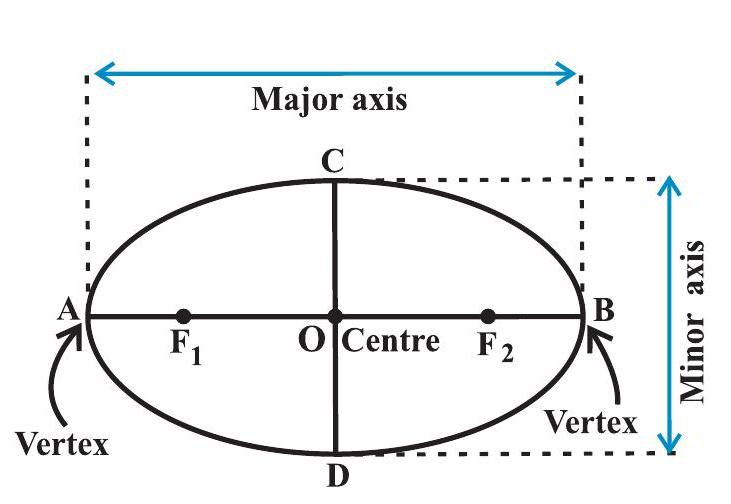
Standard ellipse with axes, centre, vertices, and foci.
Parts of an Ellipse
An ellipse has two perpendicular symmetry lines: the major axis and the minor axis.
The major axis is the longest chord; its endpoints are called vertices.
The minor axis is the shortest chord and meets the major axis at the centre.
Two fixed points on the major axis, equidistant from the centre, are the foci.
Key Points:
- Major axis: longest chord, length \(2a\).
- Minor axis: shortest chord, length \(2b\).
- Vertices: endpoints of major axis \((\pm a,0)\).
- Centre: midpoint of both axes \((0,0)\).
- Foci: points \((\pm c,0)\) where \(c^{2}=a^{2}-b^{2}\).
Parameters a, b, c
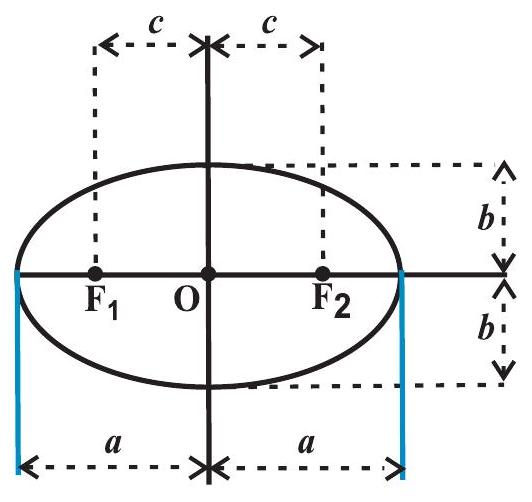
Semi-axes and focal distance
The ellipse is governed by three parameters: semi-major axis \(a\), semi-minor axis \(b\) and focal distance \(c\).
These values define its size, flatness and the position of its two foci.
Key Points:
- Relationship: \(b^{2}=a^{2}-c^{2}\).
- As \(c\) approaches \(a\), \(b\) decreases and the ellipse stretches.
- If \(c=0\), then \(b=a\); the curve becomes a circle.
Standard Forms
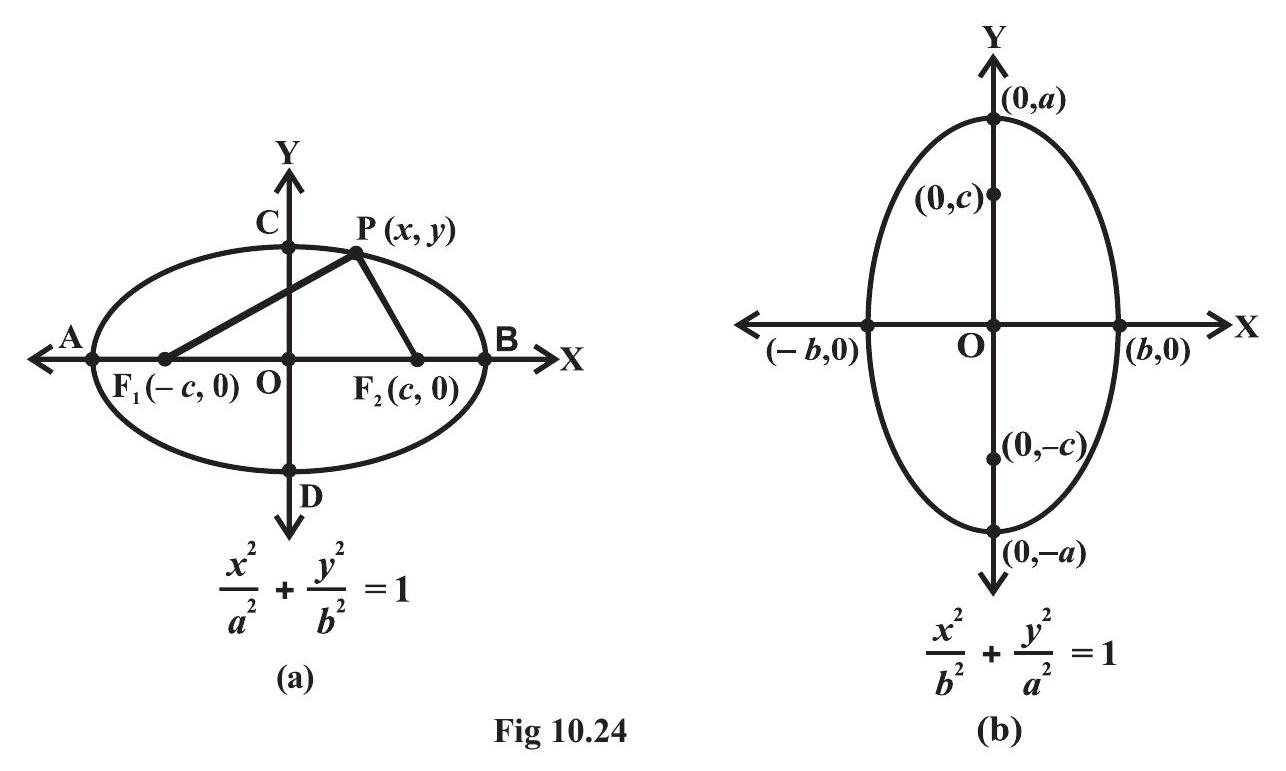
Ellipse with horizontal and vertical axes
Ellipse: choose the right standard equation
Identify the major axis, then write the matching standard equation.
Key Points:
- Horizontal major axis: \( \frac{x^{2}}{a^{2}} + \frac{y^{2}}{b^{2}} = 1 \)
- Vertical major axis: \( \frac{x^{2}}{b^{2}} + \frac{y^{2}}{a^{2}} = 1 \)
- For both, \( b^{2} = a^{2} - c^{2} \)
e vs b/a Curve
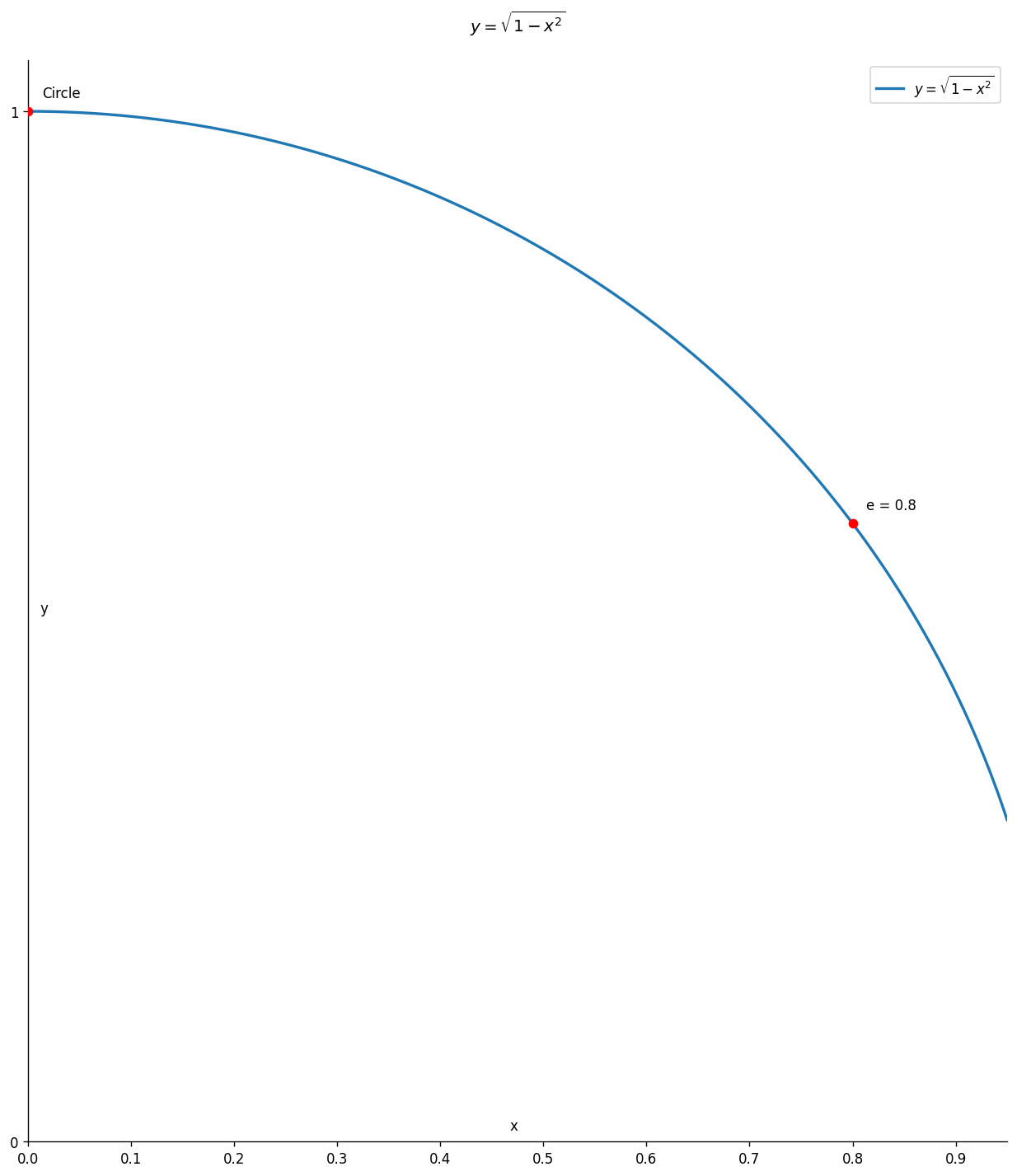
Curve of \( \frac{b}{a} = \sqrt{1-e^{2}} \)
Eccentricity vs Semi-minor Ratio
Graph displays the relationship \( \frac{b}{a} = \sqrt{1-e^{2}} \) between eccentricity and semi-minor ratio.
As \(e\) rises, \(b/a\) falls, flattening the ellipse.
Key Points:
- \(e = 0\): \(b/a = 1\) — circle
- \(e = 0.6\): \(b/a \approx 0.8\) — moderate flattening
- \(e \to 1\): \(b/a \to 0\) — almost a line