Cone Slice View
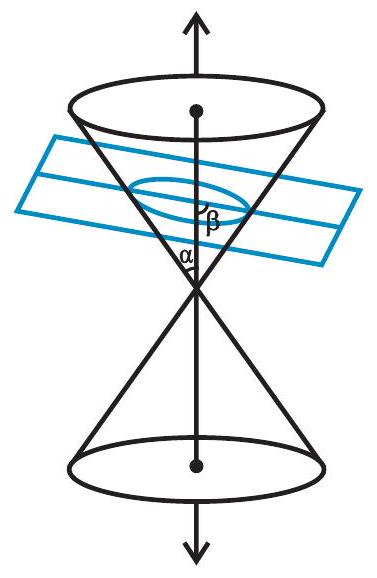
Tilted plane slicing a cone produces an ellipse.
Ellipse from a Tilted Plane
A right circular cone cut by a slanted plane, within a single nappe, creates an ellipse.
More tilt makes the ellipse slimmer; less tilt makes it closer to a circle.
Key Points:
- Plane angle is steeper than the base but flatter than the cone side.
- Cut stays within one nappe, giving a closed, oval curve.
- Changing the tilt alters size and eccentricity, not the conic type.
Focus Magic
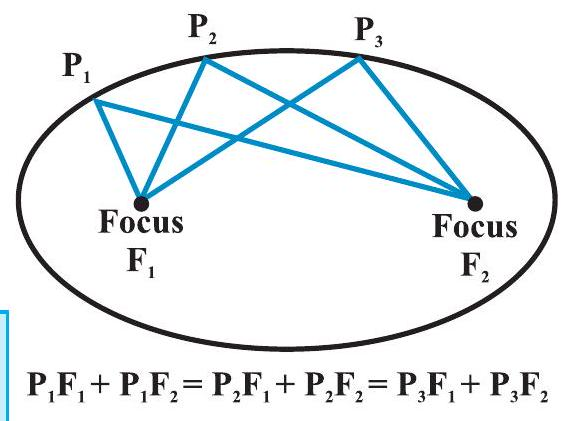
Ellipse with foci \(F_1\) and \(F_2\)
Constant-Sum Locus
An ellipse is the locus of all points \(P\) such that \(PF_1 + PF_2\) is constant.
That unchanging sum defines the curve’s size—move \(P\) anywhere and the value stays fixed.
Key Points:
- Foci \(F_1\) and \(F_2\) stay fixed inside the ellipse.
- Constant sum \(PF_1 + PF_2 = k\).
- Quiz: If one measurement gives \(10\text{ cm}\), what is \(k\) for all points?
Key Distances
Variable Definitions
Applications
Find Foci
Given \(a\) and \(b\), compute \(c\) to locate the two foci.
Check Validity
Test if lengths satisfy \(c^{2}=a^{2}-b^{2}\) to confirm an ellipse exists.
Equation Build-Up
Distance-sum rule for an ellipse with foci \((\pm c,0)\); major axis length \(2a\).
Square once to begin eliminating radicals; collect like terms.
Isolate the remaining radical, square again, and substitute \(b^{2}=a^{2}-c^{2}\).
Divide by \(a^{2}b^{2}\) to reach the standard equation centred at the origin.
Key Insight:
The link \(b^{2}=a^{2}-c^{2}\) ties focal spacing to axis lengths, sealing the derivation.
Ellipse Plot
What the graph shows
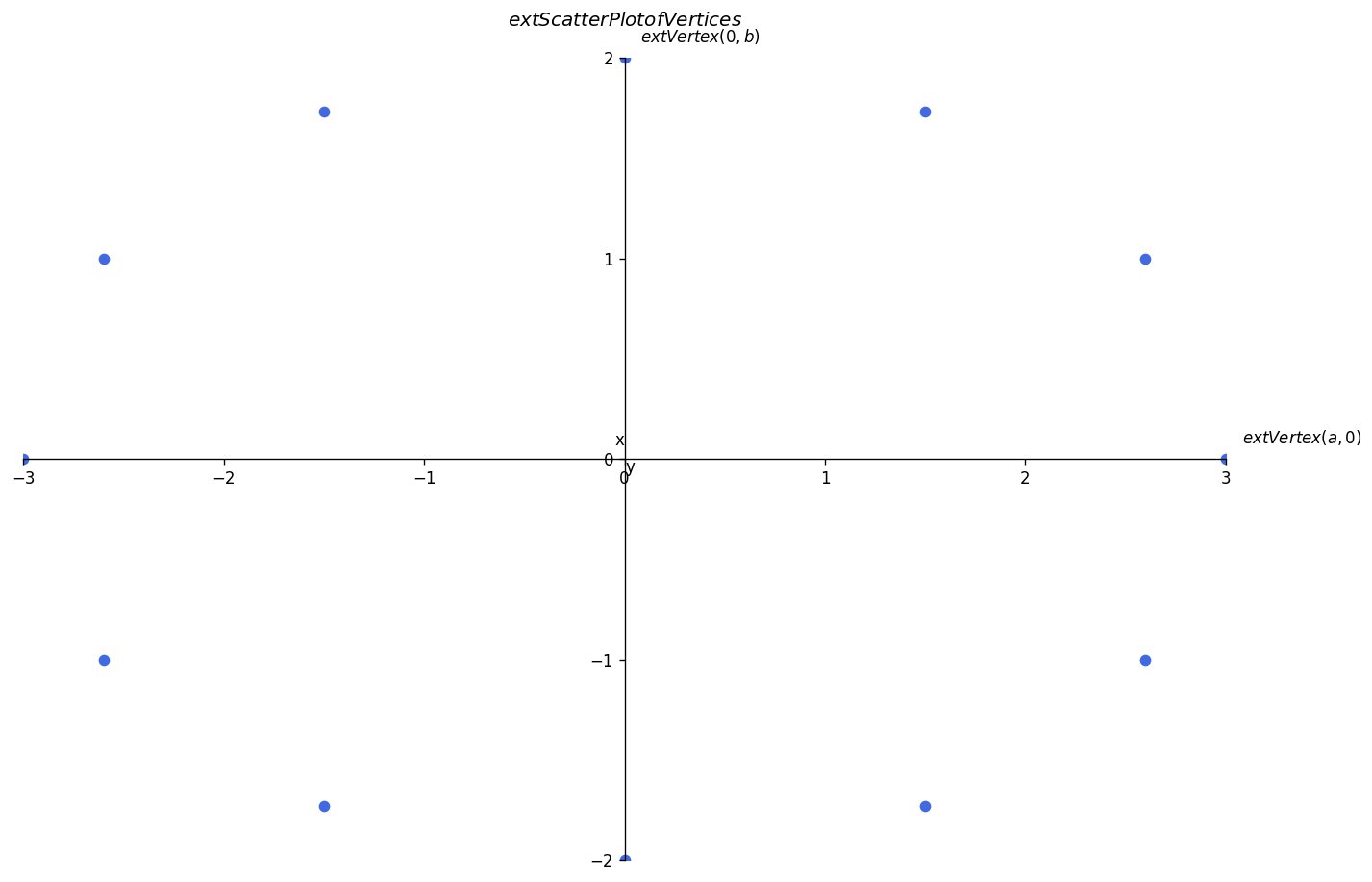
This graphical view plots the ellipse \( \frac{x^{2}}{9} + \frac{y^{2}}{4} = 1 \) on the coordinate plane.
The curve crosses the x-axis at \((\pm3,0)\) and the y-axis at \((0,\pm2)\).
These intercepts equal the semi-major axis \(a = 3\) and semi-minor axis \(b = 2\) introduced earlier.
Key Points:
- Graphical view makes the oval shape clear.
- Ends on x-axis: \((\pm3,0)\).
- Ends on y-axis: \((0,\pm2)\).