Constant Sum Magic
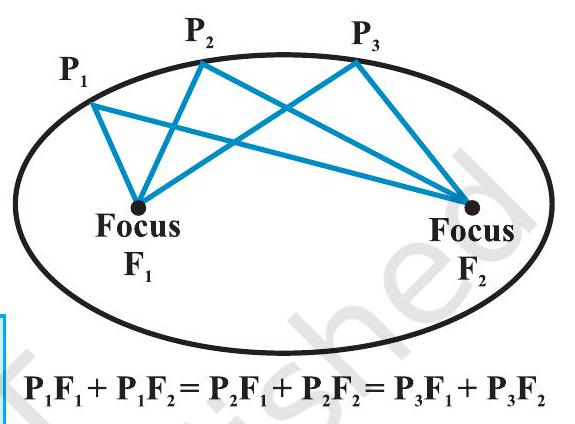
Why does the ellipse behave this way?
Visual intuition: an ellipse is the set of points P whose distances to two foci always add to the same value.
Move P along the curve; rulers show \(PF_1\) and \(PF_2\). Their sum stays constant—this is the constant-sum rule.
Key Points:
- F₁ and F₂ are called the foci.
- For every P on the ellipse, \(PF_1 + PF_2\) is constant.
- String-and-pins demo: string length = major axis (e.g., 12 cm when pins are 8 cm apart).
Axes & Parts
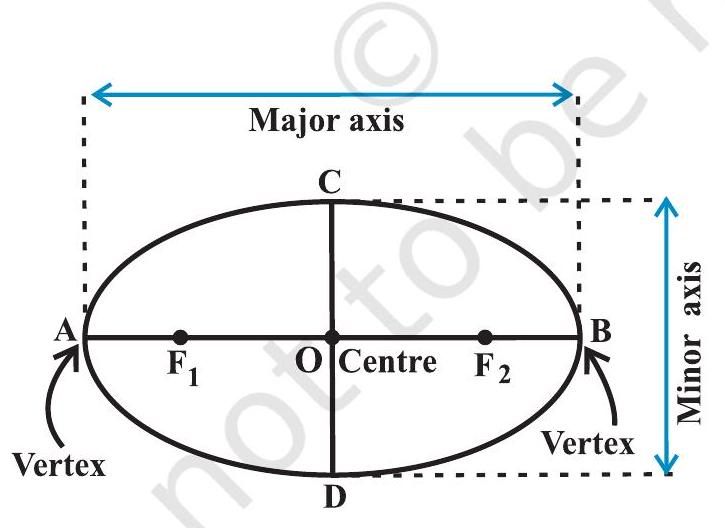
Terminology
An ellipse has two perpendicular axes that meet at the centre.
Key Points:
- Centre: intersection point of the two axes.
- Major axis: longest chord through the centre.
- Minor axis: shortest chord through the centre.
- Vertices: endpoints of each axis.
- Foci: two internal points on the major axis.
Standard Form
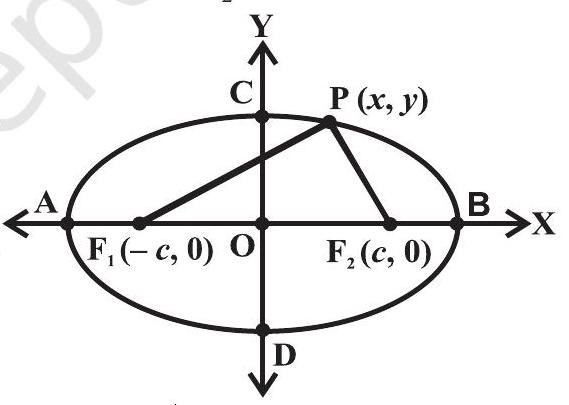
Ellipse centred at origin
The canonical equation is \( \frac{x^{2}}{a^{2}} + \frac{y^{2}}{b^{2}} = 1 \).
Centre \( (0,0) \); every point \( (x,y) \) obeying it lies on the curve.
Key Points:
- Called the standard form of an ellipse.
- Major axis length \(2a\) lies along the x-axis.
- Minor axis length \(2b\) lies along the y-axis.