What is an Ellipse?
Ellipse
The locus of plane points whose distances to two fixed points (foci) add up to the same constant.
This is the formal locus definition of an ellipse.
Standard Equation View
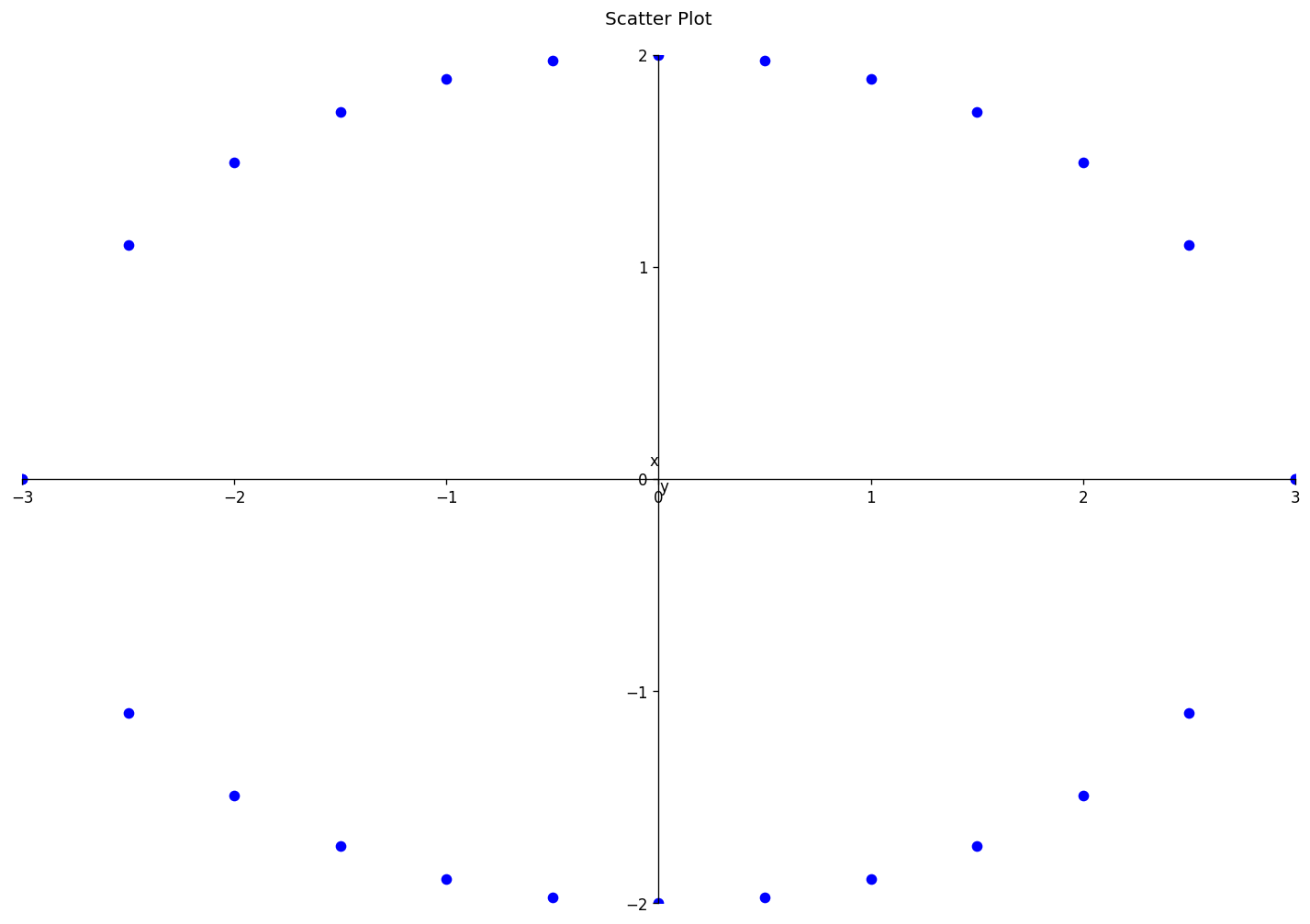
Example: \( \frac{x^{2}}{9} + \frac{y^{2}}{4} = 1 \)
Every point \((x, y)\) on this curve obeys the standard equation.
Semi-major axis: \(a = 3\) units along the x-direction.
Semi-minor axis: \(b = 2\) units along the y-direction, giving a tighter vertical span.
Key Points:
- Standard form links algebra to shape: \( \frac{x^{2}}{a^{2}} + \frac{y^{2}}{b^{2}} = 1 \).
- Semi-major axis \(a = 3\) → wider spread along x-axis.
- Semi-minor axis \(b = 2\) → narrower stretch along y-axis.
Focus–Directrix Insight
One focus and one line can generate every ellipse—here’s how.
Pick Focus & Directrix
Fix a point \(F\) and a non-intersecting line \(D\) in the plane.
Set Eccentricity \(e\)
Choose \(0 < e < 1\) and demand the ratio \(\\frac{PF}{PD}=e\) for all positions of \(P\).
Trace the Locus
The set of all points \(P\) satisfying the ratio forms a smooth closed curve—the ellipse.
Pro Tip:
Smaller \(e\) makes the ellipse more circular; as \(e\) approaches 1, it stretches out.
Equation Derivation
By definition, an ellipse keeps the sum of distances from any point \(P\) to the foci constant \(2a\).
Insert coordinates \(F(-c,0)\), \(F'(c,0)\) and apply the distance formula to point \(P(x,y)\).
Isolate one radical to prepare for systematic squaring.
Square both sides once, expand, and collect like terms.
After eliminating radicals and simplifying, divide by \(a^2b^2\) to obtain the standard form.
Key Insight:
Geometry meets algebra through \(b^2 = a^2 - c^2\); this link turns the distance-sum rule into the elegant equation \(x^2/a^2 + y^2/b^2 = 1\).
Multiple Choice Question
Question
Which statement is true for every point on an ellipse with foci \(F_{1}\) and \(F_{2}\)?
Hint:
Recall the geometric definition of an ellipse.
Correct!
Exactly. A fixed sum of distances defines an ellipse.
Incorrect
Check the definition: for an ellipse, the sum (not difference or product) stays constant.
Ellipse vs Circle
Ellipse
Circle
Key Similarities
Key Takeaways
Foci Anchor Shape
An ellipse is all points whose distances to two foci add to a constant.
Equation Reveals Geometry
Standard form \( \frac{x^{2}}{a^{2}}+\frac{y^{2}}{b^{2}} = 1 \) turns geometric distances into algebraic balance.
Parameters Shape Size
Semi-axes \(a, b\) set width and height; eccentricity \(e=\sqrt{1-\frac{b^{2}}{a^{2}}}\) gauges flatness.