What is an Ellipse?

Ellipse

A locus of points in a plane whose sum of distances from two fixed points – the foci – is constant.

Quiz: If the constant sum is 10 cm, where can the foci never be? Apply the triangle inequality.

```html

Focus Magic

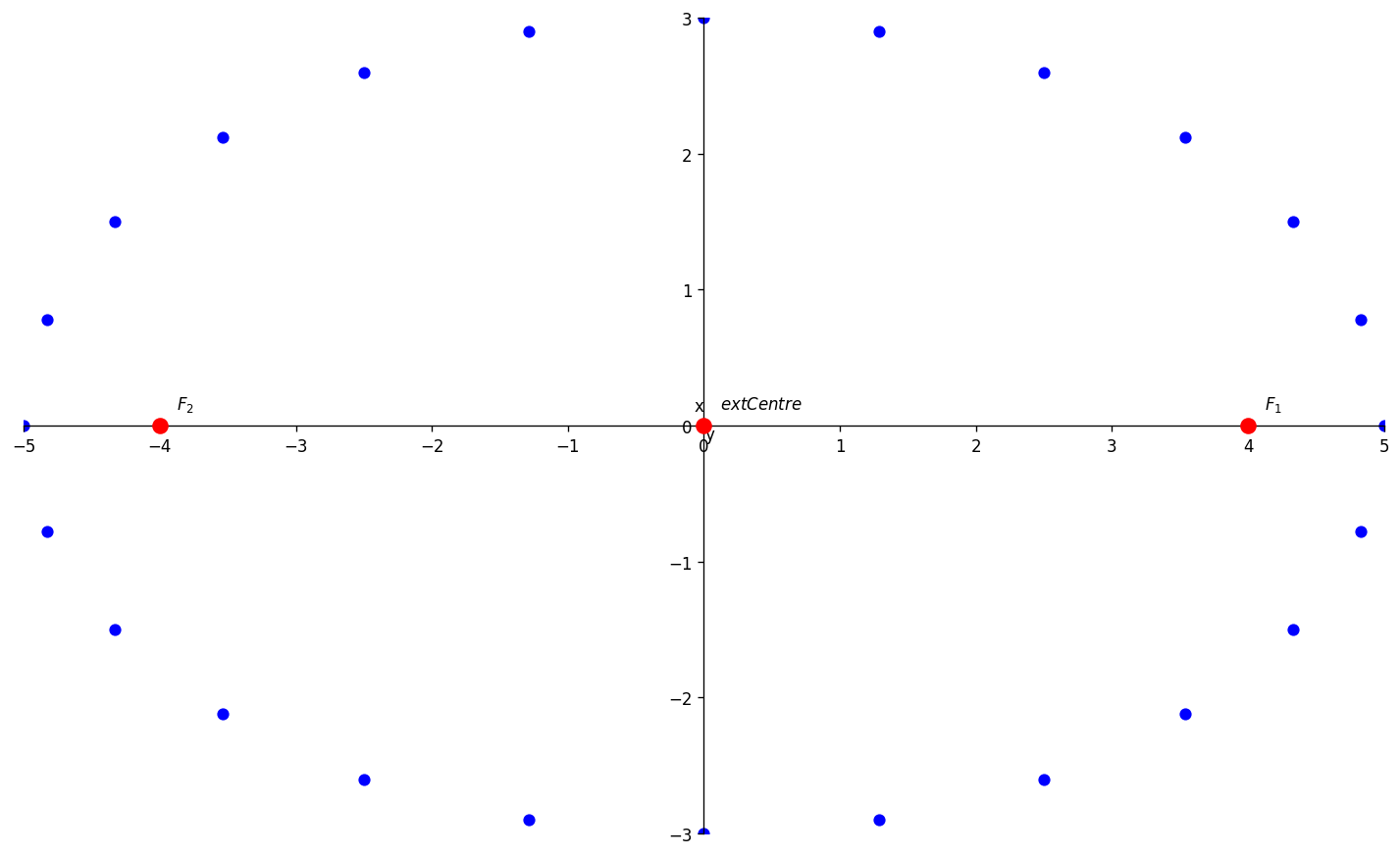
Ellipse sketch with foci

Geometry sketch: ellipse with two foci \(F_1\) and \(F_2\).

Constant-Sum Property

Each blue point \(P\) on the sketch obeys \(PF_1 + PF_2 = 10\,\text{cm}\).

The fixed 10 cm string keeps its ends at the foci while the pointer roams, tracing the ellipse.

Key Points:

  • Foci \(F_1\) and \(F_2\) are highlighted in red.
  • Sum of distances to the foci stays constant at 10 cm.
  • This rule defines and visualises an ellipse.
```

Standard Equation

\[\frac{x^{2}}{a^{2}}+\frac{y^{2}}{b^{2}}=1\]

Centre at origin; major axis horizontal. Equation links coordinates to squared axis lengths \(a^{2}\) and \(b^{2}\).

Variable Definitions

a semi-major axis (half horizontal length)
b semi-minor axis (half vertical length)

Applications

Planetary orbit modelling

Planet paths around the Sun are nearly elliptical.

Optical reflector design

Elliptical mirrors focus rays between two foci.

Focus Distance Relation

1
\[P(x, y)\ \text{ on }\ \frac{x^{2}}{a^{2}}+\frac{y^{2}}{b^{2}}=1\]

Algebraic model of the ellipse in standard form.

2
\[\lvert PF_{1}\rvert=\sqrt{(x-c)^{2}+y^{2}},\quad \lvert PF_{2}\rvert=\sqrt{(x+c)^{2}+y^{2}}\]

Geometry link: distances to foci \(F_{1}(-c,0)\) and \(F_{2}(c,0)\).

3
\[\lvert PF_{1}\rvert+\lvert PF_{2}\rvert=2a \;\;\Rightarrow\;\; c^{2}=a^{2}-b^{2}\]

Sum property gives major axis length \(2a\); algebra proves \(c^{2}=a^{2}-b^{2}\).

Key Insight:

As \(b\) approaches \(a\), the ellipse flattens into a circle and the foci converge to the centre.

```html

Eccentricity Unpacked

1
๐Ÿงฎ

Define

Eccentricity \(e=\frac{c}{a}\). For any ellipse \(0\le e<1\).

2
๐Ÿ”

Special cases

\(e=0\) gives a circle; \(e\) near 1 yields a stretched ellipse.

3
๐Ÿ“

Compute quickly

Find \(c=\sqrt{a^{2}-b^{2}}\) then \(e=\frac{c}{a}\).

Pro Tip:

Larger \(e\) signals more flattening.

```

Multiple Choice Question

Question

Which equation is an ellipse centred at the origin with its major axis along the \(y\)-axis?

1
\( \dfrac{x^{2}}{9} + \dfrac{y^{2}}{25} = 1 \)
2
\( \dfrac{x^{2}}{16} - \dfrac{y^{2}}{9} = 1 \)
3
\( y = 2x^{2} + 3 \)
4
\( (x-2)^{2} + (y+1)^{2} = 16 \)

Hint:

Look for the plus sign and unequal positive denominators.

```html

Key Takeaways

Ellipses in a nutshell

๐ŸŽฏ

Locus idea

Sum of distances to two foci stays constant.

๐Ÿ“

Standard form

\( \frac{x^{2}}{a^{2}} + \frac{y^{2}}{b^{2}} = 1 \)\, (\(a \ge b\)).

๐Ÿ”—

Foci distance

\( c^{2} = a^{2} - b^{2} \) links axes to foci.

๐Ÿ“Š

Eccentricity

\( e = \frac{c}{a} \) quantifies ovalness.

๐Ÿ› ๏ธ

Dynamic view

Changing \( a \) & \( b \) reshapes, keeping area \( \pi a b \).

๐Ÿš€

Next

Up next: parametric form & real-world applications.

```