Meet Covalent Bonds

Two hydrogen atoms share one electron pair to form H₂.
Atoms share electrons to stay stable
A covalent bond forms when two atoms share one or more pairs of electrons.
Example: In hydrogen gas (H₂) each H atom shares its single electron, so both feel a full first shell.
Key Points:
- Covalent bond = shared electron pair.
- Hydrogen + Hydrogen → H₂ by sharing one pair.
- Sharing keeps both atoms electrically neutral.
Carbon’s Four Hands

Model of methane \(CH_4\)
Carbon Valency = 4
Carbon has four valence electrons, giving it a valency of 4.
By sharing each electron with a hydrogen atom, carbon forms methane, \(CH_4\).
Key Points:
- Carbon’s valency is 4.
- Methane \(CH_4\) proves this: carbon bonds with 4 hydrogens.
Single, Double, Triple
Bond multiplicity counts shared pairs. Goal: spot the difference between single, double and triple covalent bonds.
Single Bond
Atoms share one electron pair. Longest and weakest covalent bond.
Double Bond
Atoms share two pairs. Stronger and shorter than a single bond.
Triple Bond
Atoms share three pairs. Shortest and strongest covalent bond.
Pro Tip:
More shared pairs = stronger and shorter bond.
Diamond – A Hard Giant

Tetrahedral network of carbon atoms
Diamond is an allotrope of carbon built from a continuous tetrahedral network.
Each carbon atom shares electrons with four others, forming strong covalent bonds in 3-D.
Key Points:
- Pure carbon allotrope made only of C–C bonds.
- 4 bonds per atom give a rigid tetrahedral lattice.
- Endless 3-D lattice makes diamond the hardest natural material.
Graphite – Layers that Slide

Layered Structure & Properties
Graphite is an allotrope of carbon built from flat, hexagonal sheets stacked one above another.
Weak forces between the layered sheets let them slide easily, so graphite feels soft and writes smoothly.
Each carbon contributes one delocalised electron that moves within a sheet, giving the material good electrical conductivity.
Key Points:
- Allotrope: Graphite has layered sheets of carbon atoms.
- Layer sliding → softness; free electrons within a sheet → conductivity.
Diamond vs Graphite
Diamond
Graphite
Key Similarities
Saturated Chains

Ball-and-stick model of ethane
Ethane: a Saturated Hydrocarbon
Ethane (C₂H₆) shows what “saturated” means.
Its two carbons share one single C–C bond; each carbon is filled by hydrogen.
Quiz: Propane has ___ carbon–carbon double bonds.
Key Points:
- Only single bonds between carbon atoms.
- Follow general formula \(C_nH_{2n+2}\).
Homologous Series
Homologous Series
A group of organic compounds with the same general formula. Each successive member differs by exactly one \(–\mathrm{CH_{2}}\) unit. This constant gap causes gradual changes in physical properties.
{% if context %}{{ context }}
Source: {{ source }}
Isomers of Butane
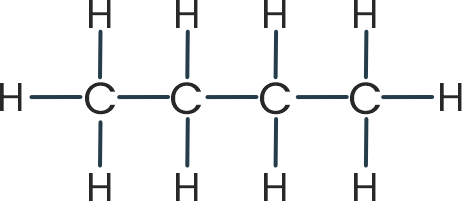
Straight-chain (n-butane) vs branched (iso-butane)
One formula, two shapes
Butane \( \mathrm{C_4H_{10}} \) exhibits structural isomerism.
It exists as a straight chain and a branched ‘T’, sharing the same formula but different atom arrangement.
Key Points:
- Straight chain: CH3-CH2-CH2-CH3
- Branched chain: (CH3)3-CH
- Different shapes ⇒ different physical properties; branched boils lower.
- Demonstrates how one formula can give multiple structures.