What is a Circle?
Circle
A circle is the set of all points in a plane equidistant from one fixed point called the centre. That constant distance is the radius.
Example: if each point is 5 cm from the centre, the radius is 5 cm.
Chord vs Arc
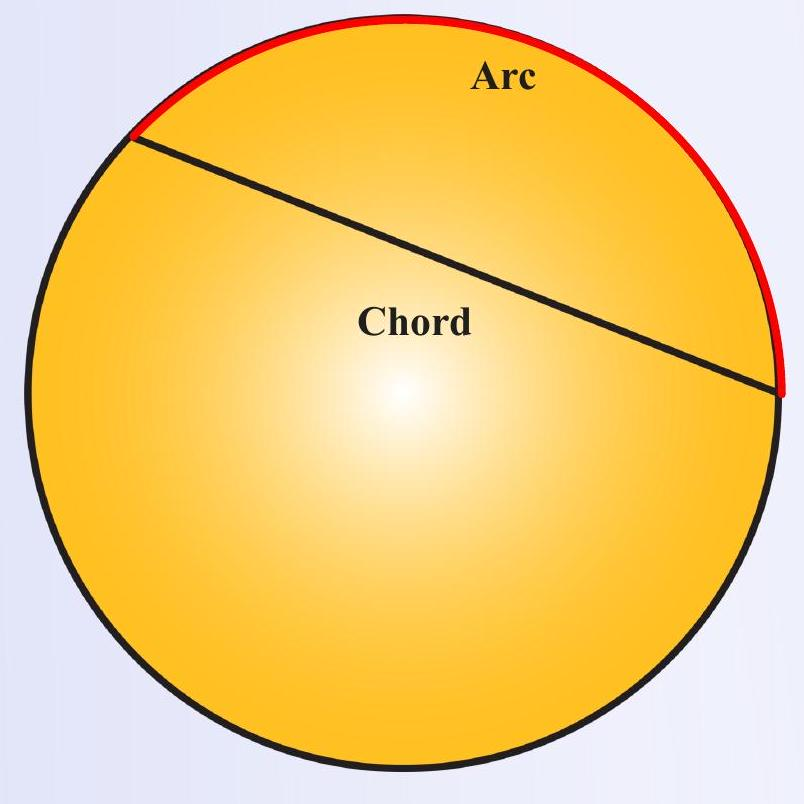
Straight chord (blue) and corresponding curved arc (red)
How are they different?
A chord is a straight line segment that directly connects two points on a circle.
An arc is the curved part of the circle's circumference between the same two points.
Key Points:
- Chord: straight, lies inside the circle.
- Arc: curved, sits on the circumference.
- Both share the same endpoints.
Name the Parts
Drag each label onto the circle to prove you know the centre, radius, diameter, chord and arc.
Draggable Items
Drop Zones
Drop here
Drop here
Drop here
Drop here
Drop here
Tip:
The radius is always half the diameter—use that fact to place both labels correctly.
Angles: Centre vs Rim
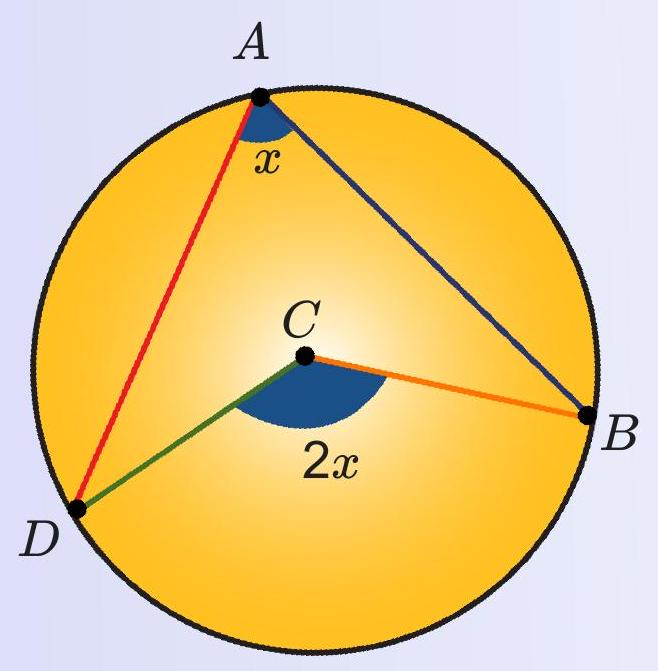
Central and inscribed angles on the same arc
Angle at Centre Theorem
Angle at Centre Theorem states: the central angle on an arc equals twice the inscribed angle on that arc.
So if the central angle measures \(2x^\circ\), the corresponding rim angle is \(x^\circ\).
Key Points:
- Central angle \( \angle AOB = 2x^\circ \).
- Inscribed angle \( \angle ACB = x^\circ \).
- Both subtend arc \( \overset{\frown}{AB} \); ratio is always 2 : 1.
Sector and Segment
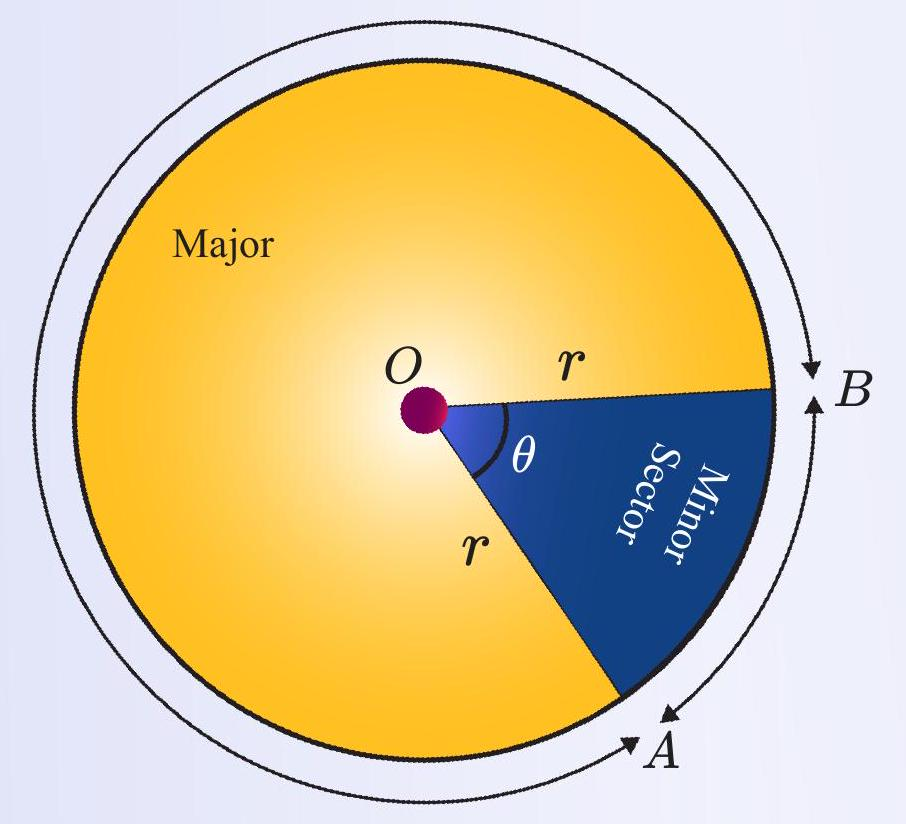
Sector (slice) vs Segment (crust)
Spot the Difference
Sector: region bounded by two radii and the arc they enclose—like a pizza slice.
Segment: region bounded by a chord and the arc between its endpoints—just the crust part.
Key Points:
- Sector boundary: 2 radii + arc.
- Segment boundary: chord + arc.
- Centre lies in every sector, rarely in a segment.
Key Formulas
These two expressions give a circle’s circumference and area. Both increase directly with radius \(r\).
Variable Definitions
Applications
Track distance
Use \(C\) to find how far a wheel rolls in one turn.
Cover circular surfaces
Use \(A\) to estimate paint, seeds, or fabric needed.
Convert diameter & radius
Knowing \(r\) links all circle measurements quickly.
Arc Length Formula
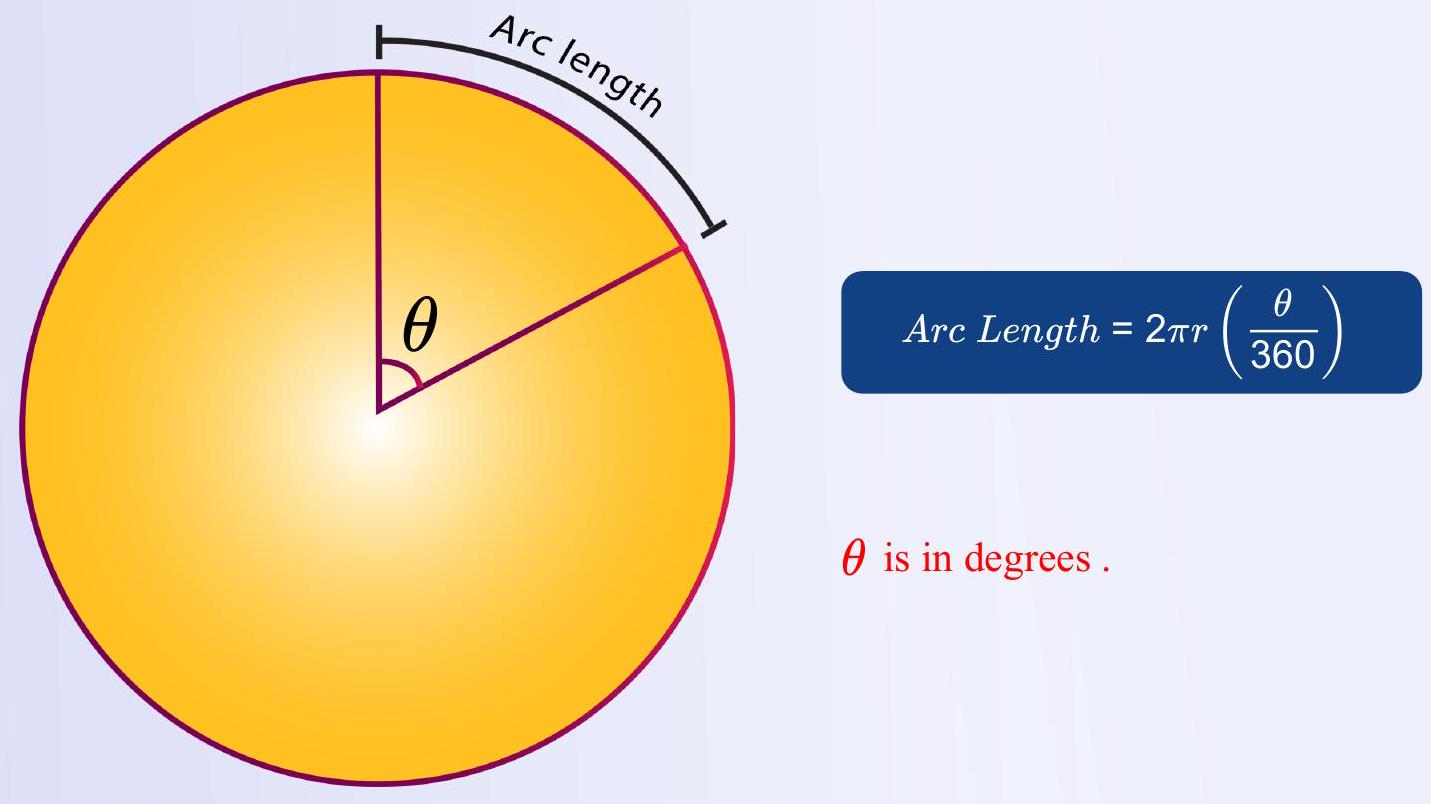
Sector with radius r and central angle θ.
Relating Angle, Radius & Arc
Formula: \(s = 2\pi r \times \frac{\theta}{360^\circ}\).
Arc length \(s\) equals the full circumference scaled by the angle fraction.
Key Points:
- Arc length is proportional to the central angle \(\theta\).
- It grows directly with radius \(r\).
- Proportional reasoning: part = whole \((2\pi r)\) × angle fraction.